AI OCR Healthcare: Top 7 Document Management Use Cases 2026
Top 7 Use Cases of AI-Based OCR in Healthcare Document Management
Healthcare generates more document-intensive workflows than almost any other sector, from patient intake and clinical documentation to insurance processing and regulatory compliance. AI OCR in healthcare document management is transforming how hospitals, clinics, insurers, and pharmaceutical companies handle this volume of unstructured information. By automatically extracting structured data from medical records, prescriptions, lab reports, and insurance forms, AI OCR eliminates manual data entry, reduces errors, accelerates clinical workflows, and supports regulatory compliance across all healthcare document types.
Key Takeaways
AI OCR processes handwritten prescriptions, varied insurance forms, and unstructured clinical documents that traditional OCR cannot handle reliably
Healthcare OCR reduces medical record digitisation costs by 60 to 80 percent compared to manual data entry at equivalent volume
IdeaGCS builds HIPAA and data privacy-aware AI OCR solutions for healthcare organisations across the UK, India, US, UAE, and Philippines
The Healthcare Document Problem
The healthcare sector operates under a paradox: it is one of the most data-intensive industries in the world, yet a large proportion of its critical information still exists in unstructured, non-machine-readable formats. Paper patient records, handwritten clinical notes, scanned imaging reports, physical prescription pads, and paper-based consent forms create significant barriers to the data availability that modern healthcare delivery, research, and administration require. The manual data entry processes used to bridge this gap are slow, expensive, and error-prone.
The cost of healthcare document management extends beyond direct processing labour. Delayed access to patient records slows clinical decision-making. Insurance claim errors create revenue cycle problems and payment delays. Regulatory compliance obligations around data retention and access require meticulous record-keeping that manual processes struggle to maintain consistently. AI OCR addresses all of these challenges by automating the extraction of structured data from healthcare documents, regardless of format or origin. Read our full explainer on AI OCR use cases across industries for broader context on how this technology applies beyond healthcare.
The Seven Key Healthcare AI OCR Use Cases
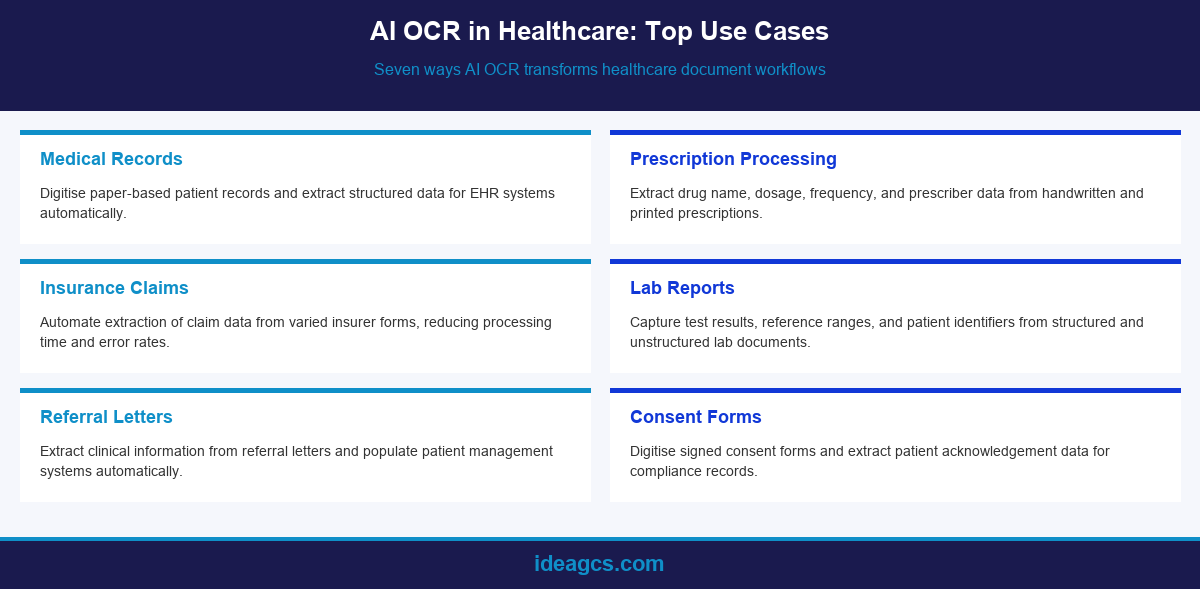
Medical records digitisation is the foundational use case: converting decades of paper patient records into structured electronic health record data that clinicians can access instantly from any care setting. Prescription processing automation extracts drug names, dosages, frequencies, and prescriber identifiers from both handwritten and printed prescriptions, reducing dispensing errors and enabling automated pharmacy management workflows. Insurance claim processing automates the extraction of claim data from varied insurer forms and supporting documentation, reducing accounts receivable cycles and improving revenue capture.
Lab report processing extracts test results, reference ranges, and patient identifiers from structured and unstructured laboratory documents, enabling automated population of EHR systems with diagnostic data. Clinical referral letter processing captures diagnosis, treatment history, and urgency indicators to populate patient management systems automatically. Consent form digitisation creates searchable, structured records of patient consent for treatment and data use. Radiology and imaging report processing extracts clinical findings and recommendations for integration with diagnostic records. Each use case delivers measurable operational improvement in the workflows it automates.
Data Privacy and Compliance in Healthcare OCR
Healthcare data is subject to the most stringent privacy regulations of any industry vertical. In the UK, GDPR and NHS data security standards govern patient information handling. In the US, HIPAA establishes strict requirements for the protection of protected health information. In the UAE and Philippines, local health data regulations apply specific obligations around data residency and patient consent. Any AI OCR solution deployed in healthcare must be built with these compliance requirements embedded in its architecture, not added as an afterthought. According to NIST's AI standards framework, healthcare AI systems must demonstrate data integrity, access control, and audit trail completeness as baseline requirements.
IdeaGCS builds AI OCR solutions for healthcare organisations with full compliance architecture, including role-based access control, end-to-end encryption of extracted data, complete audit trail logging for every document processed, and configurable data retention policies aligned to regulatory requirements. Our development process includes a compliance review stage before production deployment to verify that all applicable requirements are met. Contact IdeaGCS to discuss healthcare OCR development for your organisation.
Implementing AI OCR in Healthcare Environments
Healthcare AI OCR implementations require careful planning around document population diversity, integration with existing EHR and clinical systems, staff workflow design, and the validation protocols required to meet clinical safety standards. Training data must include representative samples of every document type and format the system will encounter, including the full range of handwriting styles, print quality variations, and document layouts used across the organisation's clinical and administrative operations.
Integration with EHR systems such as Epic, Cerner, Meditech, and proprietary clinical platforms requires expertise in healthcare interoperability standards including HL7 FHIR, which IdeaGCS incorporates into healthcare OCR development engagements as required. User acceptance testing with clinical staff is a critical phase, as accuracy standards in clinical workflows must exceed those in commercial document processing applications. Explore our AI and data services to understand how we manage healthcare AI OCR development from requirements through to clinical validation.
AI OCR is delivering measurable improvements across every major healthcare document workflow, from medical records digitisation and prescription processing to insurance claims and regulatory compliance. The technology's ability to handle handwriting, varied document formats, and multi-language content makes it the only viable option for healthcare environments where document diversity is the norm rather than the exception. Built with the right compliance architecture, healthcare AI OCR creates clinical, operational, and financial value simultaneously. IdeaGCS builds healthcare-compliant AI OCR solutions for organisations across the UK, India, US, UAE, and Philippines. Explore our AI and data services to discuss your healthcare document automation requirements.
Frequently Asked Questions
Contact Us
Share on Social Media
Contact Us