7 Signs You Need Product and Application Modernization Today
Introduction
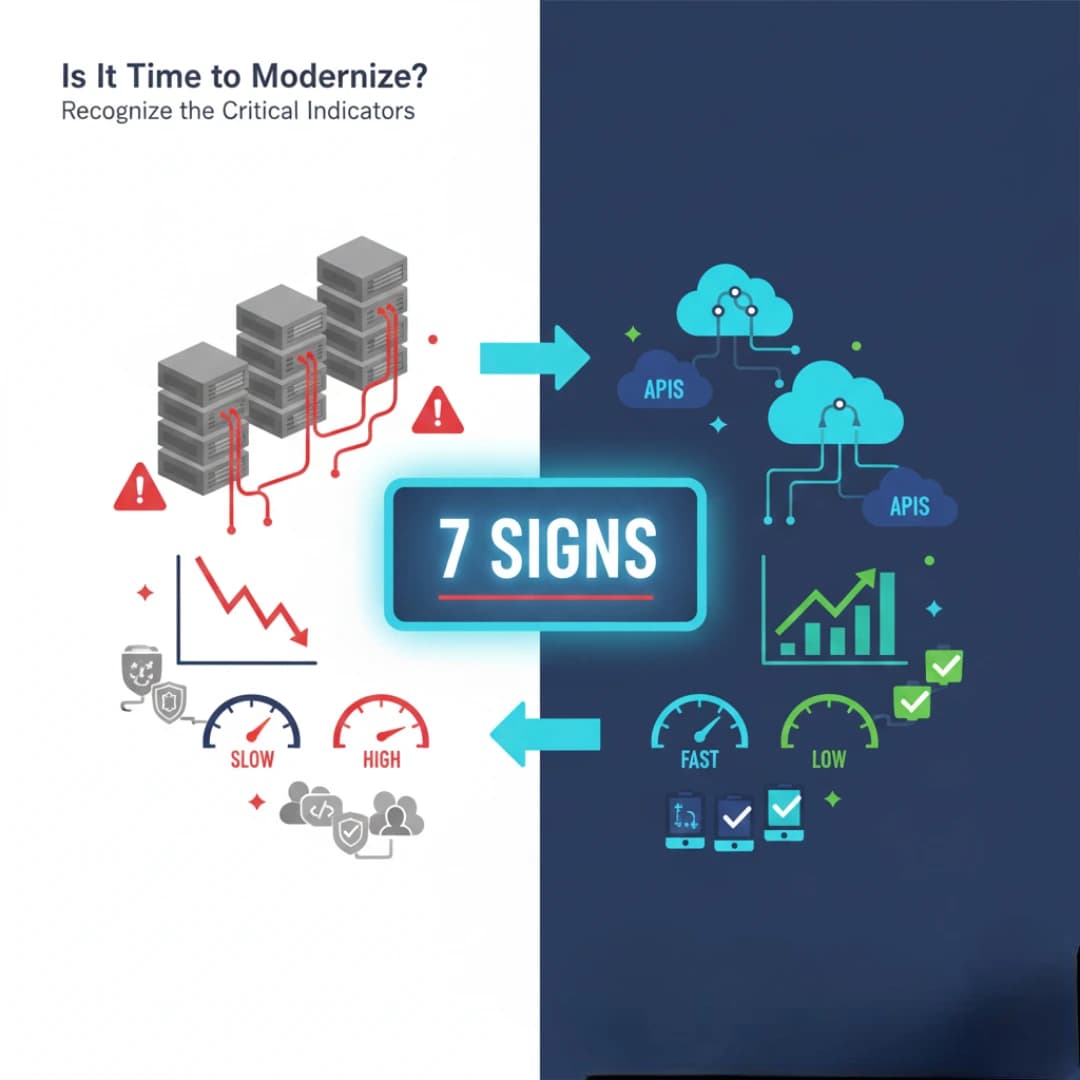
Is your business losing ground to competitors who deliver features faster and serve customers better? The answer might lie in your outdated technology infrastructure. Product and application modernization has become a strategic imperative for organizations seeking to maintain competitive advantage in today's digital-first economy. Legacy systems that once powered business growth now often create bottlenecks, security vulnerabilities, and mounting operational costs. With over 20 years of experience helping businesses transform their technology infrastructure, IdeaGCS has identified seven telltale signs that indicate when modernization is no longer optional it's critical for survival.
Key Takeaways
Legacy systems cause significant productivity losses and increase security vulnerabilities that put business operations at risk
Rising maintenance costs and difficulty integrating with modern technologies signal urgent modernization needs
Product and application modernization delivers measurable ROI through improved efficiency, reduced downtime, and enhanced customer experience
Strategic modernization combines cloud migration, API integration, and modern development practices for sustainable competitive advantage
1. Your IT Maintenance Costs Are Spiraling Out of Control
One-Line Summary: When maintenance expenses consume more than 70% of your IT budget, leaving minimal resources for innovation, your legacy systems are draining profitability and stalling growth initiatives.
Organizations typically spend between 60-80% of their IT budgets maintaining outdated systems rather than driving innovation. This unsustainable pattern emerges when applications run on obsolete platforms requiring specialized expertise that's increasingly difficult—and expensive—to find. Legacy infrastructure demands constant patching, workarounds, and manual interventions that consume valuable engineering hours. The true cost extends beyond direct expenses: opportunity costs multiply as your team troubleshoots old technology instead of building competitive advantages. Modern applications and digital engineering services reduce maintenance overhead by 40-60% through automated deployments, self-healing systems, and cloud-native architectures. IdeaGCS has helped numerous organizations redirect maintenance budgets toward innovation, enabling them to develop new features and services that directly impact revenue growth.
2. Integration Challenges Are Slowing Your Digital Initiatives
One-Line Summary: When connecting new applications to existing systems requires months of custom development and extensive workarounds, your architecture is actively preventing the agility modern business demands.
Integration complexity is a hallmark indicator that modernization can no longer wait. Legacy monolithic applications weren't designed for the API-driven, microservices-based ecosystem that defines modern business technology. Each new integration becomes a custom project requiring deep system knowledge, extensive testing, and ongoing maintenance. This architectural rigidity prevents organizations from adopting best-in-class solutions, responding to market opportunities, or meeting evolving customer expectations. The average enterprise now manages over 1,000 applications, and without modern integration capabilities, this ecosystem becomes unmanageable. Product and application modernization services establish API-first architectures that make integration seamless and scalable. By implementing modern integration patterns, businesses reduce time-to-market for new features from months to weeks, enabling rapid response to competitive pressures and customer demands.
3. Security Vulnerabilities Keep Multiplying
One-Line Summary: Outdated systems running on unsupported platforms create expanding attack surfaces with known vulnerabilities that put sensitive data, customer trust, and regulatory compliance at severe risk.
Cybersecurity threats evolve continuously, but legacy systems cannot. When vendors discontinue support for older platforms, organizations lose access to critical security patches and updates. This creates a dangerous scenario where known vulnerabilities remain unaddressed, making systems attractive targets for cybercriminals. Industry research indicates that 60% of data breaches involve vulnerabilities where patches were available but not applied—often because legacy systems couldn't support the updates. Compliance requirements like GDPR, HIPAA, and PCI-DSS demand robust security controls that outdated infrastructure simply cannot provide. The cost of a single breach—averaging $4.45 million according to IBM's latest research—far exceeds modernization investments. Organizations that have completed their digital transformation through product modernization report 70% fewer security incidents and significantly improved compliance audit outcomes.
4. Customer Experience Is Suffering
One-Line Summary: When slow response times, limited functionality, and poor mobile experiences cause customer frustration and abandonment, outdated applications are directly damaging your brand and revenue.
Customer expectations have been reset by digital-native companies that deliver instant, personalized, omnichannel experiences. Legacy applications built for desktop-only interactions cannot meet these expectations. Slow page loads, limited mobile functionality, and inability to personalize experiences based on real-time data create friction that drives customers to competitors. Research shows that 53% of mobile users abandon sites that take longer than three seconds to load, and 88% are less likely to return after a poor experience. Modern customers expect seamless experiences across devices, instant access to information, and personalized interactions—capabilities that legacy systems struggle to deliver. Applications and digital engineering approaches focus on user-centric design, performance optimization, and responsive architectures that meet contemporary expectations. Organizations implementing modern customer-facing applications see average conversion rate improvements of 25-35% and significant increases in customer satisfaction scores.
5. Your Development Team Can't Deliver at Speed
One-Line Summary: When deploying new features requires weeks or months instead of days, and developers spend more time fighting with outdated tools than building value, your technology stack is the bottleneck.
Developer productivity directly impacts business agility and innovation velocity. Legacy systems force development teams into slow, waterfall-style release cycles with lengthy testing periods and risky deployment processes. Modern competitors deploy code multiple times daily using continuous integration and continuous deployment (CI/CD) practices that legacy architectures cannot support. This deployment speed gap translates directly into market disadvantage: competitors launch features faster, test market response sooner, and iterate based on customer feedback while you're still planning releases. Developer frustration with outdated technology also increases turnover, as talented engineers prefer working with modern stacks that enhance their skills and marketability. Businesses that embrace choosing the right product modernization approach enable their teams to adopt DevOps practices, implement automated testing, and achieve deployment frequencies that match business needs rather than technical limitations.
6. Scalability Issues Are Limiting Growth
One-Line Summary: When increased demand causes system crashes, performance degradation, or requires expensive hardware upgrades, your infrastructure cannot scale with business success and opportunity.
Business growth should be celebrated, not constrained by technology limitations. Legacy systems often hit hard scalability ceilings where adding capacity becomes prohibitively expensive or technically impossible. Traditional vertical scaling—adding more powerful servers—has both cost and physical limits that modern cloud-native applications avoid through horizontal scaling. The inability to scale efficiently creates a dangerous scenario where business success triggers technology failure. During peak periods like product launches, seasonal demand, or viral marketing success, systems buckle under load, creating exactly the wrong customer experience at critical revenue moments. Cloud-based modern architectures through hybrid cloud services enable automatic scaling that matches resource allocation to actual demand, ensuring consistent performance while optimizing costs. Organizations modernizing to cloud-native architectures report 90% improvements in scalability flexibility and 40-50% reductions in infrastructure costs.
7. You're Struggling to Find Talent Who Can Maintain Legacy Systems
One-Line Summary: When the expertise required to maintain your systems is retiring faster than you can replace it, and younger developers avoid legacy technologies, you face a knowledge crisis.
The technology talent market has shifted decisively toward modern skills. Computer science graduates learn cloud platforms, containerization, microservices, and modern frameworks—not COBOL, mainframes, or decades-old proprietary systems. This creates a dangerous knowledge gap where the experts who understand legacy systems are retiring, and finding replacements becomes increasingly difficult and expensive. Organizations report spending 25-40% more on compensation to attract talent with legacy skills, and even high salaries may not be sufficient to prevent talent shortages. This knowledge crisis introduces significant business risk: what happens when the one person who understands a critical system leaves? Product and application modernization solves this challenge by migrating to widely-adopted modern technologies with abundant talent pools. By following proven steps for successful modernization, organizations position themselves to attract top engineering talent eager to work with contemporary technology stacks.
Why Product and Application Modernization Delivers Strategic Value
Modernization isn't merely a technology upgrade—it's a strategic business transformation that impacts every aspect of organizational performance. Organizations that successfully modernize report average ROI of 300% within three years through combined benefits of reduced operational costs, increased revenue from improved customer experiences, and enhanced market agility. Modern architectures built on cloud-native principles, microservices patterns, and API-first design enable business capabilities that legacy systems cannot deliver: real-time analytics, AI-driven insights, seamless third-party integrations, and rapid feature deployment. The competitive advantages extend beyond technology metrics to fundamental business outcomes: faster time-to-market, improved customer satisfaction, enhanced security posture, and ability to capitalize on emerging opportunities.
Conclusion
Recognizing these seven warning signs in your organization indicates that product and application modernization has moved from optional to essential for maintaining competitive viability. Legacy systems that once enabled business success now constrain growth, increase risk, and drain resources that should fuel innovation. With over 20 years of experience guiding enterprise transformations, IdeaGCS understands that successful modernization requires strategic planning, proven methodologies, and deep technical expertise across cloud platforms, integration architectures, and modern development practices. The organizations thriving in today's digital economy share a common characteristic: they've embraced modernization as an ongoing strategic initiative rather than a one-time project.
Ready to transform your technology infrastructure for sustained competitive advantage? Contact IdeaGCS today to discuss how our comprehensive modernization services can eliminate technology constraints and unlock your organization's full potential.
Frequently Asked Questions
What are the warning signs that indicate you need application modernization?

Warning signs include rising IT maintenance costs exceeding 70% of budget, frequent system outages, difficulty integrating new technologies, security vulnerabilities, poor customer experience, slow development cycles, and inability to find talent for legacy systems.
How does product and application modernization reduce operational costs?
Product and application modernization reduces costs by eliminating expensive legacy system maintenance, automating manual processes, optimizing cloud infrastructure spending, and enabling self-service capabilities. Organizations typically achieve 40-60% reduction in operational expenses within two years.
What is the difference between product modernization and application modernization?
Product modernization updates entire software products including features, architecture, and user experience. Application modernization focuses on upgrading specific applications or systems. Both share similar approaches but product modernization encompasses broader business and market considerations beyond technical updates.
When is the right time to start modernizing legacy applications?
Start modernizing when maintenance costs exceed 60% of IT budget, security risks increase, integration becomes difficult, or customer satisfaction declines. Early digital transformation prevents costly emergency fixes and maintains competitive advantage in rapidly evolving markets.
Can small businesses benefit from application modernization services?
Yes, small businesses benefit significantly through improved efficiency, reduced costs, better customer experiences, and competitive positioning. Modern cloud-based solutions eliminate expensive infrastructure investments while providing enterprise-grade capabilities. Scalable modernization approaches fit various budgets and business sizes effectively.
What role does applications and digital engineering play in modernization?
Applications and digital engineering provides the foundation for modernization through cloud-native development, microservices architecture, API integration, and DevOps practices. These capabilities enable businesses to build scalable, resilient applications that support continuous innovation and rapid market response.
How long does it take to see ROI from modernization investments?
Most organizations achieve positive ROI within 18-24 months through reduced maintenance costs, improved operational efficiency, and enhanced revenue generation. Quick wins appear within 6 months while comprehensive transformations deliver sustained value over 3-5 years with average 300% returns.
What are the biggest challenges in product and application modernization?
Major challenges include managing technical debt, ensuring business continuity during transitions, data migration complexity, skill gaps, budget constraints, and organizational resistance. Successful modernization requires comprehensive planning, phased implementation, and experienced partners like IdeaGCS's modernization experts.
How does modernization improve application security and compliance?
Modernization eliminates unsupported platforms, implements current security protocols, enables automated vulnerability patching, and provides audit trails for compliance. Modern architectures support zero-trust models, encryption standards, and regulatory requirements like GDPR, HIPAA, ensuring robust protection against threats.
What technologies are essential for successful application modernization?
Essential technologies include cloud platforms (AWS, Azure, GCP), containerization (Docker, Kubernetes), microservices frameworks, CI/CD pipelines, API management tools, and data analytics with AI capabilities. These enable scalable, maintainable, and future-proof modern applications.
Contact Us
Share on Social Media
Contact Us