2027 Enterprise AI Adoption: Why Data Readiness, Not Model Choice, Is the Real Bottleneck

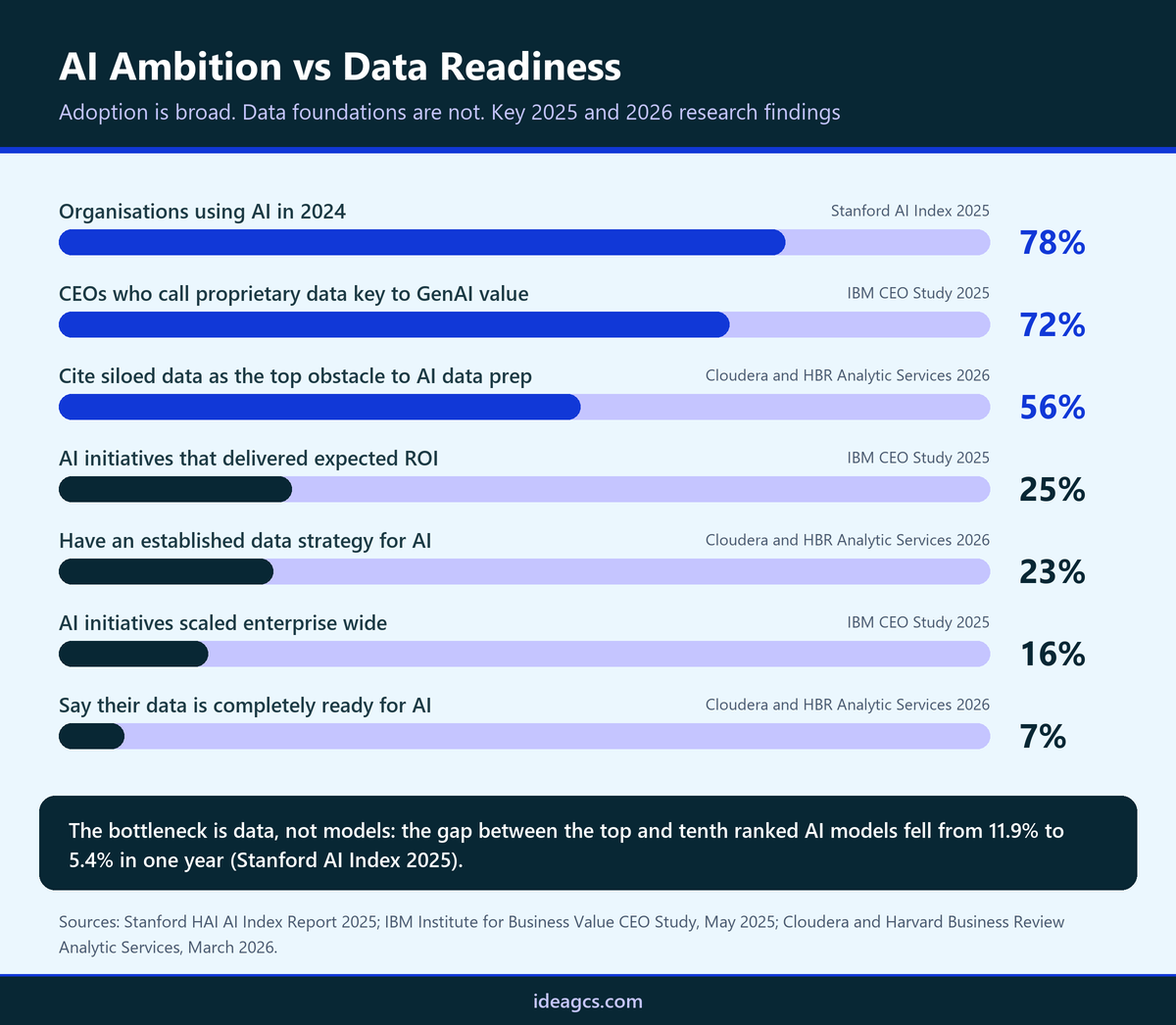
Enterprise AI budgets keep rising, yet a March 2026 Harvard Business Review Analytic Services study with Cloudera found that only 7% of enterprises say their data is completely ready for AI. That gap, not the choice between one model and another, is what stalls most programmes heading into 2027. It is why the best data and AI consulting services now start with the data estate rather than the model.
For leaders in the UAE, Saudi Arabia and the wider GCC, this is the moment to rethink where AI money goes. If you want an outside view of your own data estate, you can speak with the IdeaGCS team before funding another pilot. This guide explains why data readiness decides AI outcomes, what the latest research shows, and how enterprises can fix the foundations before they scale.
Key Takeaways
- Leading AI models are converging in performance, so the real edge in 2027 comes from clean, connected and governed enterprise data.
- Only a small share of organisations report data that is fully ready for AI, and Gulf enterprises report the same readiness gap.
- A readiness assessment, integration fixes and governance built into delivery are what move AI from pilot to production. Data and AI consulting services are most valuable when they start there.
Why Model Choice Matters Less Than It Did
Summary: The performance gap between leading AI models has narrowed sharply. Choosing the "best" model now gives a thin and short lived advantage. The durable advantage sits in the data only your organisation owns, and in how quickly that data can reach a model in a usable form.
The Stanford 2025 AI Index Report shows how fast the field is levelling. The score difference between the top ranked and tenth ranked models fell from 11.9% to 5.4% in a single year. Open weight models also cut their gap with closed models from 8% to just 1.7% on some benchmarks.
Adoption is no longer the hurdle either. The same report found that 78% of organisations used AI in 2024, up from 55% a year earlier. When almost everyone can access similar models, the winners are the firms that feed those models accurate, current and well described data.
Executives already sense this. In the IBM Institute for Business Value 2025 CEO study, 72% of CEOs said proprietary data is key to unlocking value from generative AI. Yet 50% admitted that rapid investment had left them with disconnected, piecemeal technology.
The Data Readiness Gap in Numbers
Summary: Research from 2025 and 2026 points to the same pattern. AI ambition is high, but data foundations lag behind. Siloed systems, missing strategy and weak data quality stop pilots from becoming production systems that deliver measurable returns.
The Cloudera and HBR Analytic Services study lists the top obstacles to preparing data for AI. Siloed data and difficulty integrating sources lead at 56%. A lack of clear data strategy follows at 44%, then data quality and bias issues at 41%. Only 23% of respondents said their organisation has an established data strategy for AI.
The financial cost shows up in results. IBM found that only 25% of AI initiatives delivered their expected ROI over recent years, and only 16% scaled enterprise wide. Better models alone will not change those figures. The fix is upstream, in how data is collected, integrated, cleaned and governed.
This is where an experienced data engineering and analytics practice earns its place. Pipelines, quality rules and a shared business vocabulary make every later model faster and cheaper to deploy.
What This Means for Enterprises in the GCC
Summary: Gulf governments are pushing hard on AI, and enterprise adoption is broad. Readiness to scale, however, remains low. Integration and talent gaps, not access to models, are the main barriers for GCC organisations planning their 2027 roadmaps.
The UAE has set out to become a world leader in AI by 2031. Its official AI policy portal describes Chief Executive Officers for AI in ministries and federal entities. Their remit includes establishing governance frameworks to support AI adoption. Private sector buyers are increasingly expected to show the same discipline.
A 2026 Korn Ferry study of Gulf organisations found that more than 9 in 10 apply AI in some form. Still, only 1% consider themselves fully equipped to adopt AI at scale. Around 30% say they are not ready at all, and 46% describe themselves as only somewhat ready.
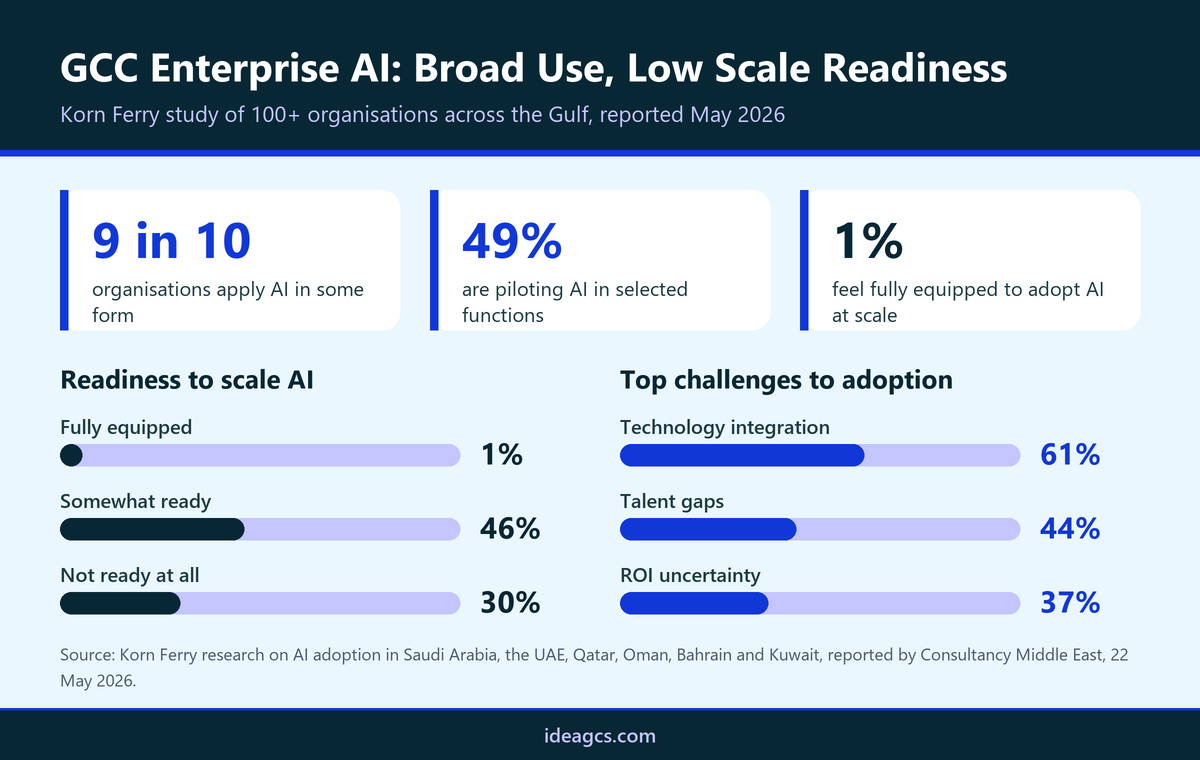
Technology integration was the biggest challenge at 61%, ahead of talent gaps at 44% and ROI uncertainty at 37%. For any enterprise weighing an AI implementation consultant in the GCC for 2027, integration depth should therefore be a core selection test.
Gulf enterprises also face data conditions that generic playbooks miss. Customer and operational records often mix Arabic and English fields. Group companies run separate ERP instances across several countries. Sector regulators in banking, healthcare and government services increasingly expect clear answers on where data sits and who can access it. Each of these is a data readiness task, and each one needs solving before a model can produce reliable answers. A readiness plan that ignores them tends to stall at the first compliance review.
A Practical Data Readiness Roadmap for 2027
Summary: Data readiness is not a single project. It is a sequence of focused steps tied to specific AI use cases. Starting narrow, fixing integration early and building governance into delivery keeps spending controlled and proves value quickly.
- Pick three priority use cases. Tie each one to a business KPI, then list the data sources it depends on.
- Profile and score that data. Check completeness, freshness, ownership and quality before any model work begins.
- Connect the silos. An API led integration approach turns point to point links into reusable, governed access to core systems.
- Modernise where it blocks progress. Legacy platforms that cannot expose clean data may need targeted application modernisation rather than a full rebuild.
- Choose the right home for the data. A hybrid cloud setup can balance data residency, cost and performance for regulated workloads.
- Build governance into delivery. Lineage, access controls and quality monitoring should ship with the pipeline, not after it.
This sequence targets the exact gaps the research highlights. With only 23% of organisations reporting an established data strategy for AI, those that build one now gain a clear head start. Every clean, connected source also lowers the cost of the next AI use case.
Budget the first phase in weeks, not years. A focused assessment of three use cases usually shows which sources are fit for purpose, which need cleansing and which need new integration. That evidence makes the business case for AI far easier to defend at board level. It also stops teams from buying model capacity that the data cannot yet support.
How the Right Partner Shortens the Path
Summary: Most enterprises do not lack AI ideas. They lack the integration, engineering and governance capacity to make data usable at scale. A partner that works across all three removes the handoffs that slow programmes down.
IdeaGCS brings more than 20 years of IT delivery across MuleSoft integration, data engineering, cloud and modernisation. The team works from offices in Abu Dhabi, Kochi, London, the United States and Manila. That combination matters because data readiness problems rarely sit in one system. They cross ERP, CRM, legacy databases and cloud platforms. Working across those layers is what separates useful data and AI consulting services from simple model reselling.
Our digital transformation engineering work connects those layers. Real time processing, forecasting models and Power BI dashboards then run on data the business can trust.
Conclusion
The AI race in 2027 will not be won by the organisation with the newest model. It will be won by the one whose data is connected, trusted and ready when the model arrives. The research is consistent: adoption is broad, model gaps are shrinking, and data readiness is the bottleneck in the GCC and globally. Treat data foundations as the first phase of every AI programme, measure progress against real KPIs, and scale only what works. When you are ready to assess your own estate, IdeaGCS offers data and AI consulting services built around that sequence. Book a data readiness conversation with our team today.
Frequently Asked Questions
What are data and AI consulting services?

Why does data readiness matter more than model choice in 2027?
How can I tell if my organisation's data is ready for AI?
What does an AI implementation consultant for enterprises in the GCC do?
How long does a data readiness assessment usually take?
Should I hire a data engineering consulting company near me or a remote team?
Why is system integration so important for enterprise AI?
What role does data governance play in AI adoption?
Can legacy systems support enterprise AI adoption?
How does IdeaGCS help GCC enterprises prepare for AI?
Contact Us
Share on Social Media
Contact Us