What Gets Automated First on AWS — and What Should Stay Manual

Automation programmes rarely fail because the automation does not work. They fail because the wrong things were automated first, in an order that made each subsequent step less trustworthy than the last. A team that automates deployment before it can reproduce an environment has built a fast path to an unpredictable destination.
This is a prioritisation framework rather than a tooling guide. It sets out what to automate in what order, why the order matters, and — the part most such guides omit — which categories of work are better left deliberate.
Key Takeaways
- Automate in order of failure frequency, not in order of technical interest.
- Environment reproducibility is the prerequisite that makes every later automation trustworthy.
- Cost controls and policy gates belong in the pipeline, but late — introduced early they get routed around.
- Some work should not be automated: one-off migrations, judgement calls, and anything where the failure mode is worse than the manual effort.
- Automating a broken process makes it fail faster and more consistently; fix the process first.
The Ordering Principle
The useful question is not "what could we automate" but "what breaks most often, most expensively, and most predictably". Those three properties together define the work that returns fastest.
Frequency matters because automation amortises. A task performed weekly returns the investment quickly; one performed annually rarely does. Expense matters because it sets the ceiling on the return. Predictability matters most of all — automation handles the well-understood case well and the exceptional case badly, so tasks with a long tail of special handling are poor first candidates regardless of how often they occur.
A short exercise makes this concrete. List every manual operation the team performed in the last month, with an estimate of how long it took and how many times it happened. The top of the resulting list is almost never what the team expected, and it is usually less glamorous.
Tier One: Build, Test, Deploy
The path from a developer's commit to a running system is the first thing to automate in essentially every estate, for two reasons.
First, it is performed constantly, so the return is immediate. Second, and more importantly, it is the foundation everything else assumes. Automated testing is not meaningful without an automated build. Automated rollback is not meaningful without automated deployment. Environment automation has nothing to deploy into.
The scope at this tier is deliberately narrow: compile or package, run the test suite, produce a versioned artefact, and place it where it is needed. Resist adding security scanning, compliance gates, or approval workflows at this stage. They come later, and adding them before the pipeline is trusted is the fastest way to have engineers work around it.
The measure of success here is simple: can any engineer get a change to production through the pipeline, without touching a server, within a defined time. Provider design guidance such as the AWS Well-Architected Framework covers the surrounding operational practice. Until that is true, later tiers are premature.
Tier Two: Environments as Code
Once deployment is automated, the constraint moves to what you are deploying into. Environments that were configured by hand drift — a package updated here, a setting changed there — and drift is what turns "it worked in staging" into a production incident.
Defining infrastructure as code makes environments reproducible, comparable, and disposable. That last property matters more than it sounds: an environment you can destroy and recreate in minutes is an environment you will actually keep clean, and a large share of cloud waste is environments nobody dares delete.
Two decisions arise here and both have long half-lives. Whether to use provider-native infrastructure tooling or a portable alternative is a genuine architecture choice with commercial consequences — portable tooling costs a little more day to day and preserves optionality; native tooling is tighter and cheaper if a second provider is genuinely implausible. And whether to define environments per-team or centrally determines whether you are building a platform or a set of conventions.
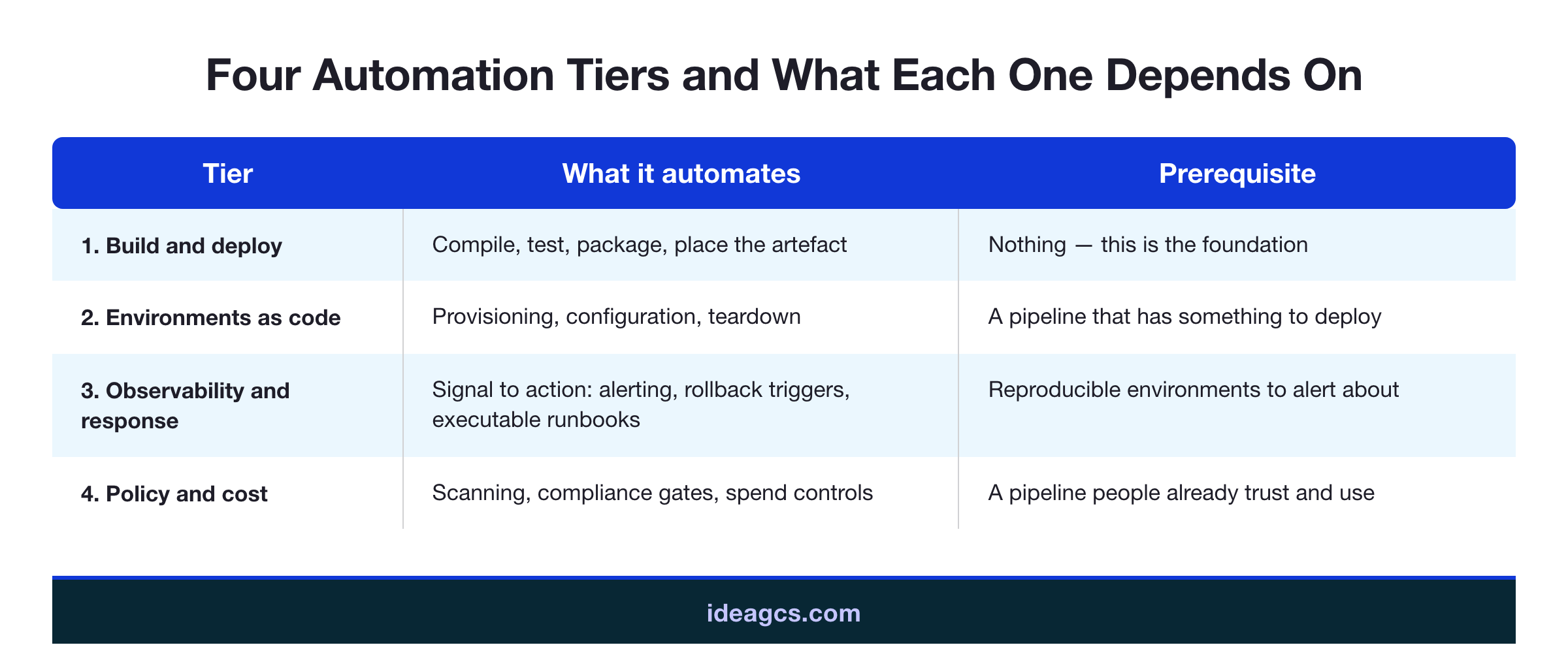
Tier Three: Observability and Response
Fast deployment without fast detection increases risk. If a change reaches production in twenty minutes and a regression is noticed four hours later, the automation has widened the blast radius rather than narrowing it.
The automation here is less about dashboards than about the path from signal to action. Alerts that route to a person who can act, with enough context to act without a fifteen-minute investigation. Automated rollback triggered by defined conditions. Runbooks that execute rather than describe.
A discipline worth adopting early: every alert that fires without requiring action should be deleted or re-thresholded. Alert fatigue is not a minor annoyance — it is the mechanism by which a real incident is missed, and it accumulates silently.
Automated remediation belongs at this tier too, but narrowly. Restarting an unhealthy instance, scaling in response to load, and failing over a degraded component are all well-suited. Anything requiring a judgement about customer impact is not.
Tier Four: Policy and Cost
Security scanning, compliance gates, and cost controls come last not because they matter least but because they need a trusted pipeline to live in.
Policy automation introduced into an untrusted pipeline produces one of two outcomes: engineers route around the pipeline entirely, or the gates are configured so permissively that they provide assurance without control. Either way the investment is wasted.
Introduced onto a pipeline everyone already uses, the same gates work. Dependency and container scanning on every build. Infrastructure policy checked before provisioning rather than audited afterwards. Cost visibility surfaced in the same place as delivery metrics, so the team optimising for speed can see what speed is costing.
Cost automation deserves particular attention because the returns are unusually direct: identifying unused resources, right-sizing over-provisioned workloads, scheduling non-production environments to shut down outside working hours. The patterns are covered in our notes on where cloud spend accumulates.
What Should Stay Manual
Four categories are better left deliberate, and saying so explicitly prevents a great deal of wasted effort.
One-off operations. A single data migration, a single account restructure. Automating a task performed once costs more than performing it, and the automation is never maintained afterwards.
Judgement calls with customer impact. Whether to fail over during a partial degradation, whether to roll back a change that is causing minor errors but fixing a major one. These need a human with context and authority, not a rule.
Anything where the failure mode exceeds the manual effort. Automated deletion of resources deemed unused is the canonical example. The manual effort saved is small; the cost of the automation being wrong is not.
Processes that are broken. Automating a bad approval workflow produces a bad approval workflow that runs faster and more consistently. Fix the process, then automate it. This is the most commonly ignored rule in the list and the most expensive.
Sequencing in Practice
A workable rollout addresses one tier at a time on one team, then replicates. Attempting all four tiers simultaneously across an estate produces four half-finished capabilities and no working reference.
Choose a team with a real delivery need and reasonable engineering discipline. Take them through tier one to a working, trusted pipeline. Then tier two. By the time they reach tier four they are a reference implementation, and the second team costs a fraction of the first.
Measure at each tier rather than at the end. Deployment frequency and lead time after tier one. Environment provisioning time and drift incidents after tier two. Detection and restore time after tier three. Policy violations caught pre-production and cost per unit of delivered work after tier four. IdeaGCS runs this sequence through its delivery automation services.
Conclusion
The order is the strategy. Build and deploy first, because everything else assumes it. Environments second, because nothing above it is trustworthy without reproducibility. Observability third, because speed without detection is just a bigger blast radius. Policy and cost last, onto a pipeline people already trust.
And keep a short list of what stays manual — one-off work, judgement calls, high-consequence automation, and any process that is broken today. Automating those is how a sound programme acquires a reputation for making things worse. Talk to IdeaGCS if you want the sequence mapped against your own estate.
Frequently Asked Questions
What should we automate first on AWS?

Why not add security scanning to the pipeline straight away?
What is the most commonly skipped step?
Should we use provider-native tooling or a portable alternative?
What should never be automated?
How do we know automation is working?
How much of incident response can be automated?
Does automation reduce cloud cost?
Should we roll this out across all teams at once?
What is the fastest way to waste an automation budget?
Contact Us
Share on Social Media
Contact Us