The Real Difference Between a Delivery-Engineering Provider and a Managed Pipeline Company

Two quite different businesses are sold under the same heading, and buyers routinely sign with one while expecting the behaviour of the other. The disappointment that follows is usually blamed on the supplier when it should be blamed on the category.
One type supplies engineering capability that works on your estate, with your tooling, under your architecture. The other operates a platform they own, into which your workloads are placed. Both are legitimate. They allocate risk, cost, and control differently enough that choosing between them is the most consequential decision in the procurement — more so than choosing between two suppliers of the same type.
Key Takeaways
- A capability provider works on your estate; a managed service operates their platform with your workloads on it.
- The distinction decides who carries availability risk and who can be held to a service level.
- Tooling ownership determines what you can actually leave with — the difference between a migration and a rebuild.
- Managed services are cheaper to start and more expensive to leave; capability providers are the reverse.
- The contract clause that reveals which one you are buying is the exit clause, not the service description.
The Capability Provider
This supplier sends engineers. They work inside your accounts, on your architecture, using tooling you have chosen or that they help you choose but that you own.
What you get. Skills you cannot recruit quickly, at the moment you need them, applied to the estate you actually have. The artefacts they produce — pipelines, infrastructure definitions, runbooks — belong to you and stay behind when the engagement ends.
What you keep. Architectural control and accountability. If the pipeline fails, it is your pipeline, built by their engineers. That is a real burden and it is also what makes the arrangement portable.
Where it fits. Estates with existing standards, regulated environments where control cannot be delegated, and any situation where the objective is to end up with a capability rather than a subscription.
The characteristic failure. Knowledge accumulating with the supplier's engineers rather than yours, until the "capability" you built is one you cannot operate. It is entirely preventable and only by deliberate contracting — a named internal owner, documented runbooks, and a period where your team runs the estate with the supplier watching.
The Managed Service
This supplier operates a platform. Your applications deploy into an environment they have built, using their pipelines, monitored by their tooling, run by their team.
What you get. Speed and a service level. A workload can be onboarded in days rather than the months a bespoke pipeline takes, and availability is contractually theirs.
What you give up. Architectural freedom, in proportion to how opinionated the platform is. Deployment shapes that the platform does not support are difficult or impossible, and "we need a different database engine" can become a commercial conversation rather than a technical one.
Where it fits. Organisations without an engineering platform team and no intention of building one; workloads that fit standard shapes; and situations where transferring availability risk is worth more than retaining control.
The characteristic failure. Lock-in that only becomes visible at renewal. Because the pipelines, infrastructure definitions, and operational knowledge live in the supplier's platform, leaving is not a migration but a rebuild. That is not necessarily wrong — it is a cost that should be priced at signature rather than discovered at year three.
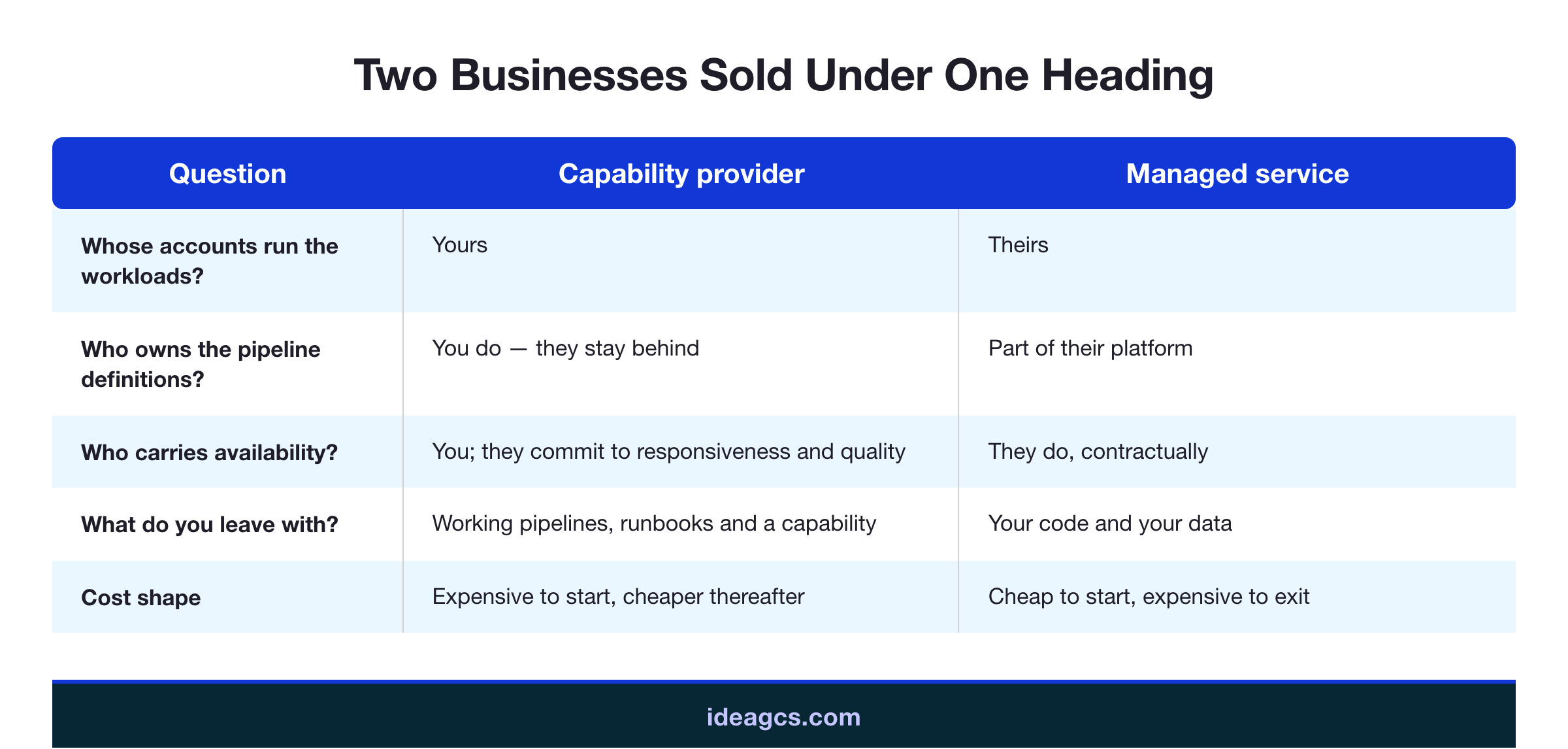
The Questions That Separate Them
Suppliers describe themselves in language that blurs the distinction. Five questions do not.
Whose accounts do the workloads run in? Yours means capability provider. Theirs means managed service. Anything ambiguous here should be resolved before anything else is discussed.
Who owns the pipeline definitions? If the answer is that they are proprietary or "part of the platform", you are buying a managed service regardless of what the proposal says.
Who carries the availability commitment? A capability provider can commit to responsiveness and quality but cannot meaningfully sign an availability commitment for the uptime of an estate you control. A managed service can and should.
What do we leave with? The most revealing question in the set. A capability provider hands over working artefacts. A managed service hands over your application code and your data, which is not the same as handing over your operating capability.
Who decides the architecture? Capability providers advise; managed services constrain. Both are defensible, but a buyer who needs to decide should not choose a supplier whose model is to decide for them.
Cost Shapes Over Time
The two models have different curves, and comparing them at a single point produces the wrong answer.
A managed service starts cheap. There is no build phase, onboarding is fast, and the first-year figure is usually well below the alternative. It then rises predictably with consumption and does not fall when your needs simplify, because the platform fee is not really a function of how much engineering you require.
A capability engagement starts expensive. The build phase is real work with real cost and no immediate service. It then falls, because once the capability exists your own team operates it and the supplier's role reduces to periodic capacity and advice.
The crossover is typically somewhere in the second or third year, though it varies widely. The more useful analysis is not where the lines cross but what happens at the end: with a capability engagement you own something; with a managed service you have been renting. Neither is wrong, and the sensible framing is the same build-versus-buy comparison set out in our four-year cost model for cloud capability applied to a different asset.
Hybrid Arrangements, and Their Pitfall
Many organisations end up with both — a managed service for standard workloads and a capability provider for the systems that do not fit the platform's assumptions. This is a reasonable design and it is not free.
The pitfall is the boundary. Two suppliers, two operating models, and an incident that spans both produces an accountability gap precisely when accountability matters most. Anything that crosses the line — shared networking, identity, data flows between platform and bespoke workloads — needs an owner named in advance.
The practical mitigation is that the boundary should follow a real seam in the estate rather than a procurement convenience. If the two halves are genuinely coupled, splitting suppliers along that coupling will cost more than consolidating.
Matching the Model to the Requirement
Three questions settle it for most buyers.
Is control a requirement or a preference? In regulated environments it is usually a requirement, and that points to a capability provider. Elsewhere it is often a preference that has never been tested against its cost.
Do you intend to have an engineering platform capability in three years? If yes, buying a managed service delays it and makes it more expensive later. If no, building one is an expensive way to arrive at the same place.
How predictable are your workloads? Standard shapes suit a platform. Estates full of exceptions — legacy runtimes, unusual data residency, bespoke networking — will fight one continuously.
IdeaGCS operates as a capability provider: engineers working on the client's estate, with the pipelines and runbooks staying behind. That is set out in its delivery automation services, with people supplied through specialist hiring services where the requirement is headcount rather than delivered capability. The red flags and green lights in supplier selection apply to both categories.
Conclusion
The label on the proposal is not the useful signal. Whose accounts the workloads run in, who owns the pipeline definitions, who carries availability, and what you leave with — those four answers tell you which business you are actually buying from.
Neither model is superior. A managed service transfers risk and costs more to exit; a capability provider retains control and costs more to start. What is reliably a mistake is signing with one while planning as though you had chosen the other, and the exit clause is where that mismatch shows up first. Read it before the service description. Talk to IdeaGCS if you want a requirement mapped to the right supplier model before going to market.
Frequently Asked Questions
What is the core difference between the two supplier types?

Which model is cheaper?
Who is responsible if production goes down?
What is the single best question to ask a supplier?
Is lock-in avoidable with a managed service?
Can we use both?
Which model suits regulated industries?
How do we prevent knowledge staying with a capability provider?
Does a managed service remove the need for internal engineers?
How do we tell which one a supplier actually is?
Contact Us
Share on Social Media
Contact Us