Consulting Firms, Agencies, or Your Own Team? Sorting Out Who Does What

Three quite different kinds of supplier, spanning advisory work and delivery, will respond to the same request for proposal, describe the same outcome, and quote prices that differ by a factor of five. Buyers frequently interpret this as a market with wide quality variation. More often it is a market where three distinct products are being sold under one name.
Sorting them out is not about deciding which is best. It is about matching the supplier type to the shape of the problem, and recognising when the problem you described is not the problem you have.
Key Takeaways
- Consultancies sell judgement and access to decision-makers; agencies sell execution; internal teams sell continuity and context.
- The price differences mostly reflect different products, not different quality.
- Most enterprise programmes need at least two of the three, sequenced rather than combined.
- The commonest expensive mistake is buying judgement when the decision is already made, or buying execution when it is not.
- Whoever you buy from, the capability that must stay internal is the one that decides what "done" means.
The Three Types
Management and technology consultancies
What they sell. Judgement on hard, ambiguous questions, backed by pattern recognition across many comparable organisations, and the credibility to say something uncomfortable to a board.
Where they are strong. Genuinely undecided questions with high stakes and organisational politics — whether to consolidate two business units' systems, whether to build or buy a core capability, how to sequence a multi-year programme. Also cross-functional work where an outsider is required precisely because no internal party can arbitrate.
Where they are weak. Sustained execution at scale, and any situation where the decision has already been made and only the doing remains. Paying consultancy rates for delivery is the most expensive way to buy delivery.
What to watch. Who is actually on the account. The gap between the partner who pitches and the team who delivers is the defining complaint about this category, and it is worth contracting against by name.
Delivery agencies and specialist firms
What they sell. Execution capability in a defined domain — building the platform, running the migration, delivering the integration, staffing the engineering.
Where they are strong. Well-specified work. Given a clear target, they will reach it faster and cheaper than a consultancy and faster than an internal team you have yet to hire.
Where they are weak. Ambiguity. An agency handed an unclear brief will build something, and it will be built well, and it may not be the thing you needed. They are also rarely positioned to tell a board it is wrong, which is sometimes what the situation requires.
What to watch. Whether the scope is genuinely specified. If it is not, an agency engagement becomes an expensive discovery exercise with a fixed-price contract wrapped around it.
Internal teams
What they sell. Continuity, context, and accountability that does not end with a contract. They know why the system is the way it is, which is knowledge no supplier can acquire quickly.
Where they are strong. Anything ongoing, anything requiring deep organisational context, and anything where the capability needs to exist permanently.
Where they are weak. Peak capacity, specialist skills used occasionally, and — importantly — objectivity about their own estate. Internal teams find it structurally difficult to recommend replacing systems they built.
What to watch. The time to build the capability. Recruitment plus ramp puts months between a decision and delivery, and that delay is a real cost that rarely appears in the comparison. Our four-year build-versus-buy model sets out the arithmetic.
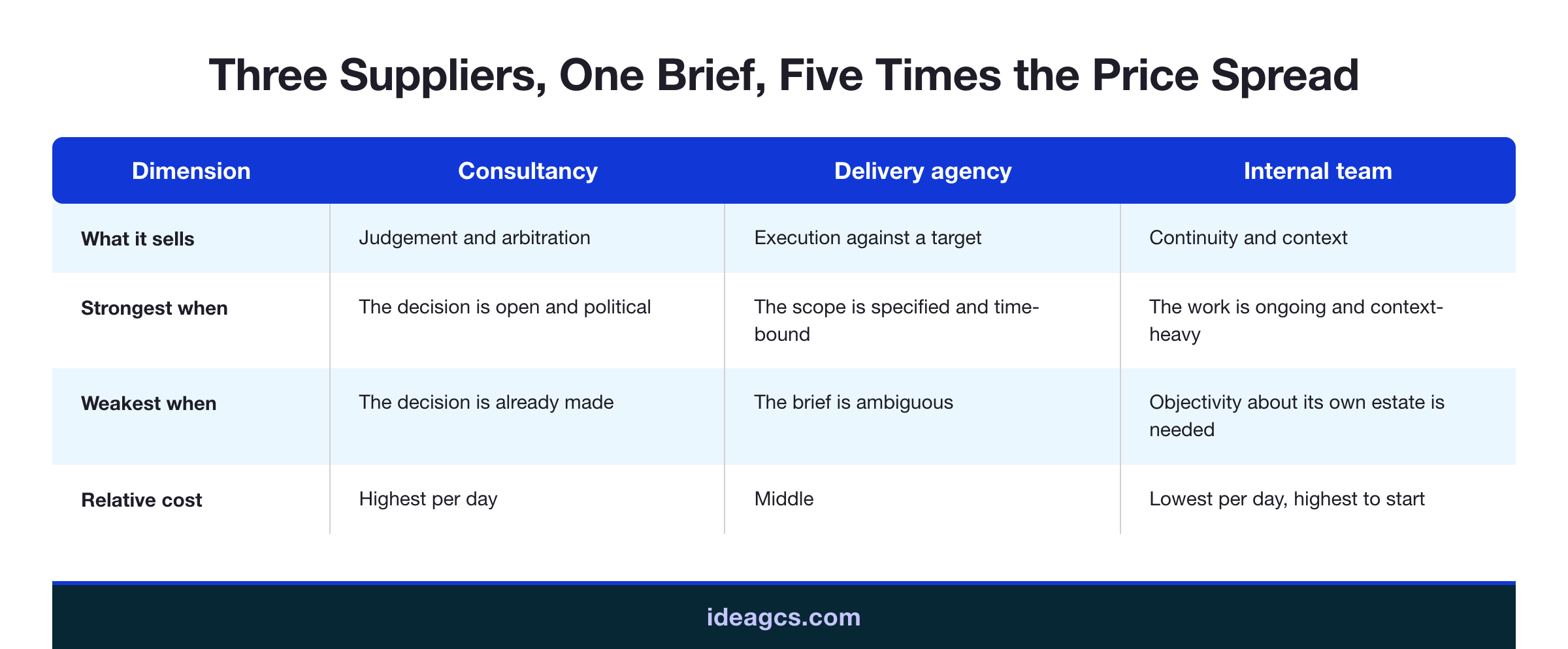
Matching the Supplier to the Problem
The decisive question is what state the decision is in.
Undecided, high stakes, cross-functional. Consultancy. You are buying judgement and arbitration, and the cost is justified by the cost of deciding wrong.
Decided, well-specified, time-bound. Agency. You are buying throughput against a defined target, and paying consultancy rates for it wastes money without improving the outcome.
Ongoing, context-heavy, permanent. Internal. You are buying continuity, and no supplier arrangement substitutes for it indefinitely.
Decided in principle, unspecified in practice. The awkward and very common case. This needs a short specification exercise — which a consultancy can do, or a senior internal architect, or an agency under a separate small contract — before the delivery engagement is let. Skipping it is how fixed-price engagements become variation-order engagements.
The Sequencing Most Programmes End Up With
A pattern recurs across enterprise programmes, and it is worth planning for deliberately rather than arriving at by accident.
A short consultancy engagement establishes the facts and the sequence, ending in decisions with named owners. An agency or delivery partner then executes the first increments against a specification that now exists. In parallel, an internal capability is built to hold what is delivered — starting with an architecture owner, growing as the estate does.
The transitions are where this goes wrong. Consultancy to delivery fails when the strategy is handed over as a document rather than as a specification. Delivery to internal fails when knowledge transfer was assumed rather than contracted. Both failures are predictable and both are cheap to prevent at the point of contracting and expensive to fix afterwards.
What Must Stay Internal Regardless
Three things cannot be outsourced, whatever the arrangement.
The definition of done. Somebody internal must be able to say whether what was delivered is what was needed. If that judgement sits with the supplier, the engagement has no meaningful acceptance criteria.
Architecture ownership. Decisions with long half-lives — platform choices, data model, integration approach — belong to someone who will still be there in three years. Suppliers advise; ownership stays.
The commercial relationship. Someone must be able to hold the supplier to account, which means understanding the work well enough to know when it is going badly. An organisation that cannot evaluate its supplier's work is not managing a supplier; it is hoping.
These three roles can be one person in a smaller organisation. They cannot be nobody. Our guidance on evaluating an advisory partner covers the diligence that supports the third.
Reading the Price Difference
A consultancy day rate and an agency day rate are not comparable numbers because they buy different things — seniority, arbitration and pattern recognition on one side, throughput and specialist skill on the other.
Two practical rules. First, compare on total cost of the outcome, not on rate: a cheaper day rate applied to twice the days is not cheaper. Second, be suspicious of a supplier of one type quoting comfortably in the other's range — an agency at consultancy rates is selling something it may not have, and a consultancy at agency rates is likely to staff the engagement accordingly.
Internal costs need the same treatment. Salary is roughly half the fully loaded figure once recruitment, ramp, management, benefits and attrition are counted, and vacancy time while a role is open is a real cost that never appears on the sheet.
Conclusion
Consultancies sell judgement, agencies sell execution, internal teams sell continuity. The wide spread in prices for apparently the same brief mostly reflects that these are three products rather than three quality tiers.
Match the supplier to the state of the decision: undecided and political goes to a consultancy, decided and specified goes to an agency, ongoing and context-heavy stays internal. Plan the transitions between them at contracting time, and keep the definition of done, architecture ownership, and the commercial relationship on your side of the line whatever else you buy. Talk to IdeaGCS if you want a brief sorted into the right supplier type before it goes to market.
Frequently Asked Questions
What is the actual difference between a consultancy and a delivery agency?

Why do quotes differ so much for the same brief?
When is a consultancy worth the premium?
When should we use an agency instead?
What if the decision is made but the work is not specified?
What must stay internal no matter what?
Can we just build an internal team instead of using suppliers?
How should we compare costs across the three?
Where do these engagements usually go wrong?
Is it a warning sign if a supplier quotes outside its type's normal range?
Contact Us
Share on Social Media
Contact Us