How Support and Specialist Hiring Work Together During a Cloud or Integration Migration

Migration programmes are planned as build programmes. Budget, staffing and governance are organised around delivering the new estate, and support is treated as something that happens afterwards.
It does not happen afterwards. From the moment the first workload moves, the organisation is supporting the old estate, the new estate, and the transitional states between them — with the same people, and often with the specialists most capable of doing so seconded onto the migration itself. This is the most predictable resourcing failure in enterprise IT and one of the least planned for.
Key Takeaways
- During transition the support surface is larger than either the before or after state, not somewhere between them.
- The specialists who can support the new estate are usually the ones building it — plan the conflict rather than discovering it.
- Build-to-run handover needs acceptance criteria and a defined date, not an email.
- Incidents spanning old and new need a single named owner from day one.
- Support capacity should be funded from the migration budget while the migration causes it.
The Doubled Surface
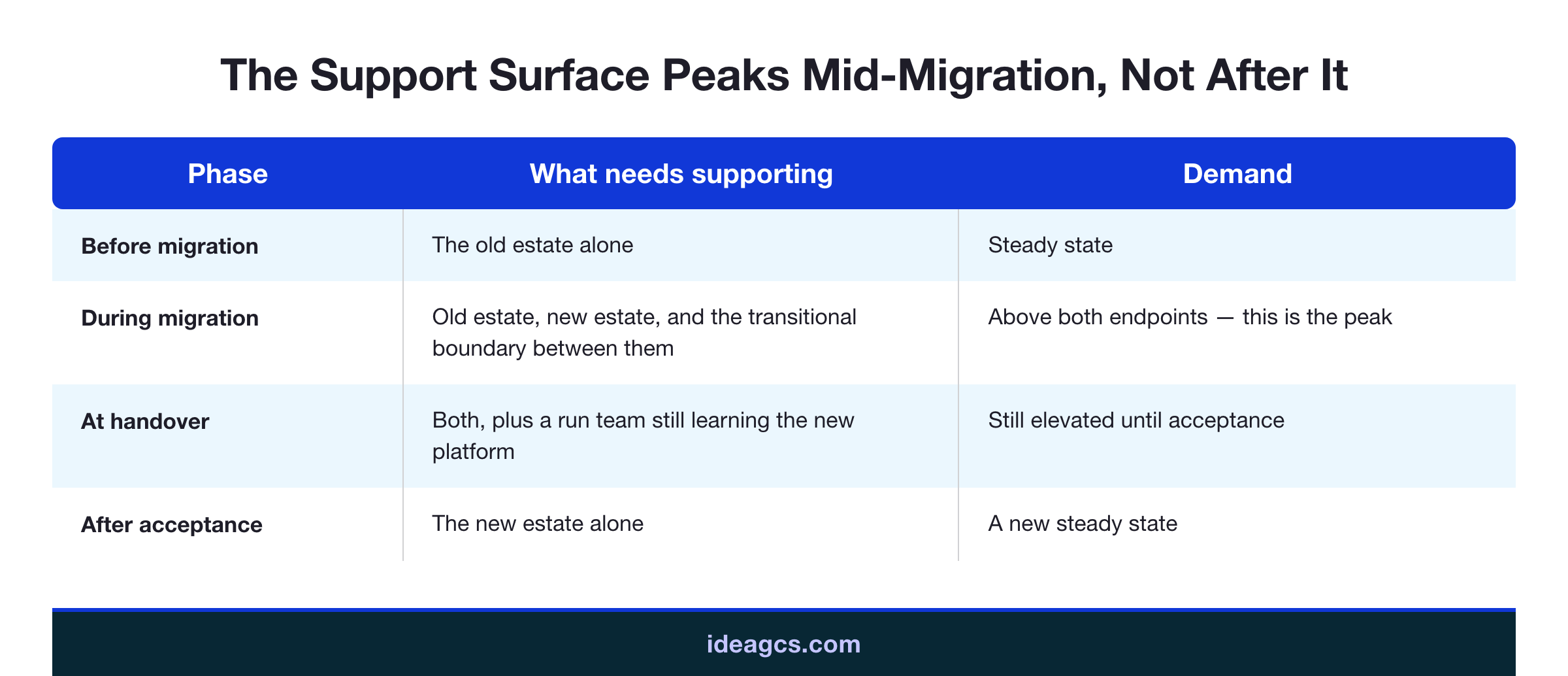
For any period where a workload exists in both places, or where some workloads have moved and others have not, three things are true simultaneously.
The old estate still needs support. It is running, users depend on it, and it does not become less fragile because a replacement is coming. If anything it becomes more fragile, because the people who knew it best have moved onto the new work and change to it is deprioritised.
The new estate needs support from its first production workload, and it needs it from people who understand a platform that is new to the organisation.
The boundary between them needs support, and this is the part nobody owns. Data flowing between old and new, identity spanning both, integration points built for the transition and intended to be temporary. Incidents here are the hardest to diagnose and the most likely to fall between teams.
The consequence is that support demand during migration exceeds both the pre-migration and post-migration steady states. Plans that model support as a straight line between the two understate the peak substantially.
The Specialist Conflict
The people who can support a newly migrated workload are, almost by definition, the people who migrated it. That creates a direct conflict between delivery velocity and support responsiveness, and it is resolved badly by default — usually by interrupting engineers, which degrades both.
Three arrangements work better than interruption.
A rotating support role within the migration team. One engineer per period is on support rather than delivery, and the delivery plan is sized accordingly. It costs visible capacity and prevents everyone losing time to interruption.
Deliberate shadowing during the build, which is as much an organisational change as a technical one. Support engineers work alongside the migration team on the workloads they will inherit. This costs delivery time and is the single most effective intervention available, because the alternative is knowledge transfer through documentation, which is always thinner than intended.
External capacity for the peak. The migration period genuinely needs more support capacity than the steady state, and it is a temporary need. Hiring permanently for a temporary peak leaves a trough; bringing in capacity for the transition period does not. Our comparison of hiring models for bounded work covers when each instrument fits.
What does not work is assuming the existing support team will absorb it. They are already at capacity, and adding an unfamiliar platform plus a transitional boundary to their scope produces slower resolution across everything, including the old estate.
Handover Needs Criteria and a Date
Build-to-run handover is where most of the value leaks, and it leaks because it is treated as a communication rather than as an event with acceptance criteria.
A workable handover has five components. Documentation covering architecture, dependencies, and the decisions taken and rejected. Runbooks for the operations the support team will actually perform, tested by someone who did not write them. A shadowing period where support handles incidents with the build team available. A reverse-shadowing period where the build team observes support handling incidents unaided. And a formal acceptance point at which the run team says it is ready — with the authority to say it is not.
That last item is what makes the rest real. A handover the receiving team cannot decline is an announcement, and it produces systems where incidents take three times longer than they should for the following year.
The corollary for planning: the migration is not complete when the workload runs in the new environment. It is complete when the support team has accepted it. Programme plans that mark completion at cutover systematically under-report the remaining work.
Cross-Boundary Incidents Need an Owner
An incident that spans the old estate and the new one is the characteristic failure of a migration period, and it is the one most likely to become an inter-team discussion while the business waits.
Name the owner in advance. Someone — a role, not a committee — is accountable for any incident touching both estates, with the authority to direct effort on either side. Whether that sits with the migration lead, the support lead, or a dedicated transition manager matters less than that it is decided before the first one occurs.
Two supporting mechanisms. A single incident record spanning both, rather than parallel tickets in two systems that have to be reconciled afterwards. And severity definitions that account for transitional states — a workload mid-migration may be more critical than either its old or new steady state, because the fallback is less certain.
Where support is provided by a partner, this needs to be explicit in the arrangement rather than assumed. Our guide to what support agreements actually commit to covers the clause-level detail.
Funding It From the Right Budget
Support cost rises during migration because of the migration. Charging that increase to the support budget, which was set for steady-state operations, produces a support function apparently overspending while a migration programme reports on budget.
The consequences are practical rather than accounting. Support leaders under budget pressure reduce coverage or defer recruitment at exactly the point the organisation needs more of both, and the migration programme has no visibility of a cost it is generating.
Fund the transition support capacity from the migration budget for as long as the migration causes it, then transfer the steady-state element to the support budget at acceptance. This also produces a more honest migration business case, because the true cost of the programme includes the support surface it creates.
Sequencing Around Support Capacity
A final planning consideration, and one that routinely improves outcomes: sequence migration waves against support capacity rather than only against technical dependency.
Two workloads that could technically move in the same wave should not if doing so exceeds what the support function can absorb. Spreading them across two waves extends the elapsed programme and reduces the peak, and the peak is what causes incidents to go unresolved.
The same applies to the operational calendar. Migrating a workload immediately before its busiest period concentrates risk unnecessarily, and there is nearly always a rearrangement that avoids it at no cost to the critical path.
Conclusion
Migrations create a support surface larger than either the starting or ending state, staffed by the same people who are building the new estate. Planning capability and support as one problem — rather than two budgets consulted at different times — is what separates programmes that land cleanly from those that finish technically and then spend a year with elevated incident times.
Rotate a support role inside the migration team, shadow deliberately during the build, bring in temporary capacity for the peak, give handover acceptance criteria and a date the run team can refuse, name a cross-boundary incident owner before the first incident, and fund the transition support from the programme causing it. Talk to IdeaGCS if you want a migration plan sized against support capacity as well as delivery capacity.
Frequently Asked Questions
Why does support demand peak during a migration rather than after it?

Who should support a newly migrated workload?
What does a proper build-to-run handover include?
When is a migration actually complete?
Who owns an incident spanning old and new estates?
Should we hire permanently for the migration support peak?
Which budget should carry the extra support cost?
What is the most effective single intervention?
Should migration waves be sequenced only by technical dependency?
How should severity definitions change during transition?
Contact Us
Share on Social Media
Contact Us