MuleSoft API-Led Connectivity Architecture: A Technical Walkthrough for System Integrators

Most enterprise integration projects don't fail because a developer wrote bad code. They fail because the architecture behind mulesoft api development was never planned as a system in the first place, just a growing pile of point to point connections. MuleSoft's API led connectivity model fixes that by organizing integration work into three distinct layers instead of one tangled mess. This walkthrough is written for solution architects and system integrators who need to understand how System, Process, and Experience APIs actually compose in a real deployment, not just why API led connectivity is a good idea in principle.
Key Takeaways
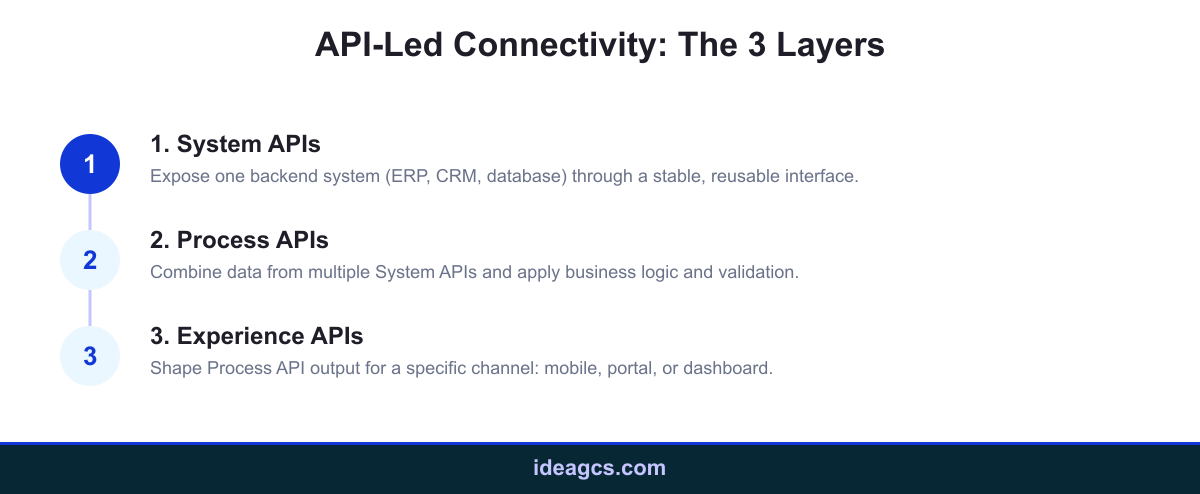
- API led connectivity organizes integration into three layers: System, Process, and Experience APIs, each with a distinct job.
- System APIs expose one backend system through a stable interface, so that system only needs to be integrated once.
- Process APIs orchestrate and reshape data from multiple System APIs to implement actual business logic.
- Experience APIs adapt Process API output for a specific consuming channel, letting one process serve many front ends.
The N Squared Problem Point to Point Integration Creates
Before getting into the three layers, it helps to see the problem they solve. In a point to point integration model, every system that needs to talk to another system gets its own custom connection. Ten systems that all need to exchange data can require up to forty five separate point to point links. Each one has its own authentication, its own data mapping, and its own failure mode. Change one backend system, and every connection touching it has to be found and updated individually.
This is the classic N squared problem: integration complexity grows roughly with the square of the number of systems involved, not linearly. API led connectivity breaks that curve by inserting a layer of reusable, well governed APIs between systems instead of wiring them directly together. Once a system is exposed through a System API, every other system that needs its data reuses that same interface instead of building a new connection from scratch.
Consider a retailer with an order management system, a warehouse management system, a CRM, and an ecommerce platform. Under point to point integration, adding a fifth system, say a returns processing tool, means building up to four new custom connections, one to each existing system. Under API led integration solutions, the returns tool integrates once with each System API that already exists, and any Process API that already orchestrates order and warehouse data can be extended or reused rather than rebuilt from scratch for the new consumer.
Layer 1: System APIs
System APIs sit closest to the backend. Their only job is to expose one system, whether that's an ERP, a CRM, a mainframe, or a database, through a stable, well documented interface that hides the underlying complexity of that system. A System API for an order management platform, for example, might expose endpoints like get order, update order status, and list orders for customer, regardless of whether the underlying system uses SOAP, a proprietary file format, or a legacy stored procedure.
Because a System API's contract stays constant even if the backend implementation changes, this is where most of the long term reuse value comes from. Migrate the order system to a new platform, and only the System API's implementation needs to change. Every Process API and Experience API built on top of it keeps working without modification, since none of them ever integrated with the backend directly. This isolation is also where governance starts: access control, rate limiting, and data masking for sensitive fields get enforced once at the System API layer instead of being reimplemented inconsistently across dozens of point to point connections.
System APIs also absorb protocol translation. A backend might only speak SOAP over an old integration bus, or expose data through flat files dropped on an SFTP server on a schedule. The System API's job is to normalize that into a clean REST interface with a predictable JSON shape, so nothing downstream ever needs to know or care what protocol the backend actually speaks. That abstraction is what lets a Process API treat a forty year old mainframe and a modern SaaS platform identically.
Layer 2: Process APIs
Process APIs sit in the middle and do the actual business logic work. They call one or more System APIs, combine and reshape the data those calls return, apply validation rules, and produce a result that reflects an actual business process rather than a raw system query. A check customer eligibility Process API, for instance, might call a System API for account status, another for payment history, and a third for support tickets, then apply business rules to decide whether the customer qualifies for a service tier upgrade.
This orchestration layer is what makes System APIs actually useful for the business rather than just technically reusable. It's also where most DataWeave transformation work happens in a MuleSoft implementation: converting inconsistent field names, date formats, and currency representations from different backend systems into one coherent, business friendly shape. Because Process APIs depend only on System API contracts and not on backend implementation details, they can be updated to reflect new business rules without touching the systems underneath them.
Layer 3: Experience APIs
Experience APIs are the outermost layer, and their job is to shape Process API output for one specific consuming channel: a mobile app, a customer portal, a partner integration, or an internal dashboard. The same customer eligibility Process API might feed a lightweight, mobile optimized Experience API for a customer facing app and a more detailed, internal facing Experience API for a call center tool, without duplicating any of the underlying business logic twice.
This is the layer that absorbs channel specific change. Redesign the mobile app or add a new partner integration, and only a new or updated Experience API is needed. The Process and System layers underneath stay untouched, which is exactly the kind of isolation that keeps a growing integration ecosystem maintainable instead of turning into the same tangled dependency web that point to point integration produces.
Experience APIs are also the natural place to enforce channel specific security requirements, like OAuth scopes for a partner integration versus session based authentication for an internal dashboard, without pushing those concerns back into the shared Process layer where they would complicate logic that has nothing to do with any one channel.
Governance and Reuse Across the Three Layers
The layering only pays off if it's paired with real API governance. That means a shared API catalog where architects can discover existing System and Process APIs before building new ones, consistent versioning so a Process API change doesn't silently break an Experience API built on top of it, and clear ownership for each layer so teams know who to talk to when a contract needs to change.
Anypoint Platform's API Manager and Exchange are built specifically to support this: Exchange acts as the searchable catalog of published APIs and their specifications, while API Manager enforces policies like rate limiting, access control, and SLA tiers consistently across every layer. This kind of API management discipline is what separates a genuinely governed API led architecture from one that just happens to have three layers of code. Integrators evaluating mulesoft integration solutions for a multi system environment should treat this governance tooling as part of the architecture decision, not an afterthought bolted on later. Without it, even a well layered API led design can drift back toward the same unmanaged sprawl it was meant to prevent.
Conclusion
API led connectivity is not just a MuleSoft marketing term, it's a concrete architectural discipline for keeping integration complexity manageable as the number of connected systems grows. System APIs isolate backend complexity, Process APIs implement reusable business logic, and Experience APIs adapt that logic for each consuming channel, all without falling back into brittle point to point connections. For system integrators planning a new mulesoft api development engagement, getting this layering and its governance right from the start is what determines whether the integration estate stays maintainable two years and twenty projects later. Explore IdeaGCS's MuleSoft integration services to talk through how this architecture would map to your own systems.
Frequently Asked Questions
What is mulesoft api development based on API led connectivity?

What is the difference between a System API and a Process API?
Why are Experience APIs necessary if Process APIs already exist?
How does API led connectivity solve the N squared integration problem?
What role does Anypoint Exchange play in this architecture?
Can an Experience API call a System API directly, skipping Process APIs?
Does API led connectivity require rebuilding existing point to point integrations?
What is the main governance risk in a layered API architecture?
Who typically owns each layer in a MuleSoft API led implementation?
Where can I read more about the business case for API led connectivity?
Contact Us
Share on Social Media
Contact Us