Which Hiring Model Fits a One-Off Role Versus a Scaling Tech Team?

An organisation that needs one senior integration engineer and an organisation that needs forty engineers over eighteen months have the same problem in the abstract and entirely different problems in practice. The first is a search. The second is a process.
A search specialist serves the first; a process-led hiring arrangement — one that runs part or all of your recruitment function — serves the second. Buying the wrong one for the problem is expensive in a specific way: the search model applied to volume produces inconsistent quality and unpredictable cost, and the process model applied to a single role produces a great deal of infrastructure for one hire. Both mistakes are common because the two models are sold to the same person by suppliers who often offer both.
Key Takeaways
- One is built for search and placement; the other is built to run your hiring process at volume.
- Contingent placement fees are efficient for one or two roles and expensive at scale.
- The volume model earns its setup cost somewhere in the range of a dozen or more hires — below that it rarely pays back.
- Employer brand and candidate experience are the volume model's real deliverable, not just the placements.
- Hybrid arrangements are common and workable; the risk is overlapping candidate pools, which needs governing.
The Search Model
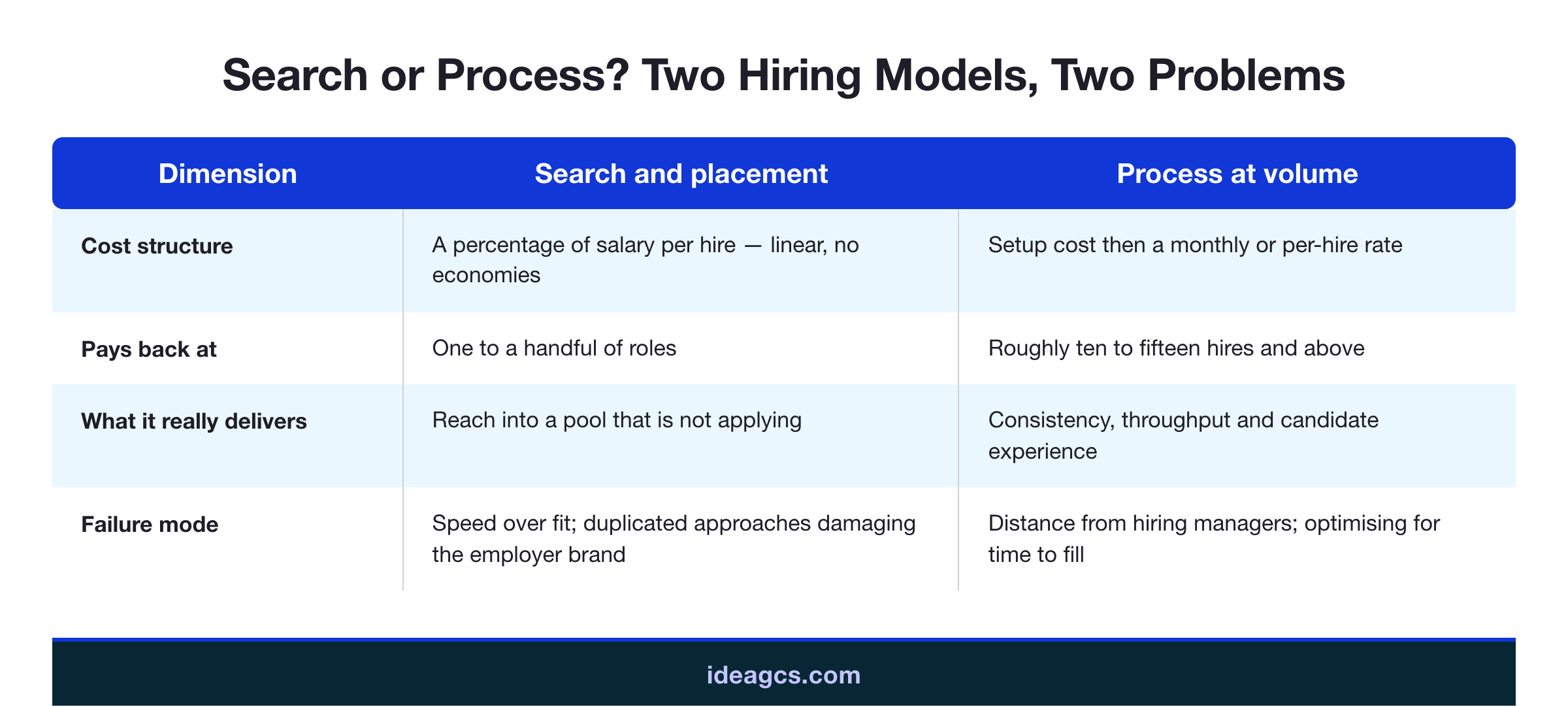
What it is. A specialist finds and places individuals against a defined role. Typically paid on placement as a percentage of salary, sometimes retained for senior or scarce positions.
What it is good at. Reach into a specific talent pool, particularly for skills that do not respond to job advertisements. Senior integration engineers, niche cloud specialists, regulated-domain architects — these people are usually employed and not looking, and finding them is a relationship business rather than a search-engine one.
Where it costs. Fees are a percentage of salary, so cost scales linearly with hires. At two or three roles this is efficient; at thirty it is a large number with no economies of scale.
Its failure modes. Contingent arrangements incentivise speed over fit, because the fee arrives on placement rather than on retention. And multiple contingent suppliers working the same role produce a duplicated, sometimes hostile, candidate experience that damages the employer brand in exactly the market you are trying to hire from.
The Volume Model
What it is. A partner takes on part or all of your recruitment process — sourcing, screening, scheduling, assessment, offer management, and often onboarding — usually paid as a monthly fee or per-hire rate under a longer arrangement.
What it is good at. Consistency and throughput. When a business is hiring continuously, the value is in a repeatable process: consistent screening, predictable timelines, a candidate experience that does not depend on which hiring manager is involved, and data on where good hires actually come from.
Where it costs. There is a setup period before it is efficient. Process design, employer-brand work, assessment calibration, and systems integration all precede the first hire. An arrangement that ends after six months usually has not repaid it.
Its failure modes. Distance from the hiring managers, producing candidates who pass the process and fail the team. And optimising for the metric that is contracted — commonly time to fill — at the expense of the one that matters, which is retention at twelve months.
Which One the Problem Needs
Three questions settle it in most cases.
How many hires, over what period? A handful over a year is a search problem. Continuous hiring, or a defined ramp of a dozen or more, is a process problem. The crossover varies by market and role scarcity, but somewhere around ten to fifteen hires is where the volume model usually starts to pay back.
How scarce is the skill? Very scarce skills need a search regardless of volume, because process throughput does not help when the constraint is that only a small number of qualified people exist and none of them are applying to job advertisements.
Is the hiring predictable? A process model needs a pipeline to run against. Genuinely unpredictable, opportunistic hiring is hard to serve with a process arrangement, and the fixed cost sits idle between requisitions.
There is a fourth, quieter question: what state is your own process in? If hiring managers are slow to give feedback, interview loops are inconsistent, and offers take a week to approve, neither model will fix it — but the volume model will surface it immediately, and some organisations find that surfacing more valuable than the hires.
What Both Models Cost, Honestly
Neither cost is only the fee.
On the search side: the fee, plus your hiring managers' time in interviews, plus the cost of a role sitting open, plus the cost of a mis-hire. That last one is the largest and the least modelled — a senior mis-hire discovered at month five has consumed recruitment cost, salary, management attention, and the delivery that did not happen.
On the volume side: the fee, plus the setup effort on your side, plus internal stakeholder time in process design, plus the cost of the arrangement not fitting if the hiring plan changes. Volume arrangements are less flexible than they look, and a hiring freeze mid-contract is an awkward conversation.
The comparison that actually matters is cost per retained hire at twelve months, not cost per placement. Organisations that measure the first make better model decisions than those that measure the second, and the difference between the two numbers is often large. Our look at what a permanent engineer really costs sets out the fully loaded arithmetic.
The Hybrid Arrangement
Most organisations at scale run both. A process arrangement covers the predictable volume — the engineering roles hired continuously — while a search relationship handles the scarce and senior positions the process cannot reach.
This works and it needs one thing governed: the boundary. Two suppliers working overlapping candidate pools produces duplicate approaches, disputed placement fees, and candidates who conclude the organisation is disorganised. Define which roles belong to which arrangement, in writing, and put a mechanism in place for reassigning a role that one side cannot fill.
The second thing worth governing is data. If the process partner holds the pipeline data and the search partner holds relationships, neither party nor you has a complete picture of your own hiring market. Requiring both to report into a shared view is straightforward at contracting and difficult later.
What to Measure
Time to fill is the standard measure and the most gameable. Used alone it drives suppliers toward available candidates rather than good ones.
Quality of hire at six and twelve months, assessed by the hiring manager against a defined scale. Slow, subjective, and the only measure that describes whether the arrangement worked.
Twelve-month retention, which is the sharpest single indicator. An arrangement producing fast placements and poor retention is transferring cost from the recruitment budget to the delivery budget.
Offer acceptance rate, which is mostly a measure of your own process and employer proposition rather than the supplier's performance — useful precisely for that reason.
Cost per retained hire, which is the number that should drive the model decision.
When Neither Model Is the Answer
Worth stating: sometimes the requirement is not a hire at all.
A bounded piece of work — three integrations, a migration, a platform build — is usually cheaper and faster to buy as a delivered outcome than to staff. The recruitment cycle for a scarce skill frequently exceeds the duration of the work itself, which means hiring for it is a decision to start late and then carry a permanent cost afterwards.
The test is whether the work continues after the current requirement is met. If it does, hire. If it does not, buy the deliverable. IdeaGCS covers both — specialist hiring services where the answer is people, and delivery through its service lines where the answer is an outcome.
Conclusion
One model searches for individuals; the other runs a process at volume. The choice follows from hiring volume, skill scarcity, and predictability — with somewhere around ten to fifteen hires as the usual point at which a process arrangement starts to repay its setup.
Measure cost per retained hire rather than cost per placement, govern the boundary if you run both, and check first that the requirement is genuinely a hire rather than a bounded piece of work better bought as a deliverable. Talk to IdeaGCS if you want a requirement sized before it goes to market.
Frequently Asked Questions
What is the difference between the two hiring models?

At what hiring volume does a process arrangement pay back?
Which model suits very scarce skills?
What is wrong with contingent placement fees?
What is the biggest risk with a volume arrangement?
Can we use both models at once?
What should we measure?
What does offer acceptance rate actually tell us?
Will a supplier fix a broken internal hiring process?
When is hiring the wrong answer entirely?
Contact Us
Share on Social Media
Contact Us