How to Build an OCR AI Agent for Accounts Payable Automation

Building an OCR AI agent for accounts payable automation is one of the highest-ROI applications of intelligent document processing available to enterprise finance teams. The accounts payable function processes large volumes of invoices in varied formats from hundreds of suppliers, applying consistent validation rules and ERP posting logic to each transaction. An OCR AI agent automates this entire workflow end-to-end: from invoice receipt through extraction, validation, three-way matching, and ERP posting, with intelligent exception handling for the minority of invoices requiring human review. This guide walks through the complete build process.
Key Takeaways
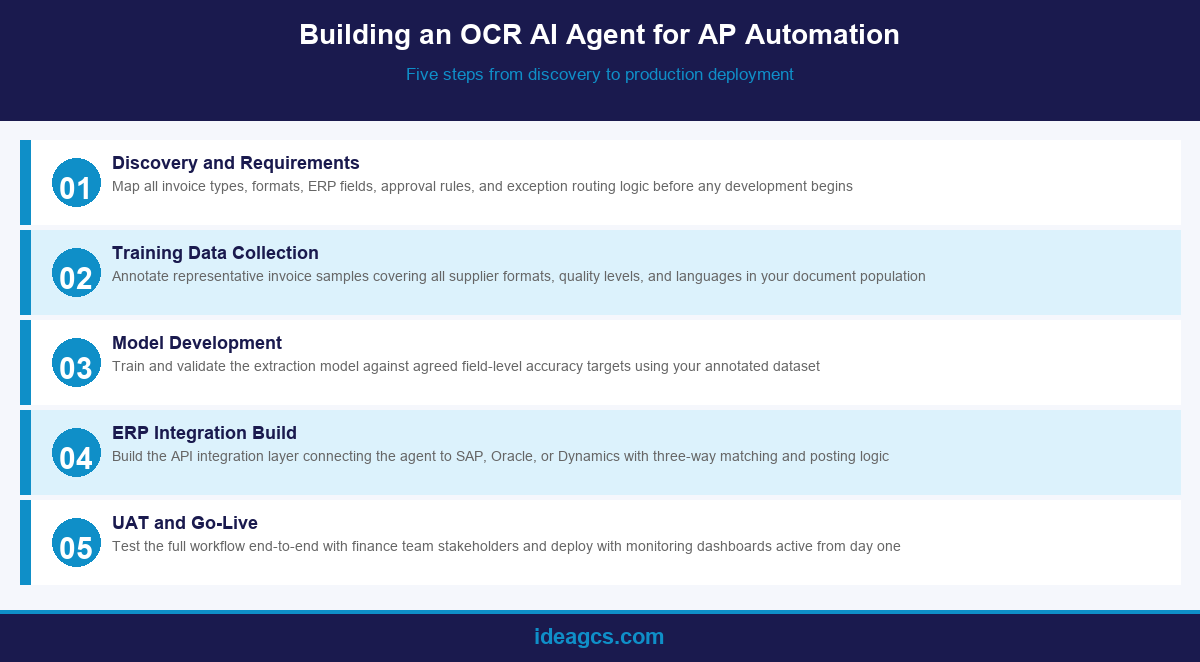
Building an OCR AI agent for accounts payable requires five phases: discovery, training data, model development, ERP integration, and production deployment
Training data quality is the single most important determinant of production accuracy; investing adequately in annotation pays back through lower exception rates
IdeaGCS delivers end-to-end OCR AI agent builds for accounts payable teams integrating with SAP, Oracle, and Microsoft Dynamics
Phase 1: Discovery and Requirements Definition
A successful AP OCR AI agent build starts with a thorough discovery phase before any technical development begins. Discovery covers three areas: document population mapping, business logic documentation, and integration scoping. Document population mapping identifies every invoice type, format, language, and quality level the agent must process, including edge cases and exceptions that the current manual process struggles with. This mapping directly informs training data requirements and is the most important input to project scope and timeline.
Business logic documentation captures every validation rule, approval threshold, three-way matching criterion, and exception routing condition that the agent must apply. For a typical enterprise AP environment, this includes PO number validation, supplier master record matching, line item tolerance rules, tax code verification, currency handling, and approval matrix logic by invoice value and cost centre. Without comprehensive business logic documentation, the agent will extract accurately but route incorrectly. IdeaGCS conducts discovery workshops with AP leads, ERP administrators, and IT stakeholders to capture this logic before development begins. Read our guide on why manual document processing slows businesses down for context on the cost of the workflows this agent will replace.
Phase 2: Training Data Collection and Annotation
Training data is the foundation of AP OCR AI agent accuracy. The agent learns to extract invoice fields by studying annotated examples: documents where every relevant field has been labelled with its correct value by a human reviewer. The quality and diversity of this training dataset directly determines production accuracy. A dataset of 500 diverse, well-annotated invoices will produce a more accurate model than 5,000 examples of a single supplier format.
Annotation requires expertise in both the document domain and the labelling methodology. Each field type (invoice number, date, line items, tax, totals) must be labelled consistently across all training examples, with agreed handling rules for edge cases such as multi-page invoices, credit notes, and invoices with non-standard line item structures. IdeaGCS manages the full training data collection and annotation process, working with the client's AP team to source representative historical invoices and applying structured annotation protocols to build the training dataset needed to meet agreed accuracy targets.
Phase 3: Model Development and Accuracy Validation
With annotated training data in place, model development begins. IdeaGCS uses transformer-based extraction architectures that learn document layout and field relationships from the training data rather than relying on fixed templates. The initial model is trained, evaluated against a held-out validation set, and iteratively improved until field-level accuracy targets are met for each key field type. Targets are agreed with the client during discovery, typically 97 percent or above for high-value fields such as total amount, tax, and payment terms.
Model validation is conducted against a test set that includes edge cases and lower-quality documents representative of the hardest examples in the production population. Providers that validate only against clean, well-structured samples create a gap between PoC accuracy and production accuracy that appears as an unexpected increase in exception rates after go-live. IdeaGCS builds the validation set to reflect the hardest 20 percent of the production document population, ensuring that go-live accuracy matches pre-launch benchmarks. According to NIST's AI evaluation standards, representative test data that includes edge cases is a prerequisite for meaningful accuracy claims.
Phase 4: ERP Integration, Testing, and Go-Live
ERP integration connects the OCR AI agent's extraction and reasoning outputs to the accounts payable module of the client's ERP system. For SAP, this involves BAPI/RFC calls for PO lookup and invoice posting, with the agent mapping extracted fields to SAP MM and FI data structures. For Oracle and Dynamics, equivalent REST API integrations are built to the same specification. The integration layer handles three-way matching logic, routes matched invoices for automatic posting, and routes exception invoices to a review interface with context and suggested corrections provided.
User acceptance testing with the AP team is the final phase before go-live. The test protocol covers the full range of invoice types in the production population, including the edge cases identified during discovery. AP team reviewers process a defined volume of invoices through the agent in a staging environment, verifying extraction accuracy, matching results, routing correctness, and exception interface usability. Issues identified during UAT are resolved before production deployment. IdeaGCS provides go-live support with monitoring dashboards active from day one, tracking extraction accuracy, exception rates, and straight-through processing rates in real time. Contact IdeaGCS to discuss your AP OCR AI agent build requirements.
Building an OCR AI agent for accounts payable automation follows a clear five-phase process: discovery, training data, model development, ERP integration, and production deployment. Each phase has defined outputs that directly determine the quality of the next, and investment in each phase pays back through the automation rate, accuracy, and exception reduction achieved in production. The result is an AP function that processes the majority of invoices without human intervention, with intelligent handling for the exceptions that genuinely require review. IdeaGCS delivers end-to-end OCR AI agent builds for accounts payable teams. Explore our AI and data services to begin the discovery process.
Frequently Asked Questions
How do I build an OCR AI agent for invoice processing?

Building an OCR AI agent for invoice processing requires five phases: discovery and requirements mapping, training data collection and annotation, model development and accuracy validation, ERP integration build, and user acceptance testing before go-live. IdeaGCS manages the full process from discovery to production.
What training data do I need for AP invoice OCR?
You need annotated examples of every invoice type, format, language, and quality level your AP team processes. IdeaGCS recommends a minimum of 500 diverse, well-annotated invoices to build a production-ready model, with additional samples for formats that appear frequently or have complex field structures.
How accurate can an OCR AI agent be for invoice processing?
A well-built OCR AI agent achieves 97 to 99 percent field-level accuracy for high-value fields such as total amount, tax, and payment terms. IdeaGCS validates accuracy against agreed targets before go-live using a test set that includes the hardest 20 percent of the production document population.
How does an OCR AI agent integrate with SAP for AP?
The agent integrates with SAP using BAPI or RFC function calls for purchase order lookup and invoice posting. Extracted invoice fields are mapped to SAP MM and FI data structures, with three-way matching logic applied before automatic posting. Exceptions are routed to a review interface with SAP posting managed on approval.
What is three-way matching in AP automation?
Three-way matching compares the invoice, purchase order, and goods receipt note to verify quantity, price, and supplier consistency before posting. An OCR AI agent automates this comparison, routing matched invoices for automatic ERP posting and flagging discrepancies for human review with context about the specific mismatch.
How long does it take to build an AP OCR AI agent?
A standard AP OCR AI agent build takes 10 to 14 weeks: two weeks for discovery, three weeks for data collection and annotation, three weeks for model development, three weeks for ERP integration, and two weeks for UAT and go-live. Complex multi-ERP or multi-market implementations may take longer.
What ERP systems can the OCR AI agent integrate with for AP?
IdeaGCS builds AP OCR AI agent integrations with SAP (MM/FI modules), Oracle Payables, Microsoft Dynamics 365 Finance, and NetSuite. Each integration is built to the client's specific ERP version and configuration, with field mapping and business logic tailored to the client's AP workflow.
What is the ROI of AP OCR AI agent automation?
AP teams processing 1,000 or more invoices per month typically recover OCR AI agent investment within 8 to 14 months through reduced data entry labour, lower error correction costs, improved early payment discount capture, and AP team capacity redeployed to higher-value activities.
Contact Us
Share on Social Media
Contact Us