How to Evaluate an RPO Provider: 12-Point Checklist

Choosing the wrong RPO provider is a costly mistake. A poorly matched provider delivers underperformance against hiring targets, compliance exposure, candidate experience damage, and a contract that is difficult and expensive to exit. The decision deserves a structured evaluation process. This guide provides a practical 12-point checklist for evaluating how to choose an RPO provider, covering the technical, commercial, and cultural dimensions that determine whether a provider will genuinely deliver on their promises throughout a multi-year engagement.
Key Takeaways
Evaluate RPO providers across 12 criteria covering compliance, technology, sector expertise, delivery track record, and commercial structure
Reference checks with existing clients are the most reliable predictor of RPO provider performance in practice
IdeaGCS welcomes structured RPO evaluations and provides detailed RFP responses, case studies, and client references on request
Why Choosing the Right RPO Provider Matters
An RPO engagement typically runs for two to five years and involves the provider managing a significant proportion of your talent acquisition activity. The provider's performance directly affects your headcount delivery against business targets, your employer brand reputation, your compliance exposure, and the cost of talent acquisition. Getting the selection decision right at the outset avoids the disruption, cost, and reputational damage of switching providers mid-contract.
The RPO market includes providers ranging from global enterprises with multi-thousand-person delivery teams to boutique specialists with deep sector knowledge but limited geographic reach. Neither size nor brand recognition is a reliable proxy for quality. What matters is the combination of capabilities, processes, and cultural alignment that will determine performance against your specific requirements. Read the complete guide to RPO to build a foundation for your evaluation before engaging providers.
The 12-Point RPO Provider Evaluation Checklist
The first four criteria cover compliance and risk. Does the provider have documented processes for right to work, IR35, GDPR, and relevant local employment law? Do they carry professional indemnity insurance? Have they experienced compliance incidents with existing clients, and how did they resolve them? Can they demonstrate their data security certifications (ISO 27001 or equivalent)? These are non-negotiable foundations. The next four cover delivery capability: What is their average time-to-fill by role type in your market? What sourcing channels and technology platforms do they use? What is their offer acceptance rate across recent engagements? Can they provide sector-specific case studies with measurable outcomes?
The final four criteria cover commercial and cultural fit. How is pricing structured, and what is the mechanism for adjusting fees if hiring volumes change significantly? What does the SLA framework look like, and what are the remedies if targets are missed? Who are the specific team members who will manage your account, and what is their relevant experience? Finally, speak with two to three existing clients. The gap between what a provider says in a pitch and what existing clients report about day-to-day performance is often the most revealing part of any evaluation. Contact IdeaGCS to request our full RFP response template and client reference list.
Red Flags to Watch for in RPO Provider Responses
Several patterns in provider responses should prompt caution. Vague answers on compliance processes suggest that compliance is not systematically embedded in their delivery model. Generic case studies without specific metrics indicate a lack of transparency or an absence of measurable outcomes from past engagements. Resistance to providing client references, particularly for clients in your sector or market, is a significant warning sign.
Overpromising on time-to-fill or cost-per-hire without market data to support the claims suggests a provider that prioritises winning the contract over realistic expectation management. Complex commercial structures with multiple add-on fees for services that should be within scope create cost unpredictability. A well-structured RPO provider will be able to give clear, consistent answers on all evaluation criteria without deflection or excessive qualification.
Running a Structured RPO Selection Process
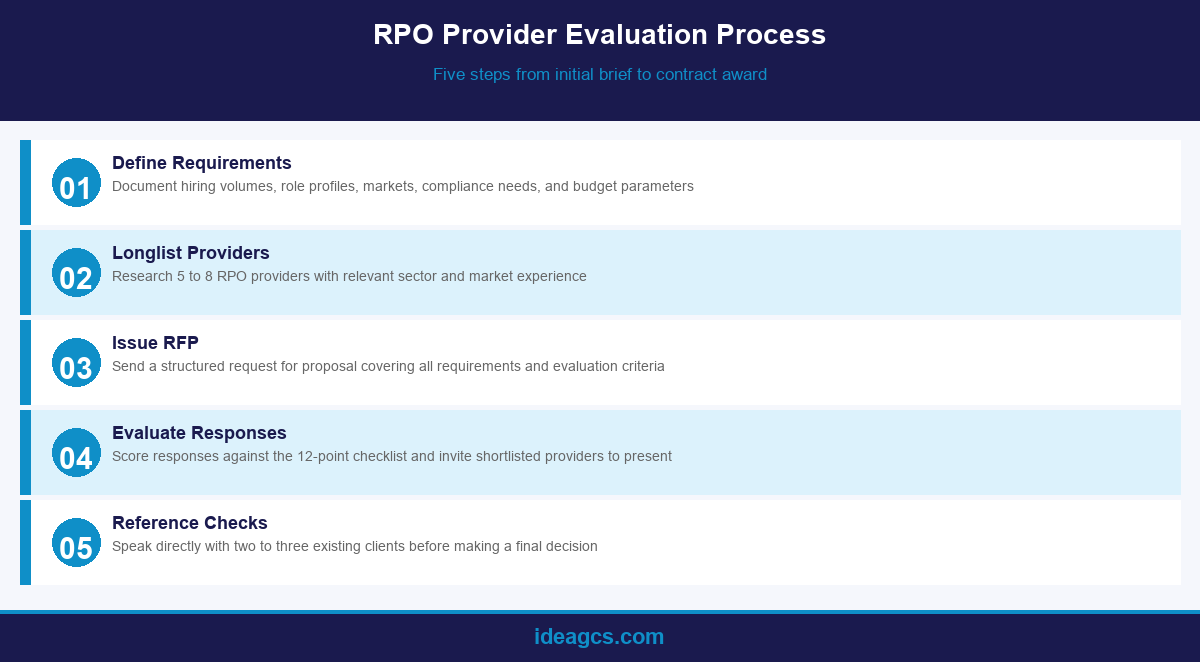
A structured RPO selection process typically runs over six to eight weeks. Begin with a clear requirements brief covering hiring volumes, role profiles, target markets, compliance requirements, and budget parameters. Issue an RFP to five to eight shortlisted providers with a scoring framework aligned to the 12-point checklist. Evaluate written responses, invite three to four providers to present, and conduct reference checks with their existing clients before making a final decision.
The final stage of any RPO selection should include a joint implementation planning session with the preferred provider before the contract is signed. This session validates that the provider's proposed approach is genuinely workable in your specific context and surfaces any misalignments in expectations before they become contractual disputes. IdeaGCS welcomes structured evaluations and provides complete transparency through our RPO selection process. Explore our technical staffing and RPO services to understand what a partnership with IdeaGCS looks like in practice.
A structured evaluation using the 12-point checklist significantly reduces the risk of a poor RPO provider selection. The investment of six to eight weeks in a thorough evaluation process is small relative to the cost of a two to five-year engagement that underdelivers against expectations. Compliance, delivery track record, sector expertise, and commercial transparency are the four dimensions that most reliably predict RPO performance. IdeaGCS provides full evaluation support including detailed RFP responses, client references, and implementation planning sessions. Contact our team via our RPO services page to begin the evaluation process.
Frequently Asked Questions
What should I look for in an RPO provider?

Evaluate RPO providers on compliance infrastructure, sector experience, technology capability, delivery track record with measurable outcomes, transparent pricing, and the quality of the specific team assigned to your account. Always conduct reference checks with existing clients before signing.
How many RPO providers should I shortlist?
Shortlist five to eight RPO providers for initial RFP evaluation, narrowing to three to four for presentations and two for detailed commercial negotiation. This provides enough competitive tension while keeping the evaluation process manageable within a six to eight week timeline.
What is an RPO RFP?
An RPO RFP (request for proposal) is a structured document outlining your hiring requirements, compliance needs, volume targets, geographic scope, and evaluation criteria. Providers respond with detailed proposals that can be scored systematically against a common framework to enable objective comparison.
How long does an RPO evaluation take?
A thorough RPO provider evaluation typically takes six to eight weeks from initial brief to contract award. This covers RFP distribution, response evaluation, provider presentations, reference checks, and commercial negotiation. Compressed timelines of four weeks are possible but increase risk.
What questions should I ask an RPO provider?
Ask about time-to-fill benchmarks for your specific role types and markets, compliance incident history and resolution processes, the names and experience of the specific team members who will manage your account, and for references from clients in your sector with comparable hiring volumes.
Can I change RPO provider if I am unhappy?
Most RPO contracts include exit provisions allowing termination with notice, typically 60 to 90 days. However, switching providers mid-contract is disruptive and costly. Thorough upfront evaluation and a well-structured SLA framework with clear remedies for underperformance are the best protections.
How do I measure RPO provider performance?
Measure RPO provider performance against agreed SLAs covering time-to-fill, cost-per-hire, offer acceptance rate, hiring manager satisfaction score, and 90-day retention. Monthly or quarterly performance reviews against these metrics provide the accountability structure needed for a high-performing RPO partnership.
Does IdeaGCS respond to RPO RFPs?
Yes. IdeaGCS welcomes structured RPO evaluations and provides detailed RFP responses, case studies, and client references for all evaluation processes. Contact our team to discuss your requirements and we will provide a full proposal within five business days.
Contact Us
Share on Social Media
Contact Us