OCR AI Agents vs RPA Bots: Key Differences for Document Automation

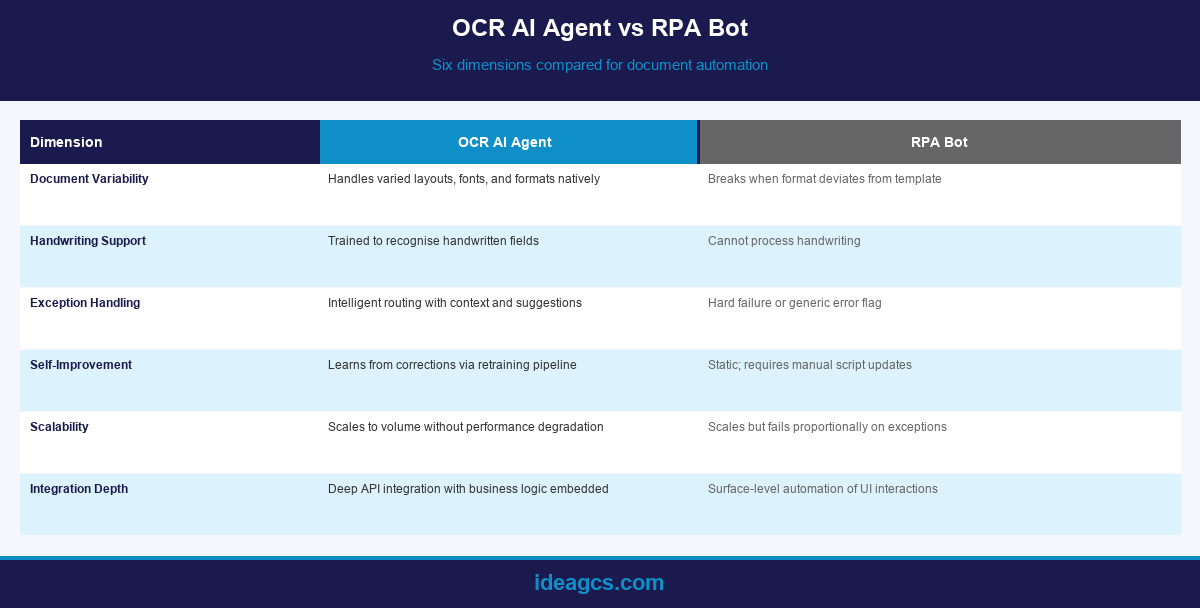
The OCR AI agent versus RPA debate is one of the most important architectural decisions in enterprise document automation. Both technologies aim to remove manual work from document-intensive processes, but they approach the problem in fundamentally different ways with significantly different outcomes when document variability, exception handling, and scalability enter the equation. This guide breaks down the six key differences to help organisations choose the right approach for their specific automation requirements.
Key Takeaways
RPA automates structured, predictable tasks by scripting; OCR AI agents apply contextual reasoning to handle document variability that breaks RPA
OCR AI agents self-improve through production feedback loops; RPA bots require manual script maintenance when inputs change
IdeaGCS builds OCR AI agents for document workflows that demand resilience, adaptability, and continuous improvement
What RPA Does Well and Where It Falls Short
Robotic Process Automation automates tasks by recording and replaying user interactions with software interfaces. It is effective for high-volume, structured, predictable tasks where inputs always follow the same format and the automation rules never change. RPA has delivered real value in processes like data transfer between systems with consistent screen layouts, form completion where field positions are fixed, and structured report generation where the template is always identical.
The limitation of RPA in document automation is brittleness. When an invoice arrives from a supplier who has changed their format, the RPA script fails because the field position it was scripted to read has moved. When a handwritten form contains data the script was not designed to handle, it errors. When exception rates rise as document variety increases, maintenance overhead grows proportionally. A 2024 McKinsey study on AI automation found that organisations relying primarily on RPA for document-heavy processes spend 30 to 50 percent of implementation cost on ongoing script maintenance as document formats evolve.
How OCR AI Agents Overcome RPA's Limitations
OCR AI agents address the root cause of RPA brittleness: the inability to handle variability. Where an RPA script uses fixed coordinates or patterns to locate data, an OCR AI agent uses deep learning to understand document structure contextually. It recognises an invoice as an invoice regardless of supplier, layout, font, or image quality, because it has learned the characteristics of invoices rather than been scripted with fixed rules about where to find data.
Exception handling is where the quality difference between OCR AI agents and RPA is most visible. An OCR AI agent encountering an unexpected document value does not simply fail. It evaluates the confidence of its extraction, applies business logic to determine the appropriate routing path, provides context to the human reviewer about what was found and what correction is needed, and updates its training data with the corrected value for future improvement. This intelligent exception management dramatically reduces the operational burden of managing an automation deployment at scale. Explore our detailed guide on AI OCR use cases for real-world examples of how this capability applies across industries.
When to Use RPA, When to Use an OCR AI Agent
RPA remains a valid approach for document automation where the document population is genuinely narrow and consistent, the format never changes, volumes are manageable, and the cost of occasional script maintenance is acceptable. It can also be appropriate as a component within a broader automation architecture, handling the structured data transfer steps downstream of an OCR AI agent that handles the unstructured document extraction upstream.
An OCR AI agent is the right choice whenever document variability is present, accuracy above 90 percent is required across a diverse document population, exception management needs to be intelligent rather than a hard failure, or the automation must self-improve over time without ongoing script maintenance. For most enterprise document processing environments, the combination of variable document formats and strict accuracy requirements makes an OCR AI agent the only architecture that reliably delivers the expected automation rate. Contact IdeaGCS to assess whether an OCR AI agent or a hybrid approach is the right fit for your document workflow.
Total Cost of Ownership: OCR AI Agent vs RPA Over Time
The upfront development cost of an OCR AI agent is higher than a comparable RPA implementation. Training data collection, model development, and integration build require more specialist investment than scripting a bot. The total cost of ownership comparison shifts over the medium term as RPA maintenance costs accumulate. Script updates when document formats change, manual exception handling for cases the bot cannot process, and the quality costs of automation errors that pass undetected all compound over a two to three year horizon.
An OCR AI agent's operational cost profile is more stable. Periodic retraining improves accuracy rather than merely patching failures, and the self-improving nature of the model means that exception rates typically fall rather than rise as the deployment matures. For organisations processing more than 500 documents per month with any format variability, the total cost of ownership analysis consistently favours the OCR AI agent over a two-year horizon. IdeaGCS models TCO projections for each client during discovery. Explore our AI and data services for details on our development and support model.
The OCR AI agent versus RPA comparison resolves in favour of OCR AI agents for any document automation scenario involving variability, complex exception handling, or continuous improvement requirements. RPA remains adequate for narrow, static, fully structured workflows. For the vast majority of enterprise document processing environments, OCR AI agents deliver higher automation rates, lower long-term maintenance costs, and a quality of exception handling that RPA simply cannot match. The right architecture depends on your specific document population, but the answer is rarely one-size-fits-all. IdeaGCS helps organisations assess and design the right document automation architecture. Explore our AI and data services to start the conversation.
Frequently Asked Questions
What is the difference between OCR AI agent and RPA?

RPA automates structured tasks using predefined scripts and fails when document formats vary. An OCR AI agent applies contextual reasoning to handle variability, learns from exceptions, and improves over time. For document-heavy processes with variable inputs, OCR AI agents deliver significantly higher automation rates.
Can RPA process handwritten documents?
No. RPA cannot process handwriting because it relies on fixed-position scripts rather than document understanding. An OCR AI agent trained on handwriting samples can extract handwritten field values with accuracy typically ranging from 88 to 95 percent depending on training data quality.
Which is better for invoice automation: RPA or OCR AI agent?
For invoice automation across varied supplier formats, an OCR AI agent is significantly better. RPA requires a script per supplier format and fails when formats change. An OCR AI agent processes any invoice format natively, handles exceptions intelligently, and improves accuracy over time as more invoices are processed.
Can OCR AI agents and RPA work together?
Yes. A common architecture uses an OCR AI agent for document extraction and reasoning, then passes structured data to an RPA bot for downstream system interactions where the target system lacks an API. This hybrid approach uses each technology for what it does best.
How much does it cost to replace RPA with an OCR AI agent?
Migration cost depends on the complexity of existing RPA workflows and the document population scope. IdeaGCS provides detailed assessments following a discovery session reviewing your current automation, document types, and accuracy targets. Migration projects typically pay back within 12 to 18 months through reduced maintenance and exception handling costs.
Why does RPA fail on document processing?
RPA fails on document processing because it relies on fixed rules and screen coordinates rather than document understanding. Any change in document layout, format, or content structure that was not accounted for in the original script causes a failure or incorrect data extraction.
Is an OCR AI agent suitable for small businesses?
Yes. IdeaGCS designs OCR AI agent solutions at scales appropriate for smaller organisations, including modular deployments that start with the highest-volume document type and expand over time. The key threshold is document volume: organisations processing 500 or more documents per month typically benefit from OCR AI agent automation.
What is the maintenance requirement for an OCR AI agent vs RPA?
RPA requires ongoing script maintenance whenever document formats change, which in most enterprise environments means regular manual updates. An OCR AI agent requires periodic retraining rather than script fixes, and IdeaGCS includes retraining as part of post-deployment support, with frequency determined by the rate of new document variants encountered.
Contact Us
Share on Social Media
Contact Us