Offshore vs In-House Development Teams: Which Is Better for Your Business?
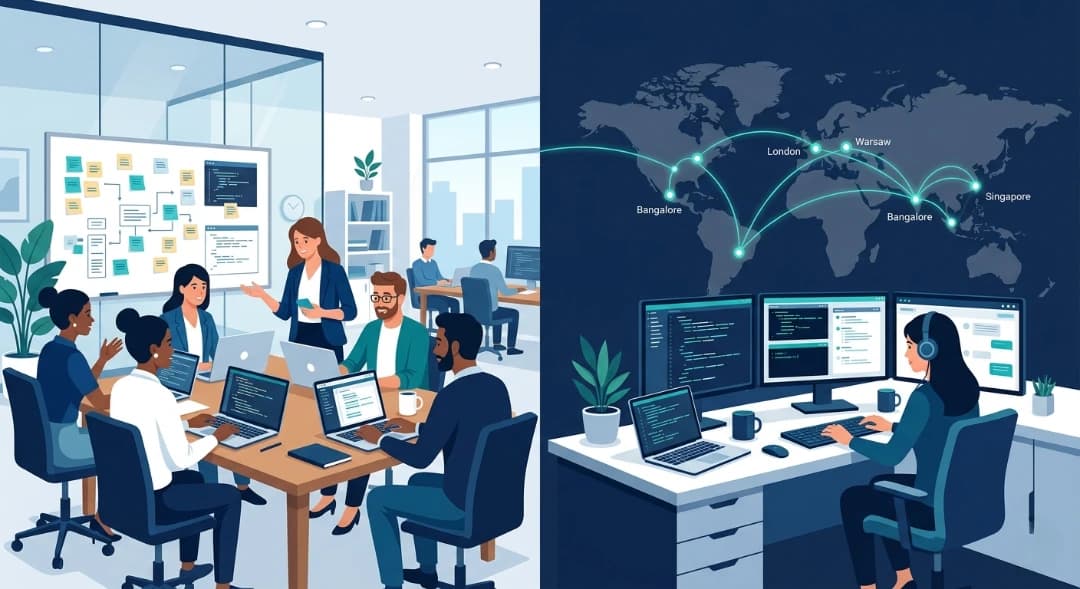
Offshore vs In-House Development Teams: Which Is Better for Your Business?
Choosing between an offshore development team and an in-house team is one of the most critical decisions a technology leader makes today. The wrong choice can drain budgets, slow product delivery, and limit growth. With software development outsourcing becoming increasingly mainstream, companies now have access to world-class talent at competitive rates.
This guide breaks down the key differences between offshore and in-house models, helping CTOs, startup founders, and HR leaders determine which approach aligns best with their goals.
Key Takeaways
Offshore development teams offer significant cost advantages, rapid scalability, and access to a deep global talent pool.
In-house teams provide stronger communication, cultural alignment, and direct project oversight.
The right development model depends on your business size, project complexity, budget, and long-term growth strategy.
What Is an Offshore Development Team?
An offshore development team is a group of software professionals located in a different country, hired to build, maintain, or scale digital products for a client organization.
Unlike traditional outsourcing arrangements, modern offshore software development is highly collaborative. Teams today operate within agile frameworks, communicate via real-time platforms, and align with the client's product roadmap. Countries like India, the Philippines, Eastern Europe, and Latin America have become leading destinations for offshore IT teams due to their technical depth, English proficiency, and favorable cost structures.
For companies looking to scale quickly without inflating operational costs, hiring offshore developers for startups and established enterprises alike has become a proven strategy. IdeaGCS's Technical Staffing Services help businesses tap into this global talent pool with precision and efficiency, connecting them with vetted professionals across every technology discipline.
What Do In-House Development Teams Offer?
An in-house development team consists of full-time employees working from the company's primary location or a dedicated office.
In-house teams are deeply embedded in company culture. They participate in daily standups, align closely with product and design teams, and bring long-term commitment to the product. For industries where compliance, data security, and constant stakeholder interaction are non-negotiable, having developers on-site provides comfort and control.
However, building a strong in-house team requires significant investment in recruitment, salaries, benefits, training, and infrastructure. In competitive markets like the USA and UK, this cost can be prohibitive for startups and mid-sized businesses, particularly when specialized skills are needed at pace.
Offshore vs In-House Development Teams: A Side-by-Side Comparison
Understanding the key differences across five core dimensions helps leaders make a more informed choice.
Cost and Budget Efficiency
Cost is often the first reason businesses explore offshore software development. In-house developers in the USA command average annual salaries ranging from $100,000 to $160,000 when factoring in benefits, payroll taxes, and office overhead. In contrast, offshore developers in India or the Philippines bring comparable technical expertise at 50 to 70 percent lower cost.
For startups operating on limited budgets, this difference is transformative. Outsourcing software development for companies at early stages allows leadership to redirect capital toward product development, customer acquisition, and market growth rather than headcount costs.
Talent Availability and Skill Depth
One of the strongest benefits of offshore development teams is the breadth of available talent. Recruiting locally can take months, especially for niche skills such as cloud-native architecture, API integration, or AI-driven application development. Offshore IT teams allow companies to access developers with specific skill sets almost immediately, without compromising on quality.
This is particularly relevant in areas like digital transformation engineering, where cross-functional expertise across cloud, data, and integration layers is critical to project success. The global talent pool makes it possible to staff these complex projects at speed.
Communication and Collaboration
In-house teams win on proximity. Shared time zones, shared language, and shared office culture all reduce friction in day-to-day communication. Product decisions move faster when developers and stakeholders occupy the same space.
Remote engineering teams, however, have significantly improved communication standards in recent years. Dedicated project managers, structured sprint reviews, asynchronous documentation practices, and strategically planned overlap hours help offshore IT teams stay aligned with client expectations. The key is choosing an offshore partner with a proven communication and governance framework built into their delivery model.
Scalability and Flexibility
Scaling an in-house team requires months of hiring, onboarding, and training. During peak project phases, businesses often need to ramp up quickly and scale back just as fast. Offshore development teams offer this operational elasticity. Adding backend developers, QA engineers, or DevOps specialists to an ongoing project can happen within weeks rather than months.
This scalability advantage makes software development outsourcing a preferred model for companies managing variable workloads, major product launches, or rapid feature rollout cycles. Explore how applications and digital engineering services support scalable, future-proof development strategies across enterprise and startup environments.
Project Control and Security
In-house teams offer maximum control over code quality, IP security, and process adherence. For sectors like fintech, healthcare, and insurance, this level of oversight is often a regulatory requirement.
Offshore partnerships can address these concerns effectively through NDAs, IP assignment agreements, secure development environments, and compliance audits. Reputable offshore partners implement enterprise-grade security standards and operate within globally recognized compliance frameworks, giving clients confidence without sacrificing the cost and talent benefits of offshore engagement.
When Should You Choose an Offshore Development Team?
An offshore development team is the right choice when:
Your budget does not support local hiring rates for the required skill set.
You need to scale development capacity quickly without long-term headcount commitments.
Your project requires specialized skills that are scarce in your local market.
You are a startup testing product ideas and need to ship fast without building infrastructure.
Your product roadmap demands continuous development across multiple time zones.
Hiring offshore developers for startups is especially valuable when speed to market is a priority. A global partner can staff a full development team in weeks, enabling faster product cycles and stronger competitive positioning in crowded markets.
When Does an In-House Team Make More Sense?
In-house development is worth the investment when:
Your product requires daily collaboration across development, design, and business teams.
You operate in a highly regulated industry where security and compliance demand on-site oversight.
Long-term IP ownership and brand alignment are central to your development strategy.
You have the budget to attract and retain top local talent consistently over time.
Many companies ultimately adopt a hybrid model, maintaining a small in-house core team for product strategy and architecture while partnering with an offshore development team for execution, feature development, and scale.
How IdeaGCS Helps You Build the Right Development Team
IdeaGCS brings over 20 years of experience helping businesses structure, staff, and scale their technology teams. Whether you are evaluating your first offshore partnership or expanding an existing team, IdeaGCS provides the expertise and global network to get it right.
Through proven technical staffing solutions, IdeaGCS helps companies identify, vet, and onboard developers across disciplines including full-stack engineering, cloud infrastructure, DevOps, data engineering, and AI development. With a presence across the USA, UK, UAE, India, and the Philippines, IdeaGCS bridges the gap between global talent and business delivery needs.
IdeaGCS does not simply place developers. The team helps clients define team structures, align developer roles to project goals, and establish governance models that ensure quality, accountability, and delivery at scale.
Conclusion
The debate around offshore vs in-house development teams does not have a universal answer. Businesses must weigh their budget, timeline, technical requirements, and long-term growth strategy before committing to a model. For many companies, an offshore development team delivers the best combination of cost efficiency, skill depth, and scalability. For others, the proximity and control of an in-house team remain non-negotiable priorities.
What matters most is choosing a model that aligns with where your business is today and where it needs to go tomorrow. With the right offshore partner, companies can access world-class talent, accelerate delivery, and compete on a global level.
Contact IdeaGCS to explore how our staffing and offshore team solutions can support your growth goals.
Frequently Asked Questions
What is an offshore development team?

What are the main benefits of offshore development teams?
How does offshore software development reduce costs?
What challenges come with managing a remote engineering team?
When is outsourcing software development the right choice for a company?
What is the difference between offshore and in-house development teams?
How do I choose the right offshore IT team for my business?
Are offshore development teams suitable for startups?
How can I maintain quality with an offshore development team?
What industries benefit most from offshore software development outsourcing?
Contact Us
Share on Social Media
Contact Us