The Future of Global Tech Hiring: Trends Companies Should Know
The Future of Global Tech Hiring: Trends Companies Should Know
The race to hire top tech talent has never been more competitive. As businesses accelerate their tech hiring trends strategies in 2026, the rules of global tech hiring are shifting fast. Companies that rely on outdated recruitment models are losing their best candidates to faster, smarter competitors.
This blog explores the most important trends reshaping how organizations hire technology professionals worldwide, and what your business needs to do to stay ahead.
Key Takeaways
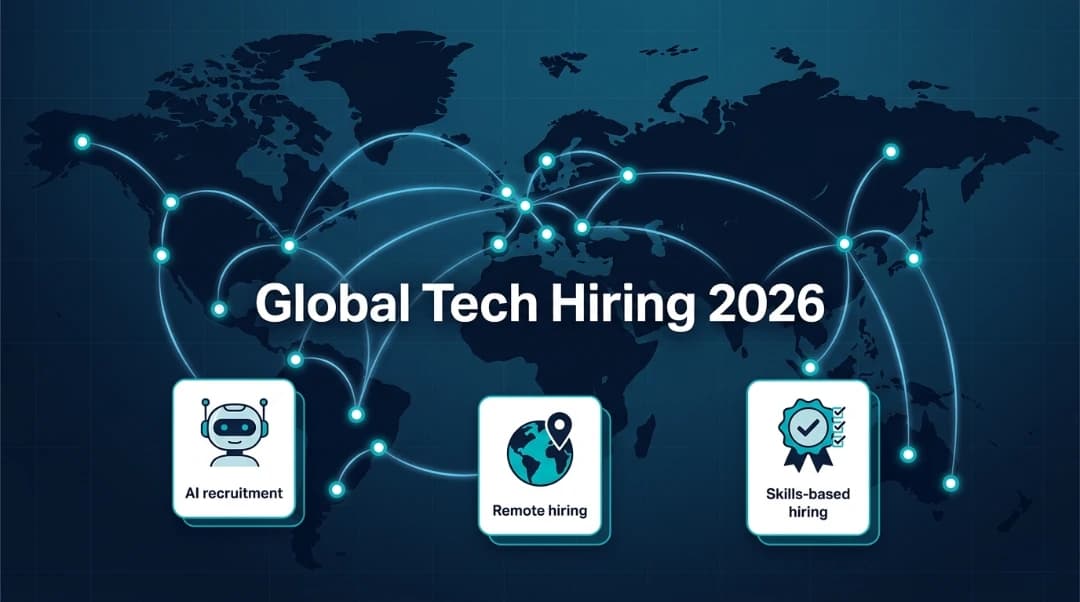
Remote-first hiring models are now standard practice for global tech teams, expanding the talent pool beyond geographic limits.
AI-powered screening tools and skills-based assessments are replacing traditional resume reviews in modern IT recruitment.
Companies that invest in technical staffing services and strategic talent pipelines are significantly outperforming competitors in tech hiring outcomes.
1. Remote-First Hiring Has Become the Global Standard
Gone are the days when hiring technology professionals meant sourcing candidates within commuting distance. Remote work permanently changed the geography of talent. In 2026, the majority of enterprise technology roles are being filled through distributed team models, with companies sourcing talent across continents without compromising on collaboration or productivity.
This shift toward borderless hiring creates a major advantage for businesses willing to adapt their hiring processes. Global talent hiring now means accessing highly skilled engineers, data scientists, and cloud specialists in markets where demand is lower and quality is high. Countries across Southeast Asia, Eastern Europe, and Latin America have emerged as strong talent hubs for software development and IT infrastructure roles.
For organizations looking to build competitive technology teams, the key question is no longer where the candidate lives, but whether they have the right skills and the right tools to deliver results remotely. Companies that have aligned their digital transformation strategies with distributed workforce models are reporting faster hiring cycles and lower costs per hire compared to location-bound recruitment approaches.
2. AI Is Transforming the Recruitment Process Itself
Artificial intelligence is no longer just a product category companies are hiring for. It is also fundamentally changing how the recruitment process works. AI-powered applicant tracking systems, automated screening tools, and predictive hiring platforms are enabling talent teams to evaluate hundreds of candidates in the time it once took to review a handful of resumes.
According to LinkedIn's 2025 Future of Recruiting report, over 62% of talent professionals say AI tools have meaningfully improved their ability to identify qualified candidates faster. This is particularly impactful in tech hiring, where demand consistently outpaces supply and the window to secure top talent is narrow.
AI recruitment tools are being used to analyze candidate portfolios, match technical skills to job requirements, and even predict cultural fit based on behavioral data. While human judgment remains critical, AI is dramatically improving the quality and speed of shortlisting in IT recruitment trends today.
Organizations that want to stay competitive in global tech hiring trends in 2026 need to invest in AI-enhanced recruitment infrastructure now. For a closer look at how AI engineers are reshaping technical teams, explore how these professionals are redefining modern engineering operations.
3. Skills-Based Hiring Is Replacing Credential Gatekeeping
One of the most impactful shifts in the future of IT recruitment worldwide is the move away from degree requirements toward demonstrable skills. Major technology companies including Google, IBM, and Apple removed four-year degree requirements from large portions of their job listings years ago. In 2026, this trend has accelerated across the broader enterprise technology market.
Skills-based hiring evaluates candidates on what they can actually do, not where they studied. This opens the talent pipeline to self-taught developers, bootcamp graduates, and professionals who have upskilled through online platforms like Coursera, Udemy, and AWS Training. For companies hiring software developers and engineers, this is a significant shift in how talent is sourced and evaluated.
The practical implication for hiring managers is clear. Job descriptions need to be rewritten around competencies and outcomes rather than credentials and years of experience. Technical assessments, live coding challenges, and portfolio reviews are replacing GPA filters as the primary qualification criteria in trends in hiring software developers.
This approach also supports workforce diversity by removing socioeconomic barriers that traditionally filtered out strong candidates who lacked access to elite academic institutions. For companies building data and AI capabilities internally, skills-based hiring is particularly powerful because the discipline evolves faster than formal curricula can keep up with. Organizations that fail to make this shift will continue narrowing their candidate pools unnecessarily in a market where qualified talent is already scarce.
4. The Global Competition for Tech Talent Is Intensifying
The global demand for technology professionals is growing at a rate that educational pipelines cannot match. The World Economic Forum projects a global shortfall of more than 85 million tech workers by 2030 if current training and hiring trends continue unchanged. This gap is already being felt by companies in the United States, the United Kingdom, and the European Union, where experienced engineers and cloud architects command premium salaries and receive multiple competing offers.
For businesses, this means that passive recruiting strategies are no longer sufficient. Companies must actively build talent pipelines, maintain talent communities, and invest in employer branding that positions them as destinations of choice for technology professionals. Global talent recruitment strategies in 2026 include proactive engagement on developer platforms, partnerships with coding bootcamps, and structured internship-to-hire programs designed to develop the next generation of engineers.
The competition also extends to compensation structures. Equity participation, flexible work arrangements, learning stipends, and technology allowances have become standard components of competitive technology hiring offers, particularly for senior engineering and architecture roles.
Companies that partner with experienced providers for building high-performance tech teams are gaining a critical advantage in this market. Specialized staffing partners bring market intelligence, pre-qualified candidate networks, and industry-specific hiring expertise that internal HR teams often cannot match alone.
5. Workforce Planning Must Shift from Reactive to Strategic
Most organizations still approach tech hiring reactively, opening roles only when a vacancy exists or a project demands immediate headcount. In a market defined by talent scarcity, this model creates costly delays and forces companies to compromise on quality. Technology hiring trends for companies in 2026 are pointing firmly toward proactive workforce planning as a strategic business function.
Proactive workforce planning means maintaining continuous visibility into your technology talent needs six to eighteen months ahead of actual hiring. It means identifying the skill gaps that will emerge as your technology roadmap evolves and building relationships with potential candidates before roles are formally opened. It also means investing in internal reskilling and upskilling programs that reduce dependence on external hiring for every new technical requirement. Organizations that treat talent acquisition as an ongoing business capability rather than a transactional function consistently outperform peers in both hiring speed and workforce quality.
Businesses with over 20 years of experience in enterprise technology consulting recognize that talent strategy and technology strategy cannot operate in isolation. The organizations building the most resilient tech teams are the ones treating workforce planning as a continuous, data-driven capability rather than an administrative response to headcount requests.
Conclusion
The future of global tech hiring is already here. Companies that understand the shift toward remote talent models, AI-powered recruitment, skills-based evaluation, and strategic workforce planning will build stronger, more adaptable technology teams. Those that continue relying on outdated hiring frameworks will find themselves consistently losing the best candidates to more agile competitors.
IdeaGCS brings deep expertise in connecting businesses with the right technology professionals across global markets. Whether you need specialized staffing support, strategic hiring consultation, or help building a scalable tech team, we are ready to help you navigate the evolving global talent landscape. Contact us today to start building your technology workforce for the future.
Frequently Asked Questions
What are the biggest tech hiring trends in 2026?

How is AI changing IT recruitment trends?
What is skills-based hiring and why does it matter?
Why is global tech hiring becoming more competitive?
How can companies improve their global talent hiring strategy?
What industries are most affected by tech hiring challenges?
What role does remote work play in the future of IT recruitment worldwide?
How should companies attract technology professionals in a competitive market?
What is the impact of the global tech talent shortage on hiring timelines?
Why should companies partner with a specialized tech staffing provider?
Contact Us
Share on Social Media
Contact Us