The Future of Recruitment: Why RPO is Replacing Traditional Hiring Models
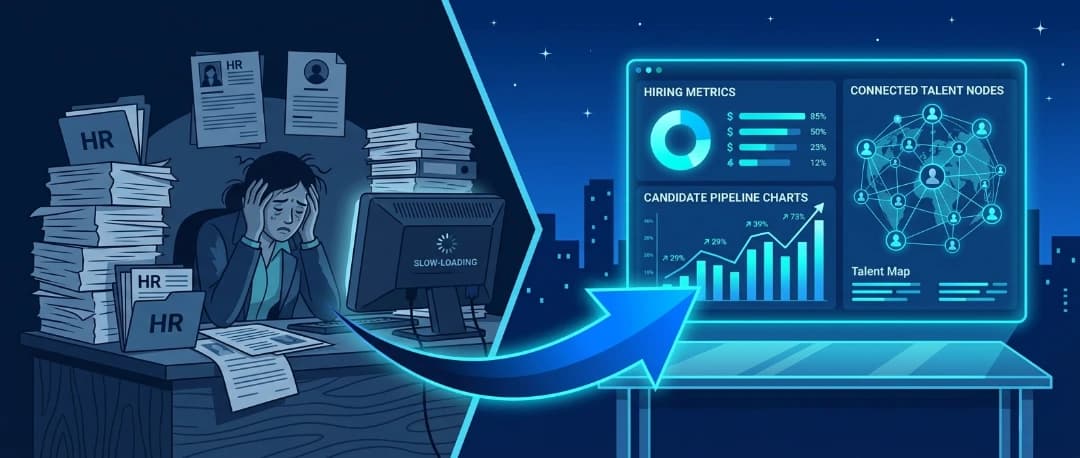
The way businesses attract and secure top talent is changing faster than most hiring teams can adapt. Traditional recruitment models, built around reactive job postings, stretched HR departments, and slow shortlisting cycles, are failing to meet the demands of a competitive, fast-moving talent market.
As a result, more organizations are turning to Recruitment Process Outsourcing (RPO) as a smarter, scalable alternative. RPO services transfer part or all of a company's recruitment function to an expert partner, delivering speed, structure, and strategic alignment. In this blog, we explore why RPO is rapidly becoming the future of talent acquisition strategy for growth-focused businesses worldwide.
Key Takeaways
RPO delivers a scalable, data-driven hiring model that outperforms traditional in-house recruitment in speed, cost, and quality.
Businesses adopting outsourcing recruitment process models gain access to dedicated pipelines, advanced hiring technology, and measurable performance outcomes.
With hiring trends in 2026 growing more competitive, RPO services are shifting from a tactical option to a strategic necessity for forward-looking organizations.
What Is Recruitment Process Outsourcing and How Does It Work?
Recruitment Process Outsourcing (RPO) is a business model in which an organization transfers all or part of its talent acquisition function to an external specialist provider. Unlike a conventional staffing agency that fills individual vacancies, an RPO partner embeds itself within the company, acting as a seamless extension of the internal HR team.
The RPO provider takes ownership of the full recruitment lifecycle. This includes building accurate job profiles, sourcing candidates across multiple channels, conducting initial screening and assessments, coordinating interviews, managing offer negotiations, and overseeing onboarding. The process is governed by agreed service levels, quality benchmarks, and reporting frameworks that give the client full transparency at every stage.
What makes RPO distinct is its strategic depth. Providers bring dedicated resources, industry-specific knowledge, and proprietary hiring technology to each engagement. This means companies are not just outsourcing a task. They are gaining a recruitment intelligence capability that most internal teams simply cannot build on their own. The model is flexible too, allowing businesses to engage RPO for a single department, a specific project, or their entire global hiring operation.
Traditional vs Modern Hiring: Why the Old Model Is Falling Short
For decades, traditional hiring meant posting a job ad, waiting for applications, filtering manually, and hoping the best candidates applied. This reactive cycle served organizations reasonably well in a slower, less competitive talent market. Today, that approach is increasingly misaligned with business reality.
In-house recruitment teams frequently struggle with high workloads, inconsistent processes, limited access to passive candidates, and a narrow view of the wider talent market. When hiring volumes surge due to expansion, new project launches, or high attrition, internal teams often lack the capacity to respond without compromising quality. The result is extended time-to-fill, inflated cost-per-hire, and candidate drop-off caused by poor experience.
Modern hiring demands agility, data, and reach. Companies need to engage candidates before roles are even posted, track performance metrics across every stage, and maintain a consistent employer brand in the market. According to research from Everest Group, organizations that adopt RPO models report up to 40% faster time-to-fill and significantly lower cost-per-hire compared to traditional in-house recruitment. The contrast between traditional vs modern hiring is no longer a matter of preference. It is a strategic divide that is reshaping competitive advantage.
Key Benefits of Recruitment Process Outsourcing for Growing Businesses
The benefits of recruitment process outsourcing extend well beyond simply delegating the hiring workload. RPO creates a structural improvement in how organizations approach talent acquisition, with measurable gains across every key performance indicator.
Scalability is perhaps the most immediate advantage. An RPO provider can rapidly scale capacity up during periods of aggressive growth and scale back during quieter cycles, without the cost or disruption of hiring and releasing internal recruiters. This elasticity is especially valuable for businesses navigating rapid market expansion or seasonal workforce peaks.
Access to talent is another critical benefit. RPO providers maintain active talent pipelines, broad sourcing networks, and expertise in engaging passive candidates who are not actively applying to open roles. This gives client companies a significant edge in competitive hiring markets where top candidates are rarely available through job boards alone.
Beyond speed and reach, RPO delivers consistency. Every candidate receives the same structured experience, from initial outreach through to offer, which strengthens employer brand perception and reduces the risk of bias in selection. Detailed reporting on sourcing channels, pipeline health, interview conversion rates, and time-to-hire metrics gives HR leaders the insight they need to continuously improve.
For organizations investing in digital transformation and looking to build specialized technical teams quickly, RPO provides the dedicated focus and market intelligence that drives results.
Why Companies Are Shifting to RPO in 2026
Several powerful forces are accelerating the adoption of RPO services in 2026. The talent market for technical and specialist roles remains highly competitive. Demand for professionals in areas such as artificial intelligence, cloud engineering, data science, and cybersecurity consistently outpaces supply. In this environment, businesses that rely on reactive, traditional hiring methods are losing top candidates to faster-moving competitors.
Simultaneously, cost efficiency has become a board-level priority. Economic uncertainty and pressure to optimize operating budgets are pushing HR leaders to evaluate every function for efficiency. Outsourcing recruitment process functions to an RPO provider replaces unpredictable hiring costs with structured, performance-based investment models that are far easier to forecast and manage.
Data is also reshaping expectations. Modern HR leaders want hiring to be as measurable and accountable as any other business function. RPO providers deliver exactly that, with real-time dashboards, analytics on sourcing effectiveness, and regular performance reviews that connect recruitment activity directly to business outcomes.
IdeaGCS brings over 20 years of experience in technical staffing and IT talent solutions, helping organizations across the USA and globally build high-performance teams aligned with their technology roadmap. As hiring trends in 2026 continue to evolve, IdeaGCS partners with businesses to deliver scalable hiring solutions that go beyond filling vacancies to building lasting workforce capability.
RPO vs In-House Recruitment: Choosing the Right Model
The decision between RPO and in-house recruitment is not one-size-fits-all. For small organizations with stable, low-volume hiring needs, an internal recruiter or small HR team may remain sufficient. However, for companies experiencing growth, entering new markets, or competing for specialized technical talent, in-house recruitment quickly reaches its limits.
In-house recruiters, even highly skilled ones, are constrained by the tools, networks, and capacity available within the organization. They often manage multiple HR responsibilities alongside recruitment, leaving limited bandwidth for the deep candidate engagement and market mapping that competitive hiring demands.
RPO models remove these constraints. An RPO partner brings a full team of dedicated specialists, each focused on specific roles or functions, supported by enterprise-grade technology and access to a vast candidate ecosystem. The model also introduces accountability frameworks that are difficult to replicate in-house, with service-level agreements, performance metrics, and continuous improvement built into the partnership from day one.
For organizations leveraging data and AI capabilities to drive business decisions, RPO providers that incorporate AI-powered sourcing and predictive analytics into their process offer a particularly compelling advantage, reducing time-to-hire while improving the quality and retention of hires.
The Future of Talent Acquisition Strategy Starts with RPO
Recruitment is no longer a back-office function. It is a strategic driver of business performance, innovation, and competitive positioning. Organizations that treat talent acquisition as a core capability, rather than an administrative task, are consistently outperforming those that do not.
The future of recruitment belongs to models that are proactive, data-driven, and scalable. Recruitment Process Outsourcing delivers exactly that. As businesses grow more complex and talent markets grow more demanding, the case for RPO services strengthens every year. Whether a company is scaling a technology team, entering a new geography, or transforming its workforce for the digital era, RPO provides the expertise and infrastructure to make it happen efficiently and at pace.
IdeaGCS is a trusted technology and talent partner with over two decades of experience supporting businesses across the USA and beyond. Our approach to technical staffing and talent solutions is grounded in strategic alignment, deep market knowledge, and measurable results.
Contact IdeaGCS today to learn how our talent acquisition expertise can help your organization build the teams it needs for 2026 and beyond.
Frequently Asked Questions
What is Recruitment Process Outsourcing (RPO)?

How is RPO different from using a traditional staffing agency?
What are the main benefits of recruitment process outsourcing?
Is RPO suitable for small and mid-sized businesses?
How does RPO reduce cost-per-hire compared to in-house recruitment?
What industries benefit most from RPO services?
How long does it take to implement an RPO model?
Can RPO providers handle technical and IT-specific hiring?
What metrics do RPO providers typically track and report?
How does RPO align with long-term talent acquisition strategy?
Contact Us
Share on Social Media
Contact Us