RPO Recruitment Strategies for Building High-Performing Teams

Building high-performing teams is the single greatest challenge facing enterprises in 2026. RPO recruitment stands for recruitment process outsourcing, and it has become the strategic solution that enables organisations to move beyond reactive hiring and build scalable talent pipelines aligned to long-term business growth. Companies operating across the UK, India, US, UAE, and Philippines are increasingly turning to specialist RPO providers to reduce cost-per-hire, accelerate time-to-fill, and consistently attract top-tier talent in competitive markets. This guide covers the essential RPO recruitment strategies that HR leaders, CHROs, and talent acquisition heads are applying right now to transform their hiring outcomes.
Key Takeaways
- RPO recruitment transforms talent acquisition from a reactive function into a strategic, data-driven operation that builds continuous talent pipelines aligned to business growth
- Strategic RPO models reduce cost-per-hire by up to 40% while improving candidate quality and 90-day retention rates compared to traditional in-house or agency-led hiring
- IdeaGCS delivers end-to-end RPO recruitment services across the UK, India, US, UAE, and Philippines, tailored to your hiring goals, growth requirements, and target geographies
RPO Recruitment: Strategy vs Tactical Hiring
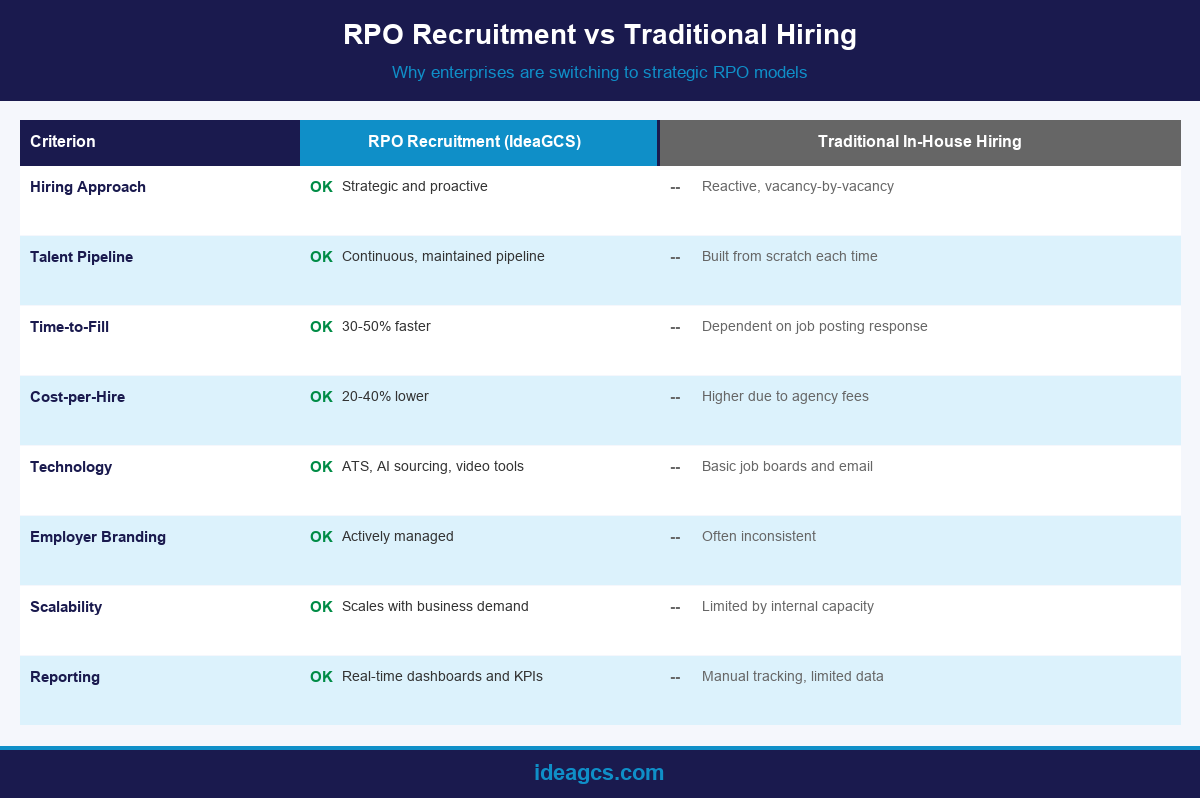
Most organisations approach hiring reactively. A vacancy opens, a job description gets posted, candidates are screened, and an offer is made. This tactical model works adequately for isolated roles but breaks down at scale. When multiple roles open simultaneously, when niche skills are required, or when business growth accelerates faster than internal HR capacity can absorb, reactive hiring produces poor outcomes: extended time-to-fill, inflated agency fees, and a revolving door of underqualified placements that cost the business far more than the recruitment spend alone.
RPO recruitment replaces this model with a strategic, embedded approach. Rather than responding to immediate vacancies, an RPO partner integrates within your organisation to understand your workforce planning goals, pipeline requirements, compensation benchmarks, and employer brand positioning. The result is a continuous, proactive talent function that operates in full alignment with your broader business strategy rather than lagging behind it.
What Makes RPO Recruitment Strategic
Strategic RPO recruitment is defined by three characteristics: advance workforce planning, continuous talent pooling, and data-led decision-making. Rather than waiting for headcount approval to begin sourcing, an RPO partner maintains active candidate pipelines for your most critical roles. When a vacancy arises, qualified candidates are ready to interview within days rather than weeks. This requires the RPO provider to understand your business at a level that goes well beyond reading a job description. They must know your growth markets, technical skill requirements, organisational culture, and long-term talent goals. IdeaGCS begins every engagement with a strategic discovery phase that maps your entire hiring ecosystem before any sourcing activity begins.
The Shift from Reactive to Proactive Hiring
Reactive hiring costs more, takes longer, and produces lower-quality outcomes at every stage. Research from Deloitte's Global Human Capital Trends consistently demonstrates that organisations with proactive talent strategies fill roles significantly faster than those relying on reactive recruitment. The shift to a proactive model requires moving budget, planning, and accountability for talent into a dedicated, structured function. That is precisely what a well-designed RPO recruitment engagement delivers when implemented by an experienced provider who understands your sector and markets.
Key Stages of an RPO Recruitment Cycle
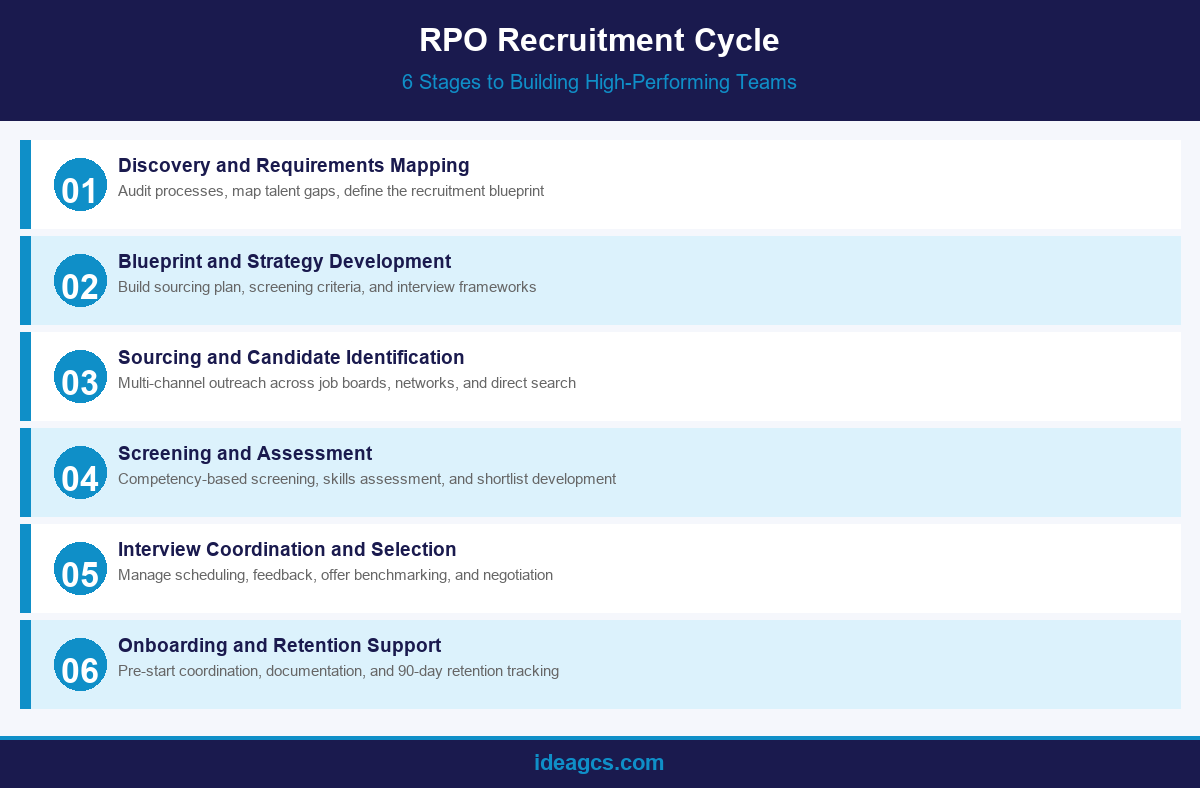
Every effective RPO recruitment engagement follows a structured cycle that covers the full hiring journey from initial requirements through to onboarding and long-term retention. Understanding each stage helps organisations set realistic expectations, assign clear accountability, and measure performance accurately against agreed benchmarks. The cycle is also iterative: as each cohort of hires moves through the process, learnings are captured and applied to future sourcing activity, continuously improving outcomes over the lifetime of the engagement.
Discovery and Requirements Mapping
The cycle begins with a structured discovery phase. Your RPO partner conducts a thorough audit of your existing hiring processes, technology stack, talent gaps, compensation benchmarks, and organisational culture. This stage produces a recruitment blueprint: a documented plan covering sourcing channels, screening criteria, interview frameworks, offer benchmarks, and onboarding timelines for every role type within the engagement scope. IdeaGCS engages directly with hiring managers, HR business partners, and C-suite stakeholders during this phase to ensure every requirement is captured with precision before any sourcing campaign launches.
Sourcing, Screening, and Selection
With the blueprint approved, sourcing begins across multiple channels simultaneously: job boards, professional networks, referral programmes, talent databases, direct outreach campaigns, and community forums relevant to your target roles and geographies. Each candidate is screened against agreed competency criteria using structured frameworks that remove subjectivity and improve consistency across all hiring managers. Shortlisted candidates progress through coordinated interview stages managed entirely by the RPO team, removing the administrative burden from your internal HR function and allowing hiring managers to focus on evaluating final-stage candidates rather than coordinating logistics.
Onboarding and Retention Support
The strongest RPO engagements extend beyond offer acceptance. IdeaGCS supports onboarding by coordinating pre-start communications, right-to-work verification, system access requests, and induction scheduling on behalf of the client. We also track 90-day retention rates as a core performance metric, holding ourselves directly accountable for long-term placement quality rather than simply placement speed. This accountability structure aligns the RPO partner's incentives with the client's, ensuring quality remains at the centre of every hiring decision throughout the engagement.
Technology Stack in Modern RPO: ATS, AI Sourcing, and Video Interviews
The technology underpinning a modern RPO recruitment operation has transformed considerably over the past three years. Organisations achieving the strongest hiring outcomes are those whose RPO partners deploy a comprehensive, integrated technology stack covering not just applicant tracking but sourcing intelligence, candidate engagement automation, structured assessment, and real-time performance reporting. Technology does not replace the human judgement that quality hiring requires, but it dramatically extends the reach, speed, and consistency of every stage in the RPO recruitment cycle.
Applicant Tracking Systems in RPO
An Applicant Tracking System serves as the operational backbone of any RPO engagement. It centralises candidate data, tracks application status across multiple roles simultaneously, manages interview pipelines, coordinates feedback workflows, and generates the performance data that informs ongoing strategy. Leading enterprise ATS platforms offer the flexibility and integration capability that complex, multi-geography RPO engagements demand. When evaluating an RPO provider, confirm that their ATS integrates cleanly with your existing HRIS, payroll systems, and ERP platforms. Disconnected systems create data gaps that slow hiring decisions and reduce the real-time visibility that senior stakeholders rely on for accurate headcount planning.
AI-Powered Sourcing and Video Interviewing
Artificial intelligence is reshaping candidate sourcing within RPO recruitment. AI sourcing tools scan professional networks, public databases, and passive candidate communities to identify individuals who match your target profile but are not actively applying. These tools compress the time required to build a quality longlist from weeks to hours. Video interview platforms add further efficiency by enabling candidates across global markets to complete structured initial interviews asynchronously, eliminating scheduling friction for international hiring while maintaining assessment consistency. IdeaGCS integrates these tools within the technical staffing services it delivers across all five target markets, ensuring technology capability is matched to each client's specific hiring context.
Building a Talent Pipeline Through RPO
The most strategically valuable output of any mature RPO engagement is a live, continuously maintained talent pipeline. This pipeline represents a curated pool of pre-qualified candidates who have expressed genuine interest in the organisation, been assessed against the hiring criteria, and are actively kept warm through regular engagement activity. When a vacancy arises, the RPO team activates candidates from the pipeline rather than beginning a cold search, reducing time-to-hire by 60 to 70 percent in mature programmes and delivering significantly higher offer acceptance rates because candidates already know and trust the employer brand before the formal hiring process begins.
Proactive Talent Pooling
Building a meaningful talent pool requires consistent, disciplined outreach that is not tied to specific open vacancies. An RPO partner runs ongoing sourcing campaigns designed to identify and engage high-potential candidates in target disciplines and geographies regardless of whether a role is currently open. These candidates are assessed, profiled, and added to a structured pipeline that is reviewed and refreshed at regular intervals. Over time, this pool becomes one of the organisation's most valuable recruiting assets. The investment compounds: every month the pool grows, the speed and quality of future hires improves, and the cost of each subsequent placement decreases.
Nurturing Passive Candidates
Passive candidates represent the majority of the working population in most professional disciplines. Reaching them requires a fundamentally different approach to engaging active job seekers. RPO partners use personalised outreach sequences, industry event engagement, thought leadership content, LinkedIn campaigns, and targeted advertising to build genuine relationships with passive candidates over months. The return on this investment is realised when a senior or niche role opens: rather than beginning a cold search and competing against every other employer in the market simultaneously, the RPO team activates a pre-warmed pipeline of candidates who already know the brand and are ready to engage without lengthy relationship-building delays.
RPO Metrics That Matter: Time-to-Fill, Cost-per-Hire, and Quality of Hire
Effective RPO recruitment is accountable recruitment. The right partner establishes clear, measurable performance metrics at the outset of every engagement and reports against them transparently throughout the partnership. Organisations that fail to define and monitor hiring metrics lose the ability to distinguish strong RPO performance from weak performance, to identify where investment is generating return, and to hold their provider accountable for outcomes rather than activity. The right metrics framework also provides the evidence base for renewing, expanding, or adjusting the engagement scope as business requirements evolve.
The Three Core RPO Performance Indicators
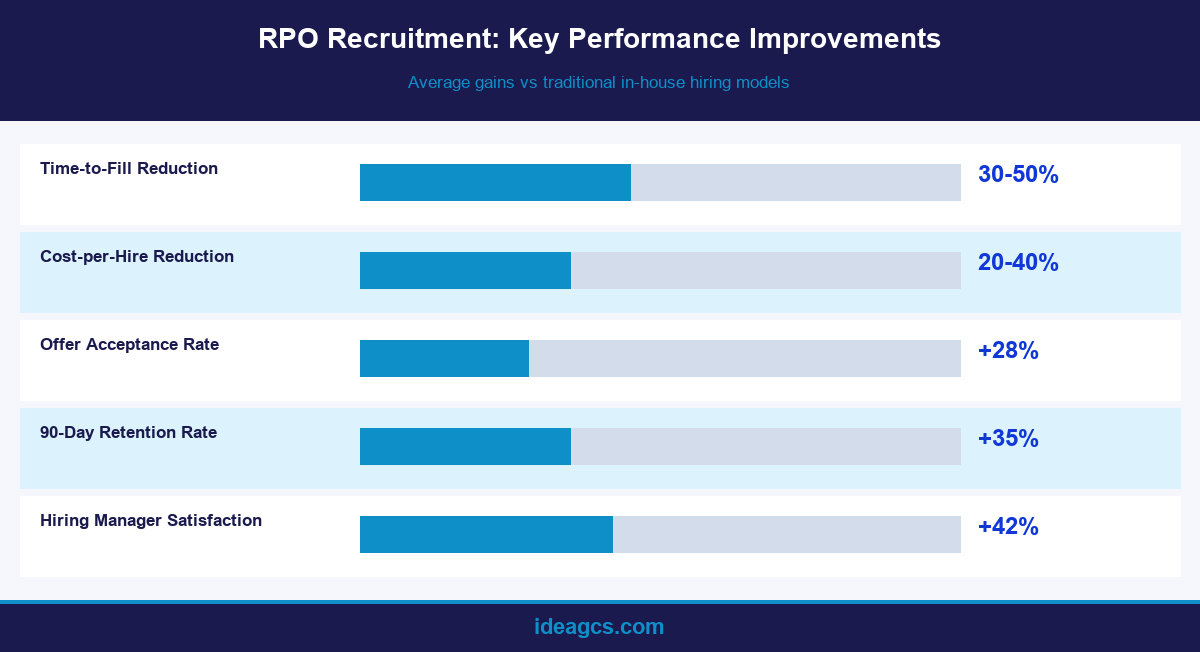
Time-to-fill measures the number of days from vacancy approval to accepted offer. According to SHRM talent acquisition benchmarking data, organisations with mature RPO partnerships typically achieve 30 to 50 percent reductions in time-to-fill within the first six months of the engagement. Cost-per-hire captures all direct and indirect costs associated with filling a role, including sourcing spend, recruiter time, assessment tools, interview logistics, and onboarding administration. RPO recruitment consistently delivers cost-per-hire reductions of 20 to 40 percent compared to traditional in-house or agency-led models. Quality of hire combines first-year performance ratings, 90-day retention rates, and hiring manager satisfaction scores to assess the long-term value of each placement, and represents the metric that matters most to sustained organisational performance.
Benchmarking Against Industry Standards
Without market benchmarks, internal metrics have no external context. A strong RPO partner provides comparative benchmarking data drawn from their broader client portfolio, enabling the organisation to assess how its hiring performance compares to peers of similar size, sector, and geographic scope. This benchmarking informs continuous improvement decisions: where to invest, where to streamline, and where performance gaps represent risk to the business. IdeaGCS provides quarterly performance reviews covering all agreed metrics alongside market benchmarking data, ensuring clients always know exactly how their RPO programme is performing relative to industry norms across each of their hiring markets.
RPO for Niche and Hard-to-Fill Roles
Some roles are consistently difficult to fill through standard recruitment channels. Technical specialists, senior leadership positions, compliance experts, and roles in high-demand global markets require a more focused approach. This is where specialist RPO recruitment delivers its most disproportionate value relative to traditional alternatives. Organisations that struggle most with niche hiring are typically those relying on reactive, generalist recruitment models that treat all roles identically regardless of their complexity, seniority, or market availability. An experienced RPO partner recognises that niche hiring demands different sourcing strategies, different candidate relationship models, and often a longer time horizon for building the pipeline required to fill specialised positions consistently.
Technical and Specialist Hiring Challenges
Technology, data science, AI engineering, and compliance roles attract intense competition across every market IdeaGCS serves. Candidates with in-demand technical skills receive multiple unsolicited approaches weekly, have strong awareness of their market value, and make employment decisions based on factors well beyond base salary, including remote working flexibility, career development trajectory, and employer reputation. Filling these roles through standard job posting achieves limited results. RPO recruitment replaces this approach with a direct sourcing model in which specialist recruiters with genuine sector knowledge actively map the talent landscape, build sustained relationships with key individuals, and introduce candidates at the right moment in their career journey rather than relying on inbound applications alone.
Market-Specific Sourcing Strategies
Each of IdeaGCS's target markets presents distinct sourcing dynamics that require tailored strategies rather than a single uniform methodology applied across all geographies. The UK talent market is highly competitive for technology, finance, and compliance roles, with strong demand from both domestic and international employers. India offers deep technical talent pools at competitive rates but requires sophisticated screening frameworks to identify the top tier within a large candidate population. The UAE has specific compliance requirements around work permits that must be navigated carefully. The Philippines represents a strong market for outsourced support and customer-facing roles, with a well-educated, English-speaking talent pool and established RPO delivery infrastructure that IdeaGCS leverages for its clients.
Employer Branding Within an RPO Recruitment Model
Employer branding is no longer a marketing function. It is a talent acquisition function, and it sits at the heart of every effective RPO recruitment strategy. In competitive talent markets, candidates evaluate employers extensively before they apply. They read reviews, explore company pages, scrutinise social media presence, and seek out employee testimonials, forming strong opinions about an organisation's culture and values before a recruiter makes first contact. The quality of your employer brand directly determines the volume and calibre of candidates that your RPO partner can engage across every sourcing channel deployed on your behalf.
Why Employer Brand Directly Affects RPO Outcomes
Strong employer brands attract higher volumes of inbound applications, reduce time-to-fill for most role types, and substantially improve offer acceptance rates. Research published by LinkedIn Talent Solutions consistently shows that organisations with strong employer brands achieve significant reductions in cost-per-hire and meaningful improvements in employee retention compared to employers with weak or inconsistent employer brand positioning. For an RPO partner, a client with a strong employer brand is considerably easier to recruit for: candidates are pre-disposed to consider opportunities with an employer they already admire, which compresses the relationship-building phase and accelerates time-to-hire across all role types and seniority levels.
Building Brand Presence Across Target Markets
IdeaGCS supports employer brand development as an integrated component of every RPO engagement. This includes optimising job descriptions to authentically reflect culture and values, coaching hiring managers on delivering consistent messaging during interviews, developing candidate-facing content that clearly articulates the employee value proposition, and managing the end-to-end candidate experience from first contact through to offer acceptance and onboarding. Across markets such as the UK, India, and UAE, where competition for senior and technical talent is particularly intense, employer brand investment delivers measurable improvements in RPO programme performance and represents one of the highest-return activities within any organisation's broader talent acquisition strategy.
IdeaGCS RPO Recruitment Methodology
IdeaGCS delivers end-to-end RPO recruitment services for organisations scaling across the UK, India, US, UAE, and Philippines. Our methodology is built on three foundational pillars: deep client partnership that goes beyond a transactional supplier relationship, technology-enabled sourcing that extends the reach and speed of every hiring campaign, and continuous performance optimisation that ensures each successive hiring cycle delivers better outcomes than the last. We bring specialist in-market expertise to every geography we serve, ensuring clients benefit from local talent intelligence alongside the operational consistency and reporting transparency of a professionally managed RPO engagement.
Our End-to-End RPO Approach
Every IdeaGCS RPO engagement begins with a dedicated discovery phase in which we map hiring requirements, workforce planning goals, current process gaps, and employer brand positioning across all target markets. We then deploy a specialist recruitment team with genuine in-market expertise for each geography, supported by an integrated technology stack that provides full pipeline visibility at every stage. We manage sourcing, screening, interview coordination, offer management, and onboarding support, giving the internal HR team real-time reporting dashboards and quarterly performance reviews. Whether the requirement is ten hires or a hundred, our model scales to meet it without compromising quality or speed. Explore the full scope of our about IdeaGCS and our approach to RPO to understand how we structure each engagement.
Why Organisations Choose IdeaGCS for RPO Recruitment
Organisations that partner with IdeaGCS for RPO recruitment consistently report measurable improvements in the metrics that matter most: faster time-to-fill, lower cost-per-hire, and higher quality of hire against pre-engagement baselines. More importantly, they gain a strategic partner that understands their business, advocates for their employer brand in the talent market, and builds the pipelines that power sustained growth across multiple geographies. Our clients benefit from a single, accountable RPO partner with both the geographic reach and the sector expertise to deliver across all hiring markets simultaneously. To discuss your RPO requirements, contact IdeaGCS today and we will arrange a discovery call with our RPO team.
Conclusion
RPO recruitment is no longer a cost-cutting measure. It is a strategic investment in your organisation's most important competitive asset: its people. From proactive talent pooling and AI-powered sourcing to employer brand development and market-specific hiring strategies, a well-designed RPO recruitment model transforms how organisations build high-performing teams at every level of seniority and across every geography they operate in. IdeaGCS brings the expertise, technology, and strategic commitment to make this transformation a reality for enterprises operating across the UK, India, US, UAE, and Philippines. Explore our RPO services or contact our team today to begin building the talent foundation your business needs to grow.
Frequently Asked Questions
What is RPO recruitment and how does it work?

What are the main benefits of RPO recruitment for enterprises?
How does RPO recruitment differ from using a staffing agency?
What RPO recruitment metrics should organisations track?
Can RPO recruitment support multi-country hiring programmes?
How long does it take to see results from an RPO recruitment engagement?
How is RPO recruitment typically priced?
How does employer branding affect RPO recruitment performance?
Is RPO recruitment suitable for small and medium-sized businesses?
What technology does IdeaGCS use in its RPO recruitment services?
Contact Us
Share on Social Media
Contact Us