OCR AI Agent Development Services: A Complete 2026 Guide

Businesses worldwide lose thousands of hours each year to manual document processing. From invoices and contracts to healthcare records and legal forms, the volume of unstructured data continues to grow with no sign of slowing. OCR AI agent development services offer a solution that goes far beyond simple text extraction. These intelligent systems read, understand, classify, and act on document data in real time. This guide covers everything you need to know about OCR AI agents: what they are, how they differ from standard OCR tools, what the development process involves, and how a dedicated development partner like IdeaGCS can build one for your specific business requirements.
Key Takeaways
OCR AI agents combine optical character recognition with machine learning to automate full document workflows, not just text extraction.
Businesses deploying OCR AI agents report significant reductions in manual processing time and data entry errors across finance, legal, and healthcare operations.
IdeaGCS delivers end-to-end OCR AI agent development services for enterprises across the UK, India, US, UAE, and Philippines.
What Is an OCR AI Agent? Definition and Evolution
Optical character recognition technology has existed for decades. Early OCR systems converted scanned text into machine-readable characters, but they required structured formats and produced frequent errors when documents were poorly scanned or varied in layout. They operated on rigid rules: if the document matched a predefined template, the extraction worked. If the document deviated from that template, the system failed and a human had to intervene.
An OCR AI agent is a fundamentally different kind of system. It combines traditional optical character recognition with large language models, computer vision, and autonomous decision-making capabilities. Rather than simply extracting text from an image, an OCR AI agent understands the meaning of a document, identifies what type of document it is, extracts the relevant data fields, validates the information against business rules, and executes the next step in a connected workflow, all without human intervention at every stage.
From Template-Matching to Contextual Understanding
The shift from rule-based OCR to agent-based document processing reflects a broader transformation in how enterprise AI is applied. Early tools required developers to build a separate extraction template for each document variant. An invoice from one supplier needed its own configuration; an invoice from a different supplier required another. Any layout deviation broke the extraction entirely. OCR AI agents learn to generalise across document variations. After training on diverse document sets, they recognise fields such as total amount due or invoice date regardless of the layout, column arrangement, or font used. This generalisation makes them scalable across hundreds of document formats without ongoing template maintenance or developer intervention.
The Agent Layer: Perception, Reasoning, and Action
The agent component refers to the autonomous action layer built on top of the OCR extraction engine. Once the system reads and validates data from a document, it can route that document to an approval workflow, populate fields in an ERP or CRM, flag anomalies for human review, or trigger downstream processes automatically. This combination of perception (reading the document), reasoning (classifying and validating its content), and action (executing the appropriate next step) defines a true OCR AI agent and separates it categorically from basic extraction software. IdeaGCS's broader AI and data services portfolio places OCR AI agents within a wider intelligent automation strategy that covers data pipelines, analytics, and enterprise integration.
How OCR AI Agents Differ from Standard OCR Tools
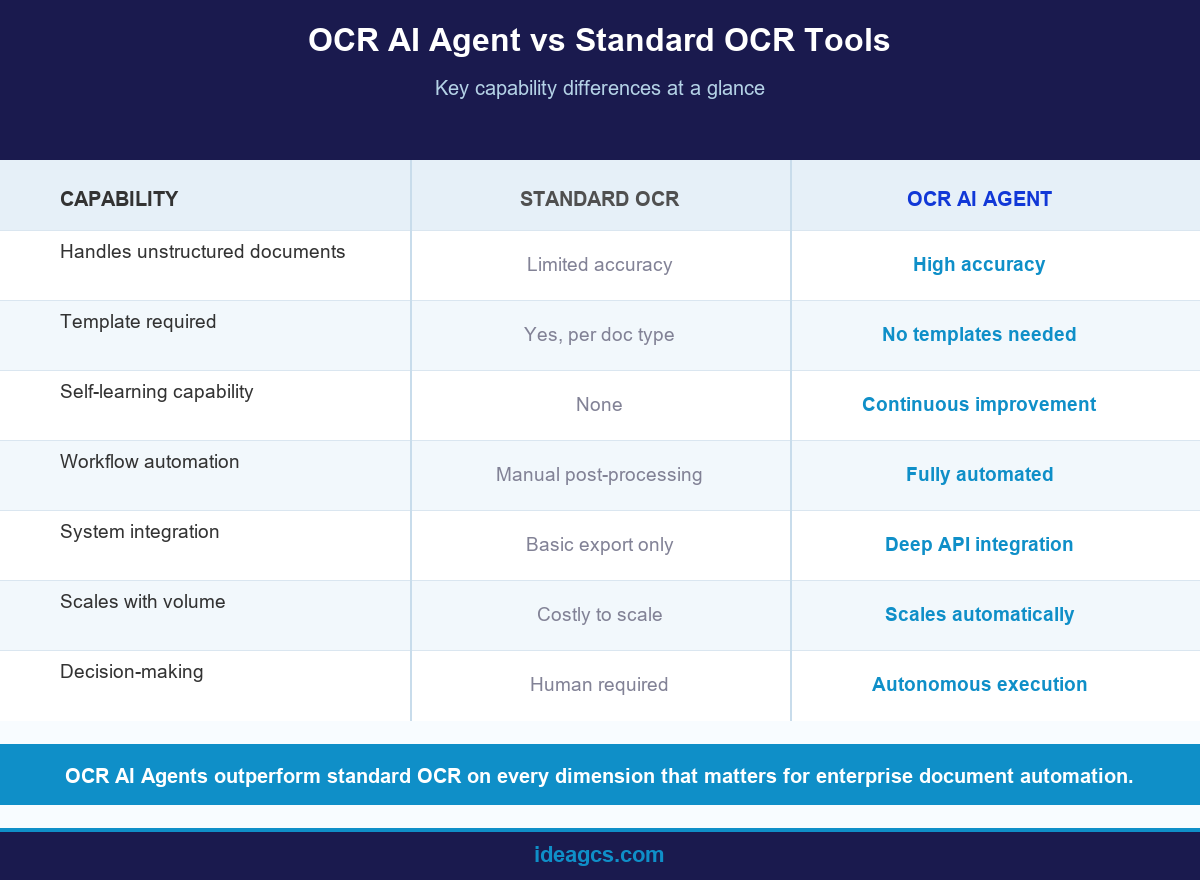
The difference between an OCR AI agent and a standard OCR tool is not simply a matter of technical sophistication. It fundamentally changes what is possible for businesses trying to automate document-heavy operations at scale. Standard OCR converts an image of text into a digital string. It requires clean formatting, consistent layouts, and considerable human post-processing to validate, classify, and act on whatever was extracted.
Accuracy Across Unstructured and Variable Documents
Standard OCR performs reliably on clean, printed text in known and consistent formats. Accuracy declines sharply when documents are handwritten, poorly scanned, multi-column, or variable in their structure. OCR AI agents use computer vision and transformer-based document understanding models specifically trained to handle variability. They process a scanned handwritten form, a multi-page PDF invoice, and a photographed receipt with consistently high accuracy. Critically, as they process more documents in production, they continue to improve through reinforcement learning pipelines, meaning accuracy increases over time rather than degrading as new document formats are introduced by suppliers or partners.
Decision-Making Without Human Handoff
A standard OCR tool stops at extraction. An operator must then take the extracted text, check it for accuracy, enter it into a business system, and route it manually to the next step in the process. OCR AI agents eliminate this human handoff entirely. They classify the document type, extract structured data from the correct fields, cross-validate extracted values against connected databases or business rules, and execute the next action in the workflow automatically. A finance processing agent, for example, reads an invoice, matches it to a purchase order record, verifies it against a supplier database, and submits it for payment approval without any human involvement in the chain. The infographic below summarises the key capability differences between standard OCR and OCR AI agents.
Key Capabilities: Self-Learning, Context Understanding, Workflow Automation
OCR AI agents deliver enterprise value through three interconnected capabilities. Each one contributes to a system that improves with use, integrates with existing infrastructure, and handles the full document lifecycle from arrival to completed action. Understanding these capabilities is central to evaluating whether an intelligent document processing investment aligns with your operational priorities and is ready for production deployment.
Self-Learning and Continuous Improvement
Unlike static OCR templates that require manual updates whenever a new document format appears, OCR AI agents improve with use. They are initially trained on labelled document datasets and continue to learn from operational corrections and new document variations encountered in production. When a human reviewer corrects an extraction error, the agent uses that feedback to recalibrate its extraction logic for similar documents in the future. Over months of live deployment, extraction accuracy increases and exception rates decline. This self-learning loop reduces ongoing maintenance overhead and means the system becomes more capable as your document library grows, rather than requiring constant developer intervention to keep pace with changing formats.
Context Understanding and Semantic Extraction
Modern OCR AI agents use natural language processing to understand the meaning of document content, not just the characters printed on the page. They distinguish between a payment date and an invoice date that appear on the same document. They extract line items from complex tables, identify signatory names from free-form text, interpret abbreviations and regional number formats, and categorise document sections by their semantic purpose rather than their position on the page. This contextual layer is especially critical in industries like healthcare and legal services, where terminology is precise and extraction errors carry significant regulatory or financial consequences for the organisation.
End-to-End Workflow Automation
Beyond reading and interpreting documents, OCR AI agents integrate with existing enterprise systems to complete the full processing lifecycle. A document processing agent connects to an ERP, CRM, or document management platform through REST APIs or system-specific connectors. Once data is extracted and validated, it is pushed directly to the correct destination: a purchase order record, a patient file, a contract database, or an approval queue. This end-to-end automation eliminates manual re-keying, reduces processing latency from days to minutes, and creates a complete, auditable digital trail of every document the system touches.
Business Problems OCR AI Agents Solve
Organisations across every industry face a shared operational challenge: growing document volumes, limited staff to process them, and mounting costs from errors and delays. Our earlier article on why manual document processing slows down businesses covers the cost of inaction in detail. OCR AI agent development services address these problems at the root, delivering measurable operational improvements from the first months of deployment.
Manual Data Entry and Processing Backlogs
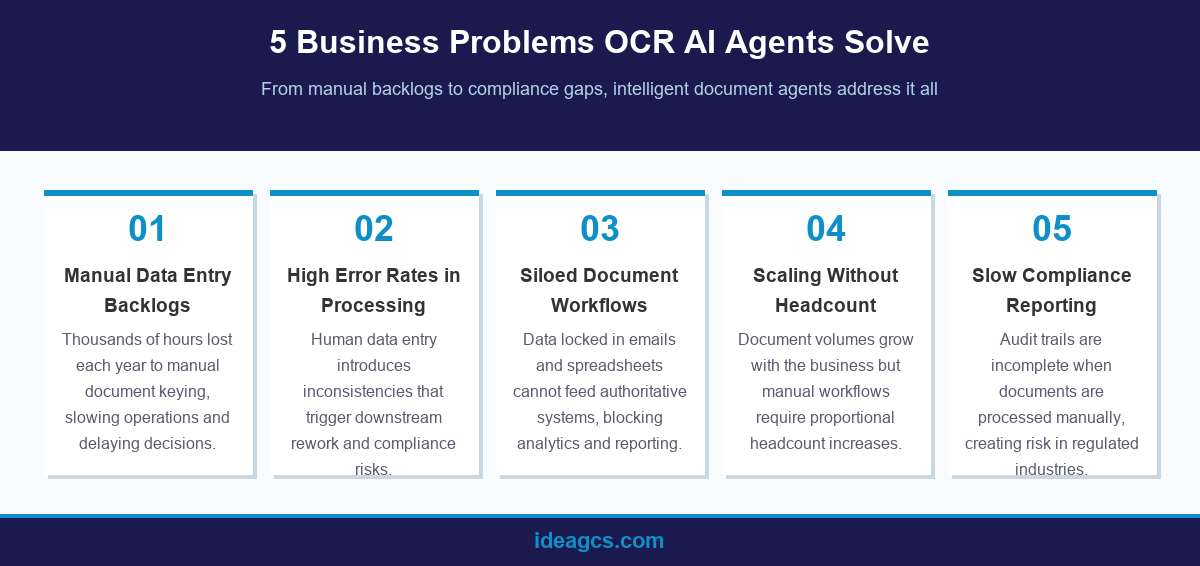
In many organisations, accounts payable teams spend the majority of their working hours manually entering invoice data from supplier documents. Legal departments process contracts with copy-and-paste workflows that introduce errors and slow deal cycles. HR teams key in candidate details from CVs and onboarding forms, creating data quality issues that affect downstream systems. Each of these activities carries a real cost: labour time, processing delay, and the consistent risk of human error. OCR AI agents replace this manual effort with automated extraction, classification, and routing. Staff are freed to handle exceptions and high-value decisions rather than spending time on data entry that a machine performs with far greater consistency and speed.
Data Quality Issues and Siloed Workflows
When documents are processed manually, extracted data frequently lives in emails, shared spreadsheets, and local drives rather than the authoritative business systems where it belongs. This creates information silos that slow reporting cycles, complicate audit preparation, and introduce inconsistency across interconnected systems. OCR AI agents extract structured data directly into systems of record, ensuring every processed document generates a consistent, machine-readable output. Downstream analytics, compliance reporting, and system integrations become reliable and accurate. Businesses that deploy intelligent document agents consistently report improvements in data quality alongside gains in processing speed and operational cost efficiency.
Scaling Document Operations Without Proportional Headcount
Growth creates document volume. As a business expands its supplier base, customer contract portfolio, patient records, or loan applications, document processing overhead scales proportionally. With manual workflows, this means hiring. With an OCR AI agent, the same system handles ten documents or ten thousand with equal efficiency and no proportional increase in cost. Peak periods such as financial year-end, contract renewal seasons, or high-volume onboarding cycles become manageable without temporary staffing or significant operational disruption. The infographic below identifies the five most common business problems that OCR AI agents solve for enterprise clients.
The Development Process: From Requirement to Deployment
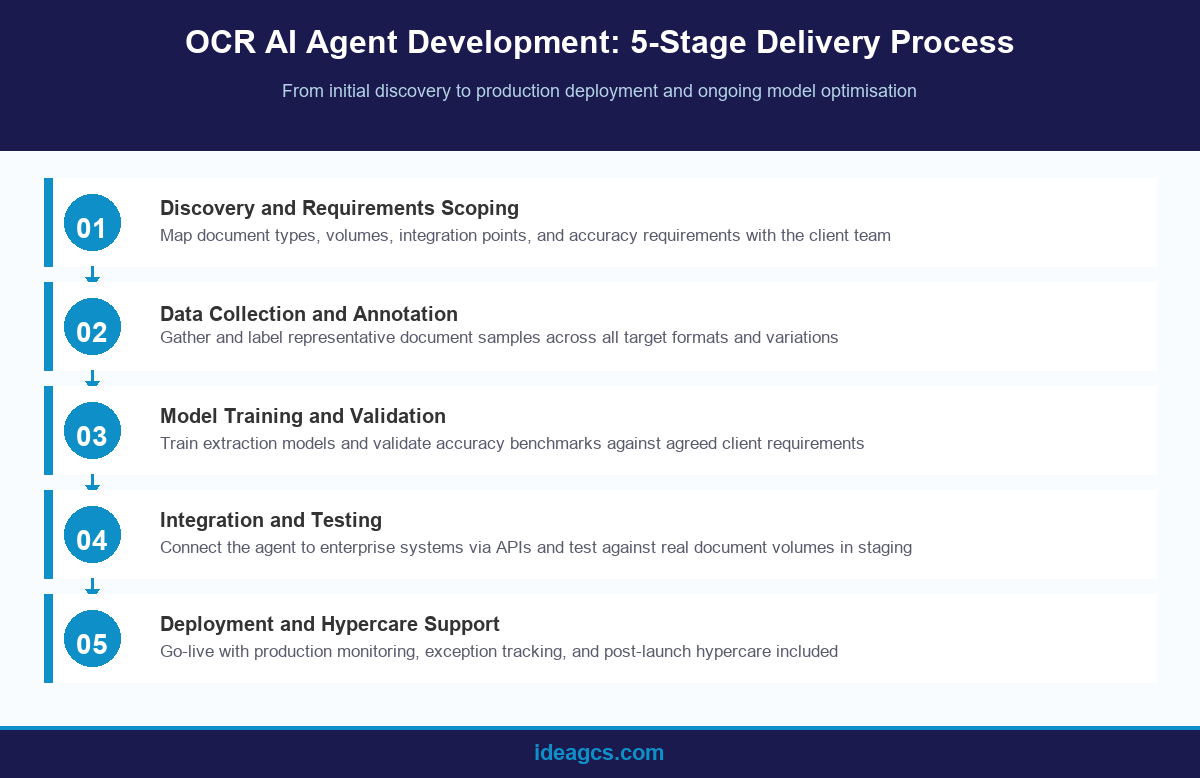
Building a production-grade OCR AI agent requires a structured development approach that addresses data quality, model accuracy, system integration, and operational stability in sequence. At IdeaGCS, the delivery process is designed to move efficiently from initial discovery through to a live, integrated system that performs against agreed accuracy benchmarks from the first day in production.
Stage 1: Discovery and Requirements Scoping
The development process begins with understanding the specific document landscape and operational context of the client. Our team maps existing document types, processing volumes, current workflows, and integration requirements. We identify the target systems the agent needs to connect with, whether SAP, Oracle, Salesforce, SharePoint, or a proprietary platform. We define the data fields to be extracted, the validation rules to be applied, and the exception-handling logic required for documents that fall outside the expected range. This scoping phase produces a detailed technical specification that guides every subsequent development and integration decision, ensuring the delivered system solves precisely the right problem.
Stage 2: Data Collection, Model Training, and Validation
OCR AI agent development requires representative training data: real document samples that cover the formats, layouts, and variations the agent will encounter in production. Our data science team annotates these document sets, trains extraction models on the annotated data, and iterates on model performance until accuracy benchmarks are met. Validation is conducted against held-out document sets that the model has not seen during training, providing an honest measure of generalisation capability. Only when model performance clears the agreed accuracy thresholds does integration development begin.
Stage 3: Integration, Testing, and Deployment
Integration connects the trained agent to the client's existing technology infrastructure through APIs or direct system connectors. Security and compliance requirements are implemented as part of the integration layer from the outset, not added retrospectively. Prior to go-live, the system is tested against real document volumes in a staging environment. Edge cases, error handling logic, and exception routing are all validated against business rules before any production deployment. Post-launch, a monitoring dashboard tracks processing volumes, exception rates, and model accuracy. A defined hypercare support period ensures the system stabilises to its expected performance level and early issues are resolved without disruption to operations.
Real-World Applications and ROI Examples
OCR AI agents are already delivering measurable operational returns for businesses across multiple industries. The following examples illustrate the breadth of application and the kinds of outcomes that structured OCR AI agent development engagements consistently produce.
Finance: Accounts Payable and Invoice Processing Automation
Finance teams processing high volumes of supplier invoices are among the most frequent adopters of OCR AI agent technology. The typical workflow involves receiving invoices in varied formats across email, supplier portals, and paper scans, followed by manual data entry into an ERP system for matching and payment approval. An OCR AI agent automates this entire workflow: reading each invoice regardless of format or supplier layout, extracting key fields such as invoice number, supplier details, line items, and total amount due, matching against purchase order records, and routing exceptions to human reviewers for resolution. Organisations implementing this workflow routinely achieve reductions in processing time per invoice of 60 to 80 percent and a material improvement in three-way match accuracy, with the investment typically recovering within one to two years at scale.
Legal: Contract Review and Clause Extraction
Law firms and corporate legal teams manage large portfolios of contracts, NDAs, and regulatory filings that vary significantly in structure and length. A purpose-built OCR AI agent for legal document processing extracts key clauses, obligation dates, party names, jurisdiction details, and termination provisions from varied contract formats without requiring a template for each agreement type. This accelerates the contract review cycle substantially, supports proactive compliance tracking across large portfolios, and enables a centralised and searchable contract database that would be impractical to build through manual effort alone. The agent flags non-standard clauses or missing mandatory provisions for attorney review, combining automation speed with the precision of human legal judgment for decisions that require it.
Healthcare: Patient Record and Clinical Document Processing
Healthcare providers and hospital networks deal with patient intake forms, referral letters, clinical notes, and insurance authorisation documents in multiple formats. An intelligent OCR agent built for this environment extracts patient demographics, clinical codes, insurance details, and provider information from incoming documents, routing the structured data directly to electronic health record systems in real time. This reduces the administrative burden on clinical staff, improves accuracy across patient records throughout the care journey, and supports compliance with healthcare data protection regulations in the relevant jurisdiction. Faster document processing directly supports patient throughput and care coordination at high-volume facilities, creating operational and clinical value simultaneously.
IdeaGCS OCR AI Agent Development Services
IdeaGCS Private Limited delivers OCR AI agent development services for enterprise clients in the UK, India, US, UAE, and Philippines. Our team combines AI engineering expertise with domain knowledge in document processing across finance, legal, healthcare, logistics, and human resources, ensuring that each solution is built around the specific document types and workflows of the client rather than a generic template.
What Sets IdeaGCS Apart
Our approach to OCR AI agent development is grounded in production outcomes rather than proof-of-concept demonstrations. Every engagement begins with a structured discovery phase to understand the real document processing challenge and the specific systems that need to be integrated. We build extraction models trained on client document sets rather than relying on generic pre-trained models that require extensive fine-tuning after handover. Our agents are designed for integration from the outset, connecting to the systems a business already uses rather than requiring workflow redesign to accommodate the technology. We also provide ongoing performance monitoring and model improvement as part of post-deployment support, ensuring accuracy continues to improve over time.
Our Development Approach and Commitment to Outcomes
IdeaGCS builds OCR AI agents using current-generation vision-language models and document understanding frameworks. Our delivery model follows structured milestones with defined test criteria and client review points at each stage. Clients receive a system that is fully documented, maintainable by the in-house team, and backed by an IdeaGCS team that understands both the technology and the business problem it solves. For organisations that need to scale document processing without scaling headcount, we provide the development expertise and ongoing support to make that a practical reality. Contact IdeaGCS to discuss your OCR AI agent project and learn how we can design a solution aligned to your specific document types, volumes, and integration requirements.
How to Get Started with OCR AI Agent Development
Starting an OCR AI agent development project does not require a lengthy procurement process or months of internal preparation. The most effective path to a working, production-grade system begins with a focused discovery engagement that clarifies the scope, integration requirements, and accuracy expectations before any development work begins.
Before engaging a development partner, it is useful to gather a representative sample of the document types you want to automate, an outline of the systems the agent will need to connect with, and an estimate of current processing volumes and error rates. This baseline does not need to be exhaustive. The IdeaGCS discovery process works through the details with your team in a structured session, but having this context accelerates scoping and produces a more accurate project estimate from the outset.
IdeaGCS conducts a structured discovery session that maps your document landscape and produces a clear project specification. The session covers document types and volumes, target extraction fields and validation rules, integration requirements, accuracy expectations, and any compliance or data security constraints that apply to your industry or region. The output is a scoped project plan with phased delivery milestones and a defined effort estimate that your team can evaluate and approve before any development commitment is made.
Many organisations choose to begin with a single document type: accounts payable invoices, supplier contracts, or patient intake forms. A focused first deployment demonstrates measurable ROI quickly, builds internal confidence in the technology, and creates an architectural foundation for expanding the agent to additional document categories without significant rework. IdeaGCS designs initial systems with future extensibility built in, so the first deployment does not constrain what comes next.
To begin, contact IdeaGCS through the website and request a discovery consultation. Our team will respond promptly to understand your requirements and outline a clear path to your first deployed intelligent document processing agent.
Conclusion
OCR AI agent development services represent a decisive step forward in how businesses manage document processing at scale. By combining optical character recognition with machine learning and autonomous workflow execution, these systems eliminate manual data entry, improve extraction accuracy, and scale operations without adding headcount. Whether the priority is accounts payable automation, contract management, healthcare record processing, or any other document-intensive workflow, a purpose-built OCR AI agent delivers consistent and measurable results. IdeaGCS provides the development expertise to build, integrate, and support production-grade systems for enterprises across four continents. Contact IdeaGCS today to start the conversation about your intelligent document automation project.
Frequently Asked Questions
What is an OCR AI agent?

How does OCR AI agent development differ from standard OCR software?
What document types can an OCR AI agent process?
How long does OCR AI agent development take?
What enterprise systems can an OCR AI agent integrate with?
What accuracy levels do OCR AI agents achieve in production?
Is OCR AI agent development suitable for mid-sized businesses?
Which industries benefit most from OCR AI agent development services?
How does IdeaGCS approach OCR AI agent development projects?
How do I get started with OCR AI agent development?
Contact Us
Share on Social Media
Contact Us