Intelligent Document Processing Explained: How AI OCR Transforms Business Operations
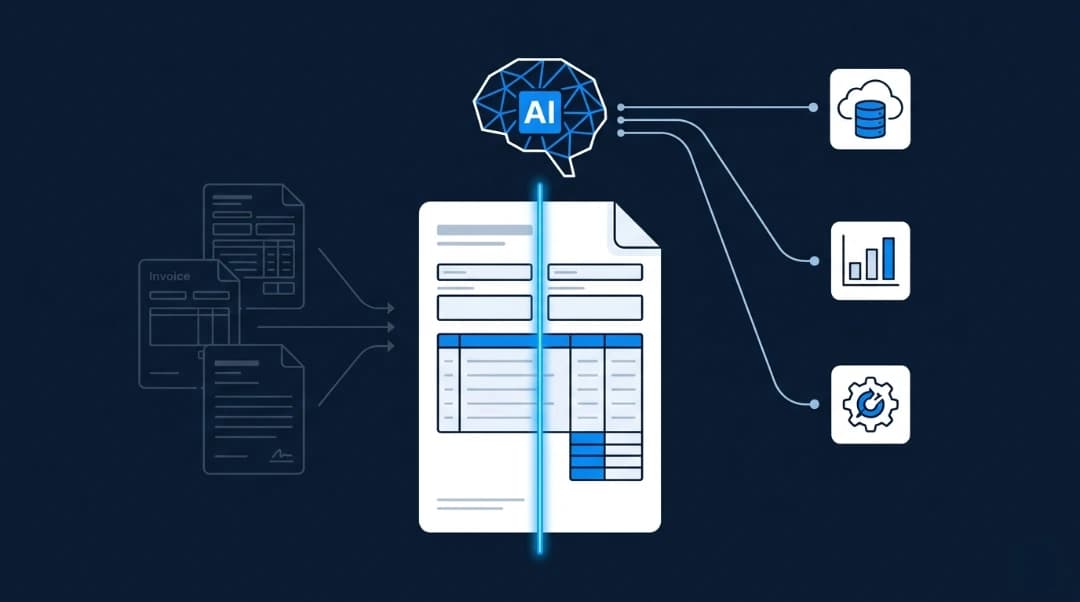
Businesses today process thousands of documents every day, from invoices and contracts to onboarding forms and compliance reports. Managing this volume manually is slow, error-prone, and costly. Intelligent document processing (IDP) solves this challenge by combining AI OCR technology, machine learning, and natural language processing to extract, classify, and act on data automatically.
In this guide, we break down how IDP works, where it delivers the most value, and how your organization can adopt document automation solutions to drive efficiency at scale.
Key Takeaways
Intelligent document processing uses AI OCR to convert unstructured data in physical and digital documents into structured, actionable information.
Automated data extraction eliminates manual entry errors, reduces processing time, and supports scalable workflows.
From OCR for invoices and forms to contract review and compliance, IDP transforms how businesses manage information end to end.
What Is Intelligent Document Processing?
Intelligent document processing is a category of automation technology that goes far beyond traditional scanning. It combines AI OCR technology, machine learning, and natural language understanding to capture, classify, and extract data from virtually any document type.
While legacy systems converted a document image into raw text, modern IDP platforms understand context. They identify document types, locate relevant data fields, validate extracted values, and route information to the correct downstream systems. Whether you are working with scanned PDFs, handwritten forms, or structured spreadsheets, IDP processes each document with a high degree of accuracy and consistency.
This makes intelligent document processing a foundational element of any serious digital transformation strategy. Rather than bolting automation onto manual processes, IDP addresses the problem at the source by eliminating the need for human intervention in routine document workflows.
How AI OCR Technology Powers Automated Data Extraction
Traditional OCR tools convert document images into text and stop there. AI OCR technology adds several layers of intelligence on top of basic character recognition, making it capable of true automated data extraction at enterprise scale.
AI-powered OCR identifies document types on receipt, locates key fields such as vendor names, invoice totals, dates, and account numbers, and extracts them into structured formats such as JSON or XML. These outputs then feed directly into business systems without any manual re-entry. What sets AI OCR apart is its ability to handle variation. Documents rarely follow a single fixed template, and AI models learn to extract the right data regardless of layout changes, different fonts, or partial scans.
For organizations generating high volumes of incoming records, this level of automated data extraction replaces hours of daily manual labor. The models also improve continuously by learning from human corrections, which means extraction accuracy increases as the system processes more documents over time. Businesses working with Data and AI Services can integrate these extraction pipelines directly into core operational systems, ensuring a seamless flow of structured data across the enterprise.
High-Impact Use Cases: OCR for Invoices, Forms, and Beyond
The applications for intelligent document processing span nearly every industry and business function. The most common and highest-impact use case is OCR for invoices and forms within accounts payable operations.
Accounts payable teams that once manually keyed line items from vendor invoices can now automate the entire capture, validation, and approval workflow. IDP reads the invoice, extracts the relevant fields, checks them against purchase orders, and submits the result for approval, all without human input for standard documents. Beyond finance, the use cases are extensive:
Insurance: Claims forms are extracted, verified, and routed to adjusters automatically.
Healthcare: Patient intake documents, referrals, and prior authorization forms are processed in seconds.
HR: Resumes, onboarding packets, and benefits enrollment forms are digitized and filed without manual effort.
Legal: Contract clauses are identified, flagged, and compared against standard templates.
Logistics: Bills of lading, customs declarations, and delivery receipts are captured and matched automatically.
Across all these scenarios, document automation solutions reduce turnaround time, lower error rates, and free staff to focus on judgment-intensive work that adds genuine business value.
The Business Case: Why IDP Delivers Strong ROI
The financial and operational case for implementing intelligent document processing is well supported by industry data. Research from McKinsey indicates that automating data collection and processing workflows can reduce back-office costs by 30 to 40 percent in document-heavy industries. For businesses processing thousands of records per month, that represents a substantial and recurring saving.
Beyond cost reduction, IDP accelerates document turnaround from days to hours or even minutes. Faster processing translates directly into faster revenue cycles, quicker customer responses, and reduced bottlenecks in approval workflows. IDP also provides a consistent audit trail for every document processed, which is critical for regulatory compliance in finance, healthcare, and insurance.
When IDP is connected to an AI-powered data pipeline, extracted data flows seamlessly into analytics platforms, ERP systems, and reporting dashboards. This enables real-time decision-making based on current information rather than batched or delayed reports. Key performance gains include:
Accuracy: AI models reduce manual data entry errors by up to 80 percent.
Speed: Automated workflows process documents in seconds, not hours.
Scalability: IDP handles volume spikes without requiring additional headcount.
Compliance: Consistent extraction ensures all regulatory requirements are met.
Integration: Structured output connects directly with ERP, CRM, and analytics tools.
How to Implement Document Automation Solutions at Scale
Successfully rolling out document automation solutions across an enterprise requires more than selecting a technology platform. The implementation approach is just as important as the tool itself.
Organizations should begin by auditing their existing document types, processing volumes, and current workflows to identify where manual effort is highest and where errors most frequently occur. Training AI models on representative samples of each document type is essential for achieving high extraction accuracy from day one. A phased rollout, starting with the highest-volume or most error-prone document process, builds organizational confidence and reduces implementation risk.
Change management is equally important. Staff need clear training on how to validate AI outputs, handle exception cases, and escalate documents that fall below confidence thresholds. Partnering with specialists in machine learning and data accuracy ensures the models are correctly tuned and validated before full deployment. When evaluating IDP platforms, look for:
Pre-trained models for common document types such as invoices, receipts, and contracts
Support for multiple file formats including PDF, TIFF, PNG, and JPEG
Human-in-the-loop review workflows for low-confidence extractions
API connectors for ERP, CRM, and workflow management systems
Real-time monitoring dashboards and model retraining capabilities
IDP as the Foundation for Business Process Automation
Intelligent document processing is not a standalone tool. It is the data ingestion layer that enables broader business process automation to function reliably. Automation workflows depend on clean, structured data as their input. When documents arrive in unstructured formats, even the most sophisticated automation breaks down at the first step.
IDP solves this by converting raw documents into structured data that downstream automation can act upon immediately. An automated invoice approval workflow, for instance, can only run reliably if the invoice data has been extracted correctly. A customer onboarding automation can only proceed if the intake form data is accurately captured and validated. By treating IDP as the entry point of the automation architecture, businesses create a scalable and reliable foundation for end-to-end business process automation.
With over 20 years of experience in enterprise IT, IdeaGCS has helped organizations across healthcare, finance, and logistics design and deploy intelligent document processing systems as part of broader automation programs. Our enterprise support services ensure your IDP implementation stays optimized, monitored, and operational as document volumes grow and business requirements evolve.
Conclusion
Intelligent document processing is no longer a capability reserved for large enterprises. With advances in AI OCR technology, automated data extraction, and document automation solutions, businesses of every size can eliminate manual document handling, reduce errors, and accelerate critical workflows. The key is to approach IDP not as a point solution but as the structured data layer that enables broader business process automation across the organization.
Whether your immediate priority is automating OCR for invoices and forms or scaling document workflows across multiple departments, the right implementation strategy makes all the difference. IdeaGCS brings the technical depth and enterprise experience to guide your organization through every stage of deployment.
Contact us today to explore how intelligent document processing can transform your operations and position your business for long-term efficiency.
Frequently Asked Questions
What is intelligent document processing?

How does AI OCR technology work?
What types of documents can IDP process?
What is automated data extraction and why does it matter?
How does IDP support business process automation?
Can IDP integrate with existing ERP and CRM systems?
What is OCR for invoices and how does it reduce errors?
How long does it take to implement an IDP solution?
What role does machine learning play in document automation solutions?
How does IDP improve regulatory compliance?
Contact Us
Share on Social Media
Contact Us