RPO vs In-House Recruitment Team: A Cost-Benefit Analysis
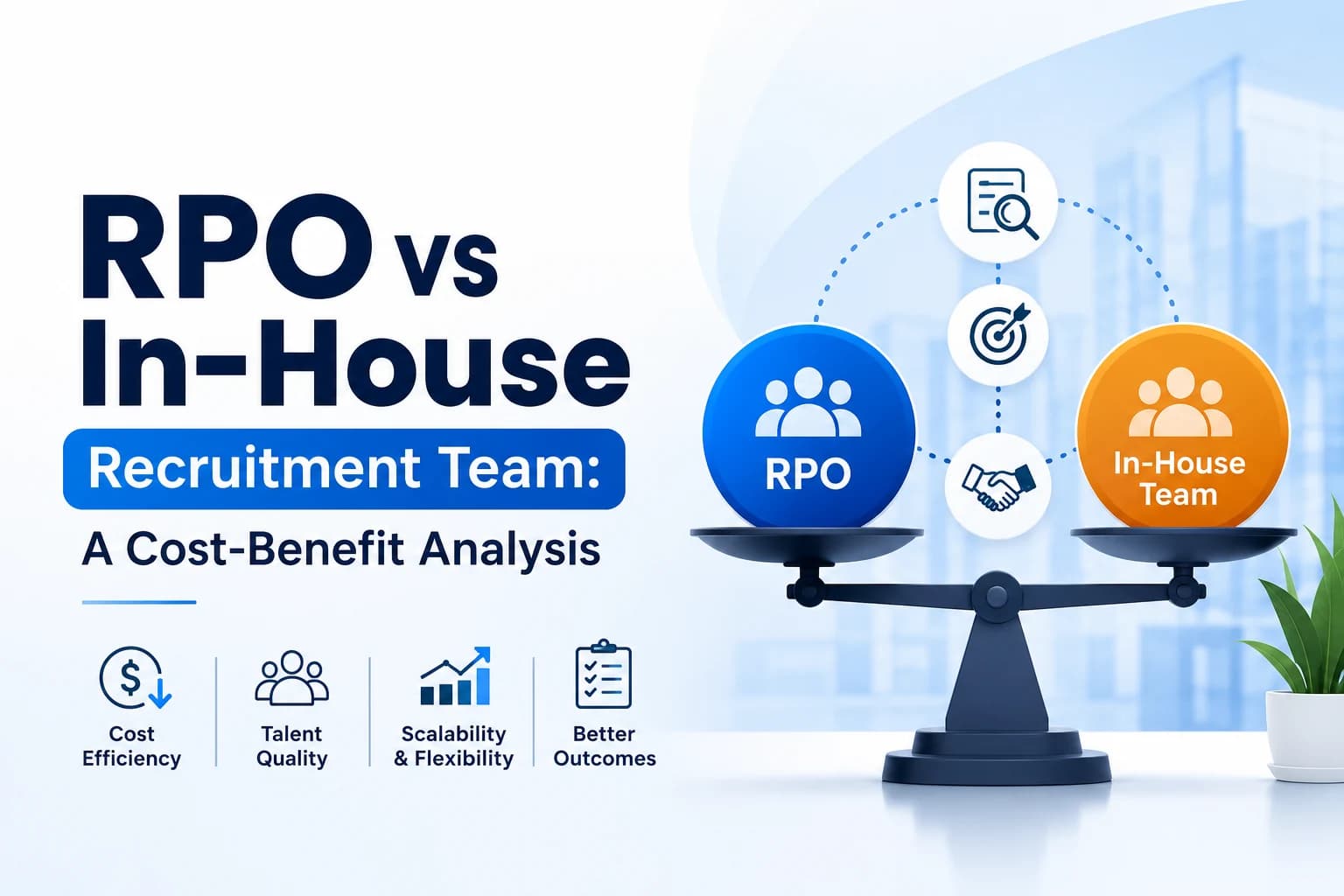
The decision between RPO versus an in-house recruitment team is one of the most consequential talent acquisition decisions a scaling organisation can make. Both models have genuine strengths and real limitations.
The right choice depends on your hiring volume, the consistency of your headcount demand, the seniority and specialisation of your typical hires, and the degree of strategic control you want to retain over your talent acquisition function. This guide provides a structured cost-benefit analysis of both approaches to help you make an informed decision.
Key Takeaways
In-house recruitment teams offer maximum strategic control but carry high fixed costs that do not flex with hiring volume changes
RPO provides variable cost scaling, specialist expertise, and broad sourcing reach at 30 to 50 percent lower cost-per-hire than in-house at equivalent volume
Most enterprises find a hybrid model optimal: RPO for volume and specialist roles, supported by a small in-house team for employer brand and stakeholder management
The True Cost of an In-House Recruitment Team
Building an internal talent acquisition function is more expensive than most organisations realise when all cost components are included. A single experienced recruiter in the UK earns GBP 40,000 to GBP 65,000 in base salary, plus employer National Insurance contributions, pension contributions, benefits, and office overhead.
Add annual recruitment technology costs (ATS, LinkedIn Recruiter, job board subscriptions, assessment platforms) that typically run from GBP 20,000 to GBP 60,000 depending on team size, and the fixed annual cost of a five-person in-house TA team exceeds GBP 350,000 before any direct advertising or assessment costs are incurred.
This fixed cost base does not flex when hiring volumes drop. During periods of slower growth, hiring freezes, or business restructuring, the in-house team cost remains largely fixed while its workload decreases. Conversely, when hiring demand spikes, the in-house team cannot easily scale, forcing organisations to add agency relationships on top of their fixed team cost, creating the worst of both worlds: high fixed overhead plus variable agency fees.
The True Cost of RPO
RPO costs are variable rather than fixed, scaling with the volume of hiring activity. In a management fee model, the client pays a monthly fee that covers a dedicated RPO team, technology access, and sourcing channel costs. In a cost-per-hire model, fees are incurred only when placements are made. Both structures ensure that RPO costs align more closely with hiring output than an in-house team's fixed overhead does. According to Deloitte's global human capital research, organisations that switch from in-house to RPO models at consistent hiring volumes report cost-per-hire reductions of 30 to 50 percent in the first 12 months.
RPO also eliminates the technology investment required for an in-house team. The provider's ATS, sourcing tools, assessment platforms, and analytics dashboards are included in the engagement cost rather than billed separately. For a growing company that has not yet built its recruitment technology stack, this is a significant capital saving. The RPO provider also absorbs the ongoing cost of technology upgrades, vendor management, and integration maintenance.
Quality, Speed, and Scalability Comparison
A well-resourced in-house team has real advantages in employer brand knowledge, hiring manager relationships, and cultural understanding that takes time for an external provider to develop. These advantages are most pronounced in senior and leadership hiring where cultural fit and nuanced judgement matter more than structured process efficiency. In-house teams also have better visibility of internal mobility opportunities and can integrate talent acquisition with talent management more seamlessly than an external RPO partner.
RPO's advantages emerge at volume, in multi-market hiring, and in specialist role categories where the provider's dedicated sector expertise and active candidate networks outperform a generalist in-house team. Scalability is where RPO is structurally superior: the provider can ramp from 10 hires per month to 50 within the contract framework without requiring the client to hire, train, and manage new internal recruiters. For most organisations with consistent or growing hiring volumes, the scalability advantage of RPO outweighs the employer brand depth advantage of an in-house team. Contact IdeaGCS to model the cost comparison for your specific hiring profile.
When Each Model Makes Sense
A pure in-house model makes sense for organisations with highly stable, low-volume hiring needs, strong employer brand differentiation that requires deep cultural knowledge to convey, and a preference for full strategic control over the talent acquisition function. It also suits organisations in sectors where relationship-based hiring of known individuals, such as investment banking or executive search, is the primary channel. Read more on this in our article on why RPO is replacing traditional hiring models to understand the broader structural shift.
RPO makes sense when hiring volumes are consistent or growing, when cost-per-hire reduction is a board-level priority, when the organisation is expanding into new markets without local talent acquisition expertise, or when in-house capacity cannot keep pace with headcount demand. Most enterprises adopt a hybrid model: a small in-house team of two to four people manages employer brand, strategic hiring, and stakeholder relationships, while RPO handles the volume and specialist sourcing. IdeaGCS technical staffing and RPO services are designed to complement rather than replace internal HR teams.
The RPO versus in-house recruitment decision is not binary. Most organisations find that a hybrid model combining a small internal HR capability with an RPO partner for volume and specialist hiring delivers the best outcome across cost, quality, speed, and scalability. Pure in-house models carry high fixed costs that do not flex. Pure RPO models may lack the employer brand depth of a dedicated internal team. The right balance depends on your hiring volume, growth trajectory, and strategic priorities. IdeaGCS helps organisations design the right model for their context. Explore our technical staffing and RPO services to see how we integrate with in-house HR teams.
Frequently Asked Questions
Is RPO better than in-house recruitment?

RPO is typically better at volume, in multi-market hiring, and in specialist role categories. In-house teams have advantages in employer brand knowledge and senior leadership hiring. Most organisations find a hybrid model combining both delivers the best overall outcome.
How much does it cost to build an in-house recruitment team?
A five-person in-house UK talent acquisition team typically costs GBP 350,000 or more annually in salaries, technology, and overhead before direct advertising costs. This fixed base does not flex with hiring volume changes, creating cost inefficiency during slower periods.
Can RPO work alongside an in-house HR team?
Yes. Most RPO engagements are designed to complement internal HR. The RPO provider manages candidate-facing recruitment activity and sourcing, while the internal team retains employer brand management, stakeholder relationships, and final hiring decisions. A small internal team plus RPO is a common high-performance model.
What are the disadvantages of RPO versus in-house?
RPO disadvantages include lower employer brand depth in the early stages of an engagement, dependency on the provider's performance, and less flexibility for highly relationship-based or culture-critical hiring. These disadvantages reduce over time as the RPO team builds client knowledge.
At what hiring volume does RPO become more cost-effective than in-house?
RPO typically becomes more cost-effective than a dedicated in-house team at consistent volumes of 30 or more hires per year. Below this threshold, the in-house fixed cost may be lower per hire. The break-even point depends on role seniority, market, and whether technology costs are included in the comparison.
How long does it take to build an in-house recruitment team versus starting RPO?
Building an effective in-house TA team takes 6 to 12 months: hiring, onboarding, tool procurement, and relationship-building. An RPO engagement from IdeaGCS can be operational in 4 to 8 weeks, making RPO the faster path to hiring capability for organisations with urgent headcount demand.
Does switching to RPO require redundancies?
Not necessarily. Many organisations transition to RPO by redirecting their existing internal recruiters to higher-value activities such as employer brand, talent marketing, and senior hiring while RPO handles volume. Natural attrition and redeployment are common approaches that avoid redundancies.
Can I switch back from RPO to in-house?
Yes. RPO contracts include exit provisions. Organisations that outgrow RPO due to extremely high and stable volumes, or that want to build proprietary talent acquisition capability, can transition back to an in-house model. IdeaGCS supports structured handover processes for clients making this transition.
Contact Us
Share on Social Media
Contact Us