What Is an OCR AI Agent and How Does It Work?

What Is an OCR AI Agent and How Does It Work?
An OCR AI agent is an intelligent software system that combines optical character recognition with AI reasoning and workflow automation to process documents end-to-end without human intervention. Where standard OCR tools extract text and stop, an OCR AI agent understands the context of what it has extracted, makes decisions based on that understanding, and executes actions across business systems automatically. This guide explains what OCR AI agents are, how they work technically, and why they represent a significant advance over conventional document automation tools.
Key Takeaways
An OCR AI agent combines text extraction with contextual reasoning and workflow automation, turning document processing into end-to-end autonomous action
Unlike standard OCR, an OCR AI agent self-improves, handles exceptions intelligently, and triggers multi-system actions without human intervention
IdeaGCS builds custom OCR AI agents for enterprises across the UK, India, US, UAE, and Philippines
OCR AI Agents Defined: Beyond Text Extraction
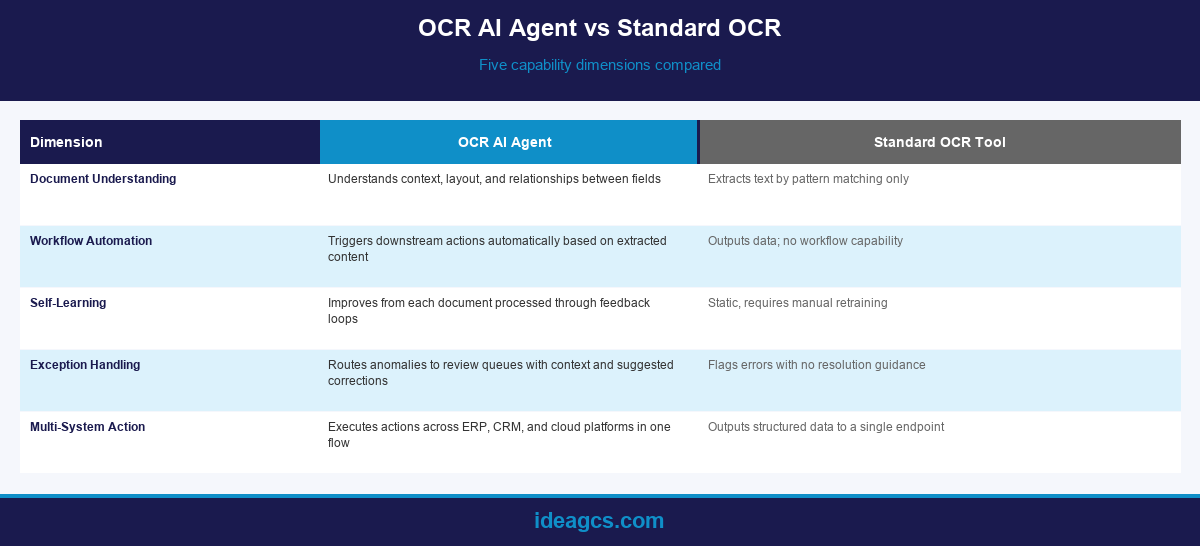
A standard OCR tool performs a single function: it converts document images into machine-readable text. An OCR AI agent does this and then applies reasoning. It understands what the extracted data means, what rules apply to it, what actions it should trigger, and what to do when something unexpected occurs. This combination of perception (reading the document), reasoning (interpreting the data in context), and action (executing downstream steps) is what distinguishes an AI agent from a conventional OCR tool.
In practical terms, an OCR AI agent receiving an invoice does not simply extract line items and stop. It validates the extracted data against purchase order records, determines whether the invoice qualifies for automatic approval, routes it to the ERP posting queue if it passes or to a human reviewer if it fails, updates the supplier record with payment terms, and flags early payment discount opportunities. All of this happens without any human instruction after the initial deployment. This is the workflow capability that organisations need when manual document handling is the bottleneck. Read our overview of intelligent document processing to understand how OCR AI agents fit within the broader IDP architecture.
The Technical Architecture of an OCR AI Agent
An OCR AI agent is built on four integrated layers. The perception layer handles document ingestion and pre-processing: normalising image quality, identifying document type and orientation, and passing a clean document image to the extraction model. The extraction layer uses deep learning models, typically transformer-based architectures, to identify and extract all relevant fields with confidence scores assigned to each extracted value.
The reasoning layer applies business logic to extracted data. It checks values against reference data, applies validation rules, evaluates approval criteria, and determines the appropriate workflow path for each document. The action layer executes the determined workflow: API calls to ERP or CRM systems, queue routing for human review, notification triggers, and audit trail updates. The feedback layer captures human corrections from the review queue and routes them back to the training pipeline for periodic model retraining. According to McKinsey's AI adoption research, organisations deploying AI agents with continuous learning capabilities achieve substantially higher automation rates over time than those using static models.
How OCR AI Agents Differ from RPA and Standard Automation
Robotic Process Automation (RPA) automates structured, rule-based tasks by following predefined scripts. It works well for consistent, predictable workflows but breaks when inputs deviate from expected patterns. Standard OCR provides text extraction but no workflow capability. An OCR AI agent combines the reading capability of OCR with the reasoning that RPA lacks, enabling it to handle the document variability that makes RPA brittle.
The key distinction is adaptability. An RPA bot following a script to process invoices fails when a supplier changes their invoice format or when an exception arises that the script's rules do not cover. An OCR AI agent recognises the new format, extracts the relevant fields based on contextual understanding, and handles the exception with decision logic rather than a hard failure. This resilience is what makes OCR AI agents the preferred architecture for enterprise document automation at scale. IdeaGCS builds OCR AI agents that are designed for production resilience from day one. Explore our AI and data services to understand our development approach.
What Problems Does an OCR AI Agent Solve?
OCR AI agents address three categories of enterprise document processing problem. Volume problems: high-frequency document workflows where manual processing cannot scale economically with business growth. Variability problems: document populations with diverse formats, sources, languages, or quality levels that defeat rule-based automation. Complexity problems: multi-step document workflows that require data validation, cross-system lookups, approval routing, and audit trail maintenance that exceed what a simple OCR tool can deliver.
Common deployment contexts include accounts payable automation (invoice processing, three-way matching, ERP posting), financial services onboarding (KYC document verification, identity validation, account creation), logistics operations (bill of lading processing, customs documentation, delivery confirmation), and healthcare administration (medical record digitisation, insurance claim processing, prescription extraction). Each context involves a document that arrives in variable format and must trigger a defined, multi-step business process. Contact IdeaGCS to discuss how an OCR AI agent can be designed for your specific document workflow.
An OCR AI agent represents a fundamental advance over conventional document automation. By combining accurate text extraction with contextual reasoning, intelligent exception handling, and multi-system action capability, it automates document workflows end-to-end in ways that standard OCR tools and RPA bots cannot. The result is higher automation rates, lower exception volumes, better audit trails, and document processing operations that improve continuously over time as the agent learns from each cycle. IdeaGCS builds custom OCR AI agents for enterprise document workflows. Explore our AI and data services to discuss your requirements.
Frequently Asked Questions
Can an OCR AI agent handle different document formats?

Yes. OCR AI agents are built on deep learning models that handle varied document layouts, fonts, and quality levels without requiring predefined templates. IdeaGCS trains agents on representative samples of each client's document population to ensure reliable performance across all format variants.
What is the difference between OCR AI agent and RPA?
RPA follows predefined scripts for structured, predictable tasks and fails when inputs vary. An OCR AI agent applies contextual reasoning to handle document variability, making it resilient to format changes and exceptions that cause RPA bots to break.
Which industries use OCR AI agents?
Finance, logistics, healthcare, legal, and government are the primary adopters. Use cases include invoice processing, bill of lading automation, medical record digitisation, contract extraction, and compliance document processing. IdeaGCS delivers OCR AI agent solutions across all five sectors.
How long does OCR AI agent development take?
A standard OCR AI agent development engagement takes 10 to 16 weeks from requirements definition to production deployment. This covers discovery, training data collection, model development, workflow logic build, integration, and user acceptance testing. IdeaGCS provides detailed project plans for each engagement.
Does IdeaGCS build OCR AI agents?
Yes. IdeaGCS builds custom OCR AI agents for enterprises across the UK, India, US, UAE, and Philippines. Our development process covers perception, extraction, reasoning, and action layers with full integration into client ERP and cloud platforms. Explore our IdeaGCS blog for further technical context.
What is an OCR AI agent?
An OCR AI agent is an intelligent system that combines optical character recognition with AI reasoning and workflow automation. It extracts data from documents, interprets it in context, makes decisions based on business rules, and executes downstream actions across business systems automatically.
How does an OCR AI agent work?
An OCR AI agent works in four layers: perception (document ingestion and pre-processing), extraction (deep learning-based field extraction with confidence scoring), reasoning (applying business logic and routing decisions), and action (executing ERP updates, approvals, or human review routing automatically).
What is the difference between OCR and an OCR AI agent?
Standard OCR extracts text and outputs it. An OCR AI agent extracts text, understands its context, validates it against business rules, and executes multi-step downstream workflows automatically. The agent adds reasoning and action capability that standard OCR tools do not have.
Contact Us
Share on Social Media
Contact Us