DevOps and AWS Cloud Automation Services: A Complete Guide for Enterprise Buyers

Most enterprises do not have a DevOps problem. They have a release problem, a reliability problem, or a cost problem, and DevOps is the discipline that has been proposed as the answer. That distinction matters, because it determines what you should actually be buying — and buyers who skip it end up commissioning tooling when they needed operating-model change, or the reverse.
This guide is written for the person signing the contract: a CIO, CTO, or IT director deciding whether to build the capability internally, buy it as a service, or run some combination of the two. It covers what the discipline actually consists of, the engagement models available and what each really costs, how to sequence automation so the first six months produce something defensible, and the governance that stops a capable delivery team from becoming a single point of failure.
Key Takeaways
- Buy the outcome, not the label — release frequency, change failure rate, and recovery time are the things worth contracting on.
- The three viable engagement models (build in-house, retained partner, hybrid) have very different cost curves, and the crossover point is usually clearer than buyers expect.
- Automate in the order failures actually occur: build and deploy first, environments second, observability third, and policy last.
- Cloud spend and delivery practice are the same problem viewed from two angles; teams that separate them overspend on both.
- Regulated industries need the audit trail designed in at the start, not retrofitted before the first inspection.
What Enterprise Buyers Are Actually Purchasing
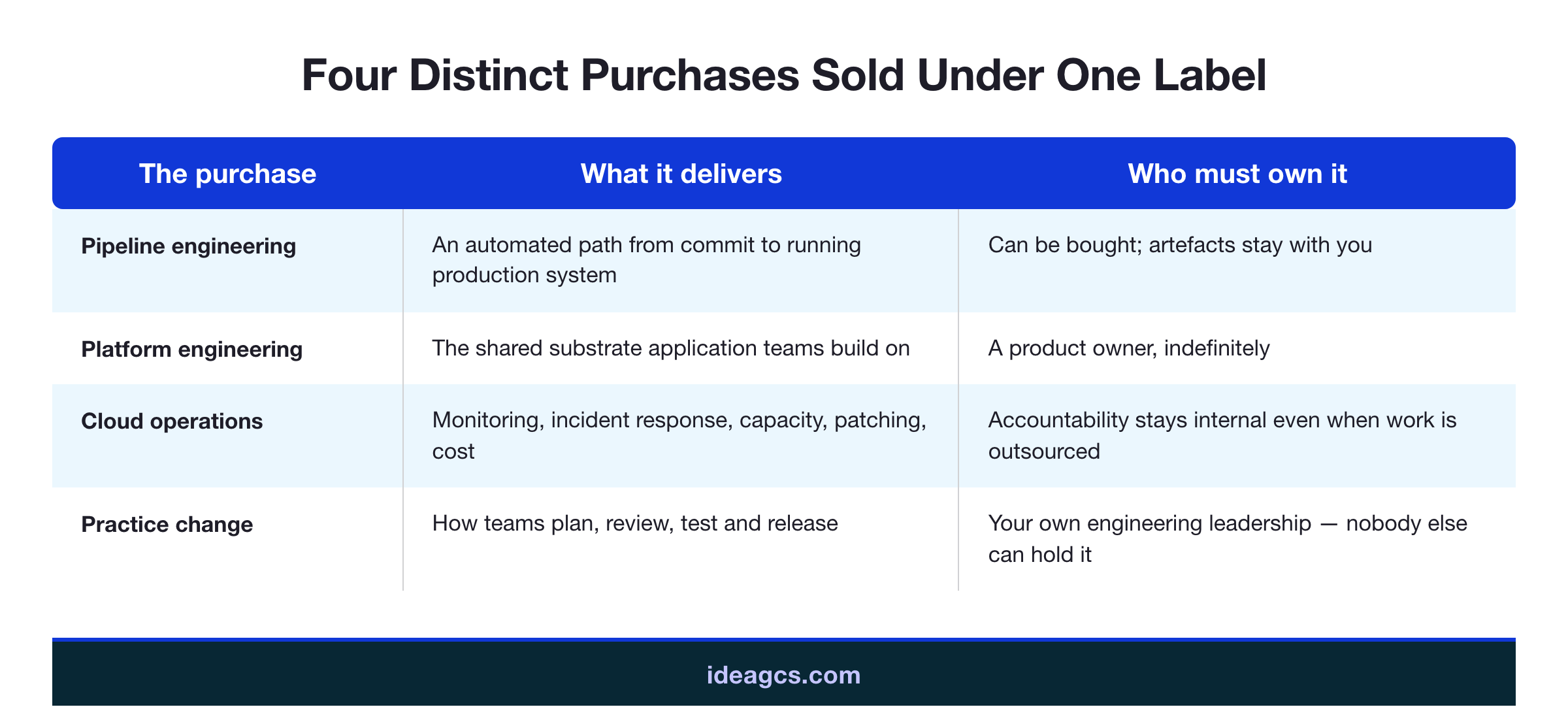
The discipline is described with one word covering at least four distinct purchases, and being precise about which one you need saves months.
The first is pipeline engineering — building and maintaining the automated path from a developer's commit to a running production system. This is concrete work with a visible artefact: a pipeline that builds, tests, scans, and deploys without a human moving anything by hand.
The second is platform engineering — providing the internal substrate that application teams build on. Standard environments, shared services, self-service provisioning, a paved road that makes the secure option also the easy option. This is a product, not a project, and it needs an owner for as long as it exists.
The third is cloud operations — running what has been deployed. Monitoring, alerting, incident response, capacity, patching, cost management. Much of this can be automated, but automation does not remove the accountability, it relocates it.
The fourth is practice change — altering how teams plan, review, test, and release. This is the hardest to buy, because no external party can hold it for you. A partner can demonstrate it, document it, and pressure-test it; only your own engineering leadership can make it stick.
Most enterprise requirements are a mix, weighted heavily toward the first two in year one. Being explicit about the weighting is the single most useful thing a buyer can do before going to market, and it is the thing most requests for proposal leave implicit. IdeaGCS scopes engagements against this split directly through its delivery automation services.
The Three Engagement Models, and What They Cost
Building the capability in-house
An internal team gives you permanence, institutional memory, and full control over priorities. It also gives you a recruitment problem in one of the tightest talent markets in enterprise technology, and a bench that has to be sized for peak demand while being paid through the trough.
The honest cost of an internal capability is not the salary line. It is salary plus recruitment plus the ramp period before anyone is productive plus the cost of the estate running unimproved while you hire. For an organisation with a continuous delivery roadmap across many teams, that cost is worth carrying. For one with a burst of modernisation followed by steady-state operations, it rarely is.
Retaining a delivery partner
A retained partner converts a hiring problem into a commercial one. You get access to engineers who have built the same pipelines across many estates, and you get them at the moment you need them rather than three months after you started looking.
The trade-off is knowledge location. A partner who builds your pipelines and leaves has built something your team must now operate without having designed. Good engagements are structured to prevent that — pairing, documented runbooks, a named internal owner from day one — but it has to be contracted deliberately. It does not happen by default. Our earlier reading on keeping quality intact when delivery work moves outside covers the failure modes in more depth.
The hybrid shape most enterprises land on
In practice, the arrangement that survives contact with reality is a small permanent core — typically an architecture owner and one or two senior engineers — with partner capacity around them that flexes with the roadmap. The core holds the design decisions, the vendor relationships, and the on-call accountability. The partner supplies throughput.
This shape costs more per unit of delivery than a pure partner model and less than a fully staffed internal team. Its real advantage is that it fails gracefully: if the partner relationship ends, the estate is still understood by someone who works for you.
Sequencing: What to Automate First
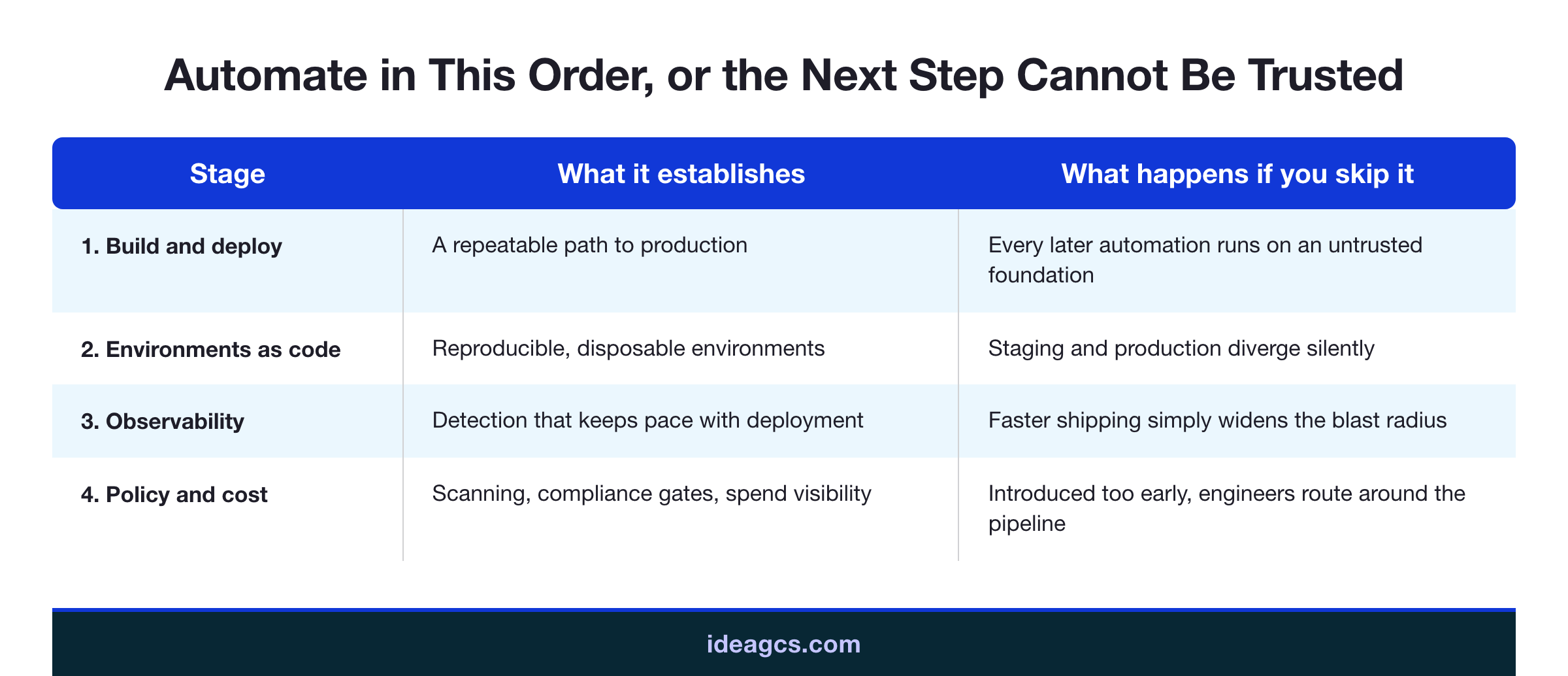
The order matters more than the tooling. Teams that automate in the wrong sequence end up with sophisticated deployment pipelines pushing untested code into environments nobody can reproduce.
Build and deploy first. Until a commit can reach production through a repeatable path, nothing else you automate is reliable. This is also where the earliest visible return sits — release frequency moves, and it moves in a way finance and the business can both see.
Environments second. Reproducible environments defined as code remove the single largest source of "works on my machine" incidents and make every subsequent automation trustworthy. Skipping this step is the most common reason a pipeline that worked in staging behaves differently in production.
Observability third. Once deployment is fast, the constraint moves to detection. If you can ship in twenty minutes and take four hours to notice a regression, you have made the blast radius bigger, not smaller. Logging, metrics, tracing, and alerting that a human can act on at 3am are the counterweight to speed.
Policy last. Security scanning, compliance gates, and cost controls belong in the pipeline, but they belong there after the pipeline is trusted. Introduced too early, they become the reason engineers route around the automation entirely.
There is a corollary worth stating plainly: some things should not be automated. One-off migrations, decisions requiring judgement about customer impact, and anything where the failure mode is worse than the manual effort are all better left deliberate. A prioritisation framework beats a tooling shortlist every time.
Where AWS Automation Fits
For estates running on AWS, a large share of what is described as DevOps work is really infrastructure automation against a specific provider's primitives — infrastructure defined as code, managed container and serverless runtimes, identity and access boundaries, and the observability and cost tooling wrapped around them.
Two things are worth flagging for buyers. The first is that the provider's own tooling is not always the right answer; portable infrastructure-as-code is often preferable where a second provider is plausible, and provider-native services are often preferable where they are not. That is an architecture decision with commercial consequences, and it should be made explicitly rather than inherited from whoever set up the first account.
The second is that cloud cost is a delivery-practice problem. Environments that cannot be torn down get left running. Workloads sized during a launch stay sized that way for years. Teams without cost visibility in the pipeline optimise for the thing they can see, which is delivery speed. Bringing spend into the same review cadence as deployment metrics is unglamorous and reliably profitable. IdeaGCS's mixed cloud services cover the cases where part of the estate is not going to move at all, which is more of them than most roadmaps admit.
Governance, Audit, and the Regulated Case
In banking, insurance, and healthcare, the pipeline is not just an engineering asset. It is evidence. Auditors will ask who approved a change, what tests ran, what was scanned, and who could have altered the artefact between build and deployment. A pipeline designed without that question in mind can usually answer it only by reconstruction, which is expensive and unconvincing.
The design principles are not complicated. Segregate the ability to approve a change from the ability to deploy it. Make artefacts immutable and traceable to the commit that produced them. Log the pipeline's own actions to somewhere the pipeline cannot rewrite. Keep the evidence retention aligned to the regulator's window, not the tool's default.
Doing this at the start costs a modest amount of design time. Retrofitting it costs a programme. Our notes on compliance-first delivery in regulated estates set out the wider context this sits inside.
What Changes for the People Doing the Work
Every discussion of this discipline eventually arrives at tooling, and the tooling is the least difficult part. The changes that decide whether an investment holds are changes to how people work, and they are worth stating plainly before a programme starts rather than discovering them in month four.
Developers acquire operational responsibility. Teams that ship to production also answer for what happens there. That is the mechanism by which reliability improves — the people who can fix a fragile design are the people being woken by it — and it is a genuine expansion of the job. It needs to be introduced with support, tooling and on-call compensation rather than announced.
Operations moves up the stack. Manual deployment, patching and provisioning shrink. What grows is reliability engineering, capacity work, incident analysis and the internal platform itself. This is a more interesting job than the one it replaces and it requires skills the existing team may not yet have. Budget the training; assuming people will absorb it in their own time is how good operations engineers leave.
Change approval stops being a meeting. Approval becomes a recorded action inside the pipeline. Governance functions that have spent years reviewing individual changes find their role shifting to approving the control pattern and sampling its output, which is a bigger adjustment for the organisation than for the technology.
Security joins earlier. Scanning in the pipeline means findings arrive at the point of change rather than in a quarterly report. That only works if someone can triage them at that pace; otherwise the pipeline generates a backlog nobody owns and the gates get switched to advisory within a month.
The organisations that get this right treat it as an operating-model change with an engineering component, not the reverse. Those that treat it as a tooling programme end up with excellent pipelines that nobody's working practice has adapted to.
Common Failure Patterns in the First Year
Six patterns account for most of the disappointment in these engagements, and all six are avoidable.
The pilot that stays a pilot. One team gets a working pipeline, the result is celebrated, and nothing propagates because the second team was never funded. Decide before starting whether the pilot is a proof or the first increment of a rollout, and fund accordingly.
Automation built on unstable ground. Deployment automated before environments are reproducible produces a fast, reliable path to an unpredictable destination. The sequence in this guide exists precisely to prevent it.
Policy gates on an untrusted pipeline. Introduced too early, they are either routed around or configured so permissively they provide assurance without control. Either way the investment is spent and the risk is unchanged.
A partner who builds and leaves. The pipelines work; nobody internal understands them; the first significant failure becomes an emergency procurement. Contract the handover — named internal owner, documented runbooks, a period where your team runs it while the partner watches.
Metrics adopted without a baseline. Deployment frequency and lead time are only meaningful against a starting point. Measure before the first change, or the twelve-month conversation is about impressions.
Cloud spend rising quietly. Automation makes environments easy to create. If cost is not visible in the same workflow as delivery, the bill grows without anyone deciding it should. This is the most common unpleasant surprise in year one and the easiest to prevent.
None of these are technical problems. Each is a decision that was left implicit at the start and became expensive later, which is why the scoping conversation matters more than the tooling shortlist.
Measuring Whether Any of It Worked
Four measures carry almost all the signal, and they are worth agreeing before work starts rather than after.
Deployment frequency tells you whether the path to production is genuinely open. Lead time for change — commit to running in production — tells you where the queue is. Change failure rate tells you whether speed is being bought with instability. Time to restore tells you how much a failure actually costs.
Two cautions. First, these are team-level measures; averaging them across an enterprise hides everything interesting. Second, any of them can be gamed in isolation. Read as a set, they are difficult to fake, which is why they have survived as the industry's default set.
Alongside them, track the two commercial numbers: cloud spend per unit of delivered work, and the proportion of engineering time spent on unplanned work. If automation is succeeding, the second falls first and the first follows.
Choosing a Provider
Most selection processes over-weight tooling familiarity and under-weight two things that matter more.
The first is whether the provider will work on your estate as it is. Estates are messy; a partner whose method assumes a clean start will spend the first quarter discovering that yours is not one. Ask for a worked example on an environment resembling yours, including what they found that they had not expected.
The second is knowledge transfer, contracted explicitly. Named internal owner, documented runbooks, a defined handover point, and a period where your team runs the pipeline with the partner watching rather than the other way round. If a provider is reluctant to commit to that, it is telling you what the engagement is really for.
Beyond that, the usual diligence applies: reference conversations with clients at your scale, clarity on who is actually staffed on the account versus who attends the pitch, and a commercial model that does not penalise you for needing less next year. Our red flags and green lights when picking an advisory partner covers the general version of this assessment.
Conclusion
The useful question is never "should we do DevOps". It is which of the four purchases you actually need, in what order, and who is going to own the result when the engagement ends. Buyers who answer that before going to market get engagements scoped against outcomes; buyers who do not get engagements scoped against tooling, and pay for the difference later.
Sequence the automation so each stage makes the next one trustworthy. Contract the knowledge transfer rather than assuming it. Design the audit trail in at the start if you are regulated. And measure the four delivery numbers plus the two commercial ones from the first week, so the conversation twelve months from now is about evidence rather than impressions. Talk to IdeaGCS if you want an engagement scoped against those measures.
Frequently Asked Questions
What is the difference between DevOps and platform engineering?

Should we build an internal team or use a partner?
What should we automate first?
How do we measure whether the investment is working?
Does this reduce our cloud bill?
What does an engagement typically cost?
How long before we see a result?
How does this work in a regulated industry?
What happens to our existing operations team?
Can this work if part of our estate will never move to cloud?
Contact Us
Share on Social Media
Contact Us