Hiring for MuleSoft and Salesforce Roles: A Niche-Skill Playbook

Roles in this space stay open far longer than the organisation expects, and the reason is usually not market scarcity alone. It is that the requisition describes a person who does not exist, the assessment tests the wrong thing, and the process moves slower than the small pool of qualified candidates will tolerate.
All three are fixable. This is a practical account of how to define, source, assess and keep people in niche platform and integration roles, written for the hiring manager rather than the recruiter.
Key Takeaways
- Most unfillable requisitions describe two or three real jobs combined into one.
- Platform experience and integration engineering are different disciplines; asking for deep expertise in both narrows the pool severely.
- Candidates in this market are employed, not searching — sourcing is a relationship exercise, not an advertising one.
- Assess judgement on messy systems, not recall of platform features.
- A slow process loses these candidates more reliably than a low offer does.
Start by Splitting the Requisition
The most common defect in these job descriptions is combination. A single role is written to cover integration architecture, hands-on platform development, administration and configuration, and stakeholder management — sometimes with a data-engineering line added.
People who genuinely hold all of those exist and are rare, senior, expensive, and generally not available. Meanwhile the actual work usually decomposes into two or three roles at different levels, at least one of which is straightforward to fill.
Do the decomposition honestly. Write down the work for the next twelve months, group it by discipline, and estimate the proportion of time each group consumes. A requisition where one discipline accounts for seventy percent of the work and three others share the rest is a role for a specialist in the first, supported for the others — not a role for a unicorn.
The second common defect is level inflation. Requiring extensive experience for work that is genuinely mid-level narrows the pool and produces candidates who will be bored within a year. Attrition at month fourteen is the usual consequence.
Platform Skills and Integration Skills Are Different
This distinction causes a great deal of hiring confusion in the Salesforce and MuleSoft space.
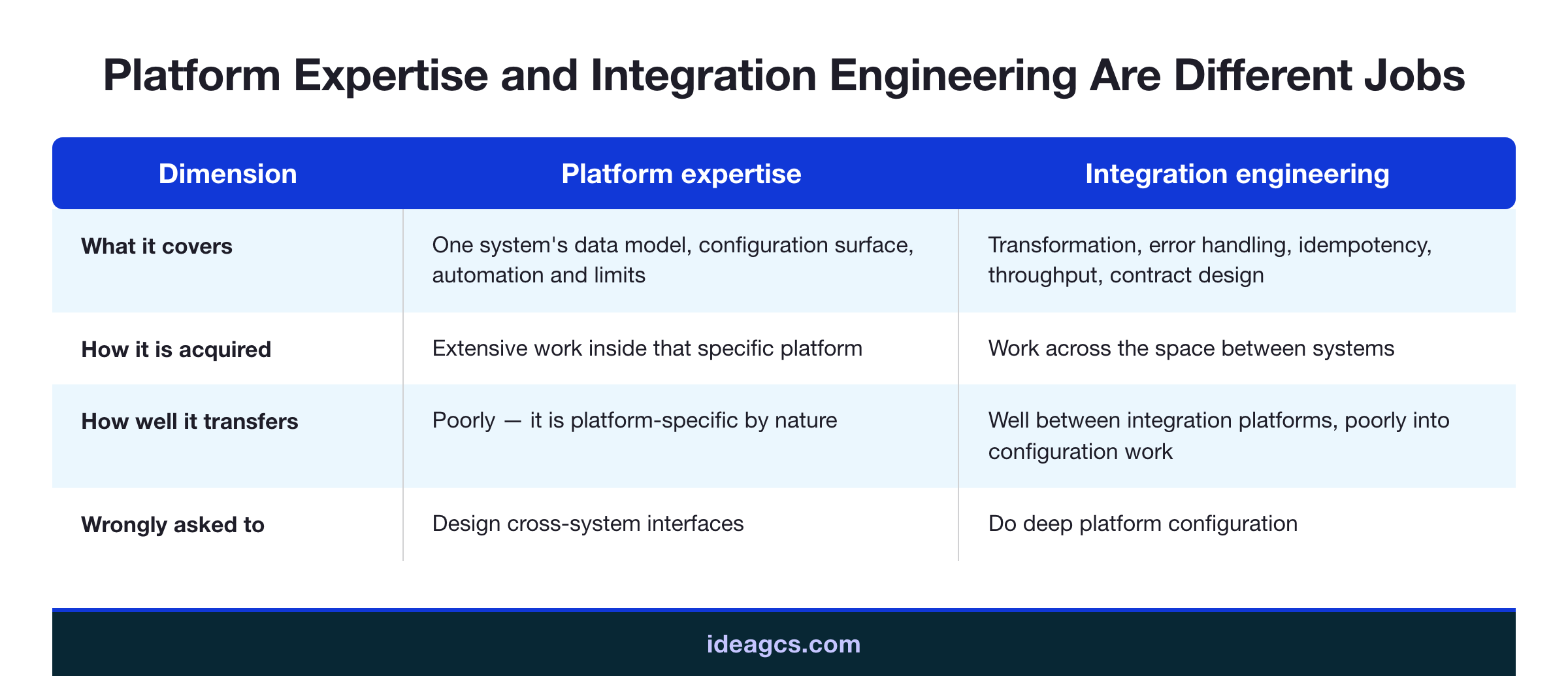
Platform expertise is depth inside one system, the kind set out across a platform's own reference material — its data model, its configuration surface, its automation tooling, its limits and its idioms. It is accumulated by working in that platform extensively, and it does not transfer readily.
Integration engineering is a discipline about the space between systems — transformation, error handling, idempotency, throughput, contract design, and what to do when the other side is a decades-old system with no API. It transfers well between integration platforms and poorly into deep platform configuration work.
A great administrator is not a partly-trained integration engineer, and a great integration engineer will often be unremarkable at platform configuration. Requisitions that require senior depth in both are looking for a small population, and the work rarely justifies it. Our decision guide on when a specialist is needed alongside an administrator works through the boundary in detail.
Sourcing a Pool That Is Not Looking
Candidates with these skills are employed and generally not browsing job boards. Three sourcing channels do most of the work.
Community presence. Platform communities, user groups, and contributor networks are where these people are visible. Sourcing here is a relationship exercise conducted over months, not a campaign run over weeks, and it works considerably better for organisations that participate rather than only recruit.
Referral from your own specialists. If you already employ one integration engineer, their network is your best channel — and it is under-used because organisations rarely make referral worth the referrer's effort or keep them informed about open roles.
Partner and delivery-firm networks. Firms delivering this work continuously see the market constantly. This is a legitimate channel, and it also frequently reframes the requirement: a partner able to fill the role can often deliver the underlying work instead, which is sometimes the better answer.
What does not work is a job advertisement with a long requirements list. In a scarce market the list is read as a filter, and qualified people who meet most of it self-select out.
Assess Judgement, Not Recall
Interviews in this space commonly test platform trivia, which is the least useful signal available. Anyone can look up a limit; nobody can look up judgement.
Four exercises produce most of the signal.
A messy integration problem. Describe a real scenario from your estate, including the awkward parts — the system with no API, the data that disagrees, the batch window. Ask how they would approach it. Strong candidates ask questions before answering, and the questions are the signal.
A design review of something imperfect. Show a design with real trade-offs and ask what they would change and what they would leave. This distinguishes engineers who improve systems from those who rewrite them.
A failure narrative. Ask about something they built that failed in production and what the root cause turned out to be. Specific, immediate answers indicate genuine production ownership.
An estimate with assumptions. Give a small scope and ask for a rough estimate and the three assumptions behind it. Estimating imprecisely is fine; estimating without stating assumptions is not.
Keep the whole loop short. Two conversations plus a technical exercise is usually enough, and every additional stage costs candidates in a market where they have alternatives.
Speed Is a Competitive Instrument
In scarce markets, process speed beats compensation more often than hiring managers believe. A candidate with three conversations running will accept from whoever moves decisively, and a week's delay in scheduling reads as disinterest.
Three practical commitments make a measurable difference. Feedback to the candidate within forty-eight hours of every stage. Interview slots held in advance rather than found reactively. And an offer approval path that can complete in days, agreed before the search begins rather than discovered during it.
Organisations that cannot do this should know that it is costing them candidates, and that no supplier can compensate for it. Our notes on what the hiring market looks like for technology roles cover the wider dynamics.
Retention: The Part That Is Usually Ignored
Hiring a scarce specialist and losing them in fourteen months is a worse outcome than not hiring at all, because you have paid the recruitment and ramp cost and returned to the same position with a gap in the estate.
Three things retain people in these roles. Interesting work, which mostly means not spending eighty percent of their time on maintenance of things they did not build. Visible progression, which is difficult in a team of one and needs deliberate attention — a specialist with no path becomes a specialist who leaves. And not being the only one, because sole ownership of a critical system is stressful, blocks holidays, and is a genuine driver of departure.
That last point argues for a structural choice: two people at mid-level often retain better and carry less risk than one person at senior level, even where the senior individual is more capable. It also removes the key-person exposure that makes these hires so consequential in the first place.
When to Buy the Outcome Instead
A recurring pattern: an organisation needs three integrations built, opens a permanent requisition for an integration engineer, spends four months searching, hires, spends two months ramping, and delivers in month eight — then has a permanent specialist with maintenance-level work.
If the requirement is bounded, buying the delivered outcome is faster and usually cheaper in total. If it is continuous, hire. If it is a burst followed by steady state — which is the most common shape — buy the burst and hire the steady state, in that order, so the permanent hire arrives into an estate that already works. IdeaGCS supports both through specialist hiring services and MuleSoft connectivity services.
Conclusion
Niche platform roles stay open because the requisition combines several jobs, the assessment tests recall rather than judgement, and the process moves slower than a small candidate pool will wait.
Split the role honestly, distinguish platform depth from integration engineering, source through communities and referrals rather than advertisements, assess with messy real problems, and move fast. Then plan retention deliberately, because a scarce specialist lost at fourteen months leaves you worse off than before. And check first whether the requirement is a role at all rather than a bounded piece of work. Talk to IdeaGCS if you want a requisition tested before it opens.
Frequently Asked Questions
Why do integration and platform roles stay open so long?

Can a Salesforce administrator move into an integration role?
Where do candidates for these roles actually come from?
What should a technical interview test?
How long should the interview process be?
Does paying more solve the problem?
Is it better to hire one senior specialist or two mid-level engineers?
What causes attrition in these roles?
When should we buy the work instead of hiring?
What is the best sequence for a burst followed by steady state?
Contact Us
Share on Social Media
Contact Us