From MuleSoft Certification to MuleSoft Career: What a Certification Actually Signals to Employers

A credential on a CV is a claim, and hiring managers have to decide how much of the claim to believe. MuleSoft's published certification track is one of the more rigorous vendor programmes in the integration market, but it was designed to prove a defined body of knowledge, not to predict how someone will perform on your estate. Knowing exactly what each exam covers, and where its coverage stops, is the difference between a shortlist that saves you six weeks and one that costs you a failed probation.
This is written for the person doing the hiring, not for the person sitting the exam. It maps the credential ladder, explains what each level does and does not evidence, and sets out the interview work that has to happen regardless of what the badge says.
Key Takeaways
- MuleSoft certifications prove platform knowledge under exam conditions, not delivery judgement on a live estate.
- The developer-level credential is the floor for a build role; the architect-level ones are the ones that carry weight on a design decision.
- Certifications expire, and an expired badge on a CV is a useful signal about how a candidate maintains their own currency.
- The gap a certificate never covers — legacy systems, messy data, stakeholder pressure — is the gap your interview has to test.
- For short engagements, buying certified capacity through a partner is usually faster than hiring it.
What the Certification Ladder Actually Covers
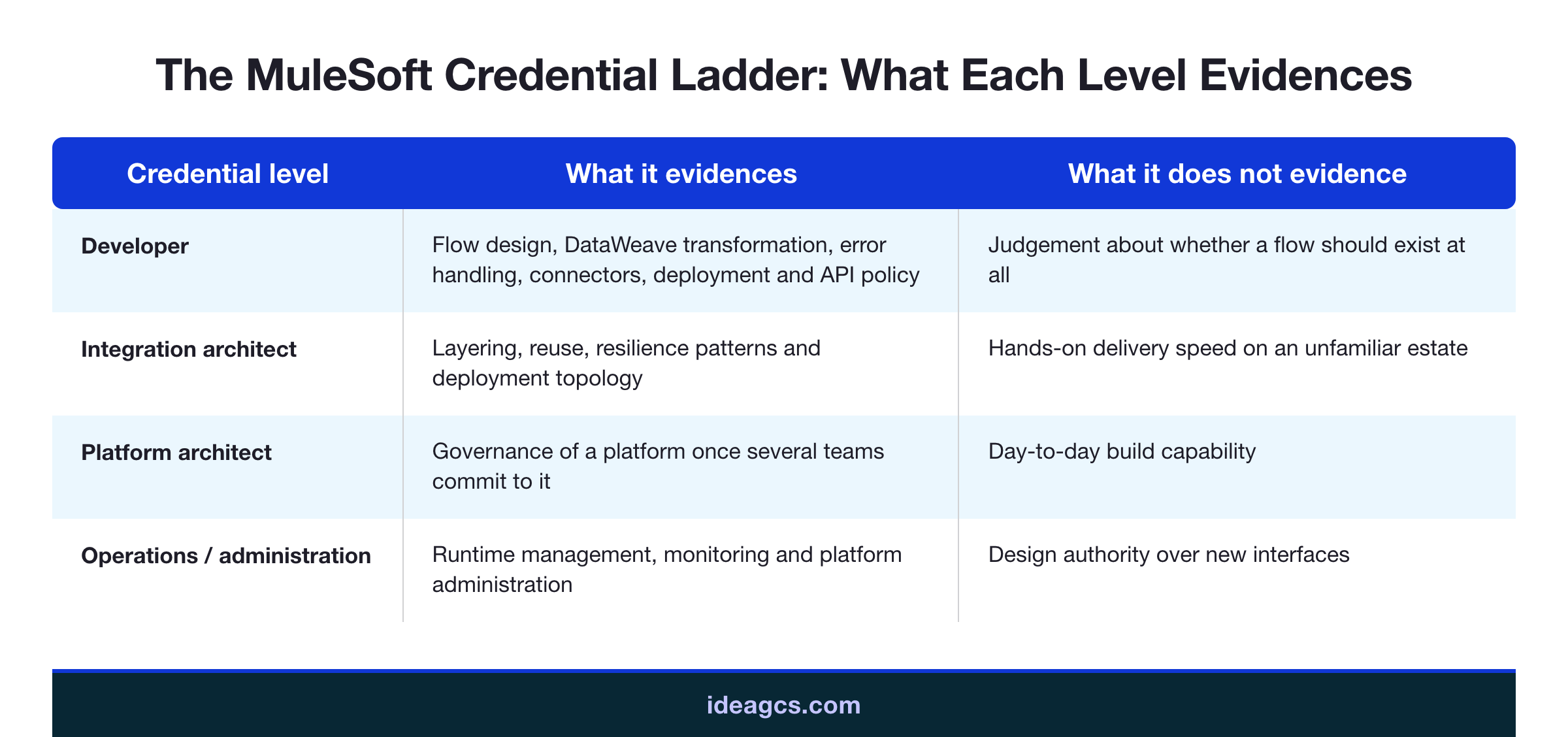
MuleSoft's programme is tiered, and the tiers are not interchangeable. At the entry level sit the developer credentials, which test the mechanics of building on Anypoint Platform: flow design, DataWeave transformation, error handling, connector configuration, deployment to CloudHub, and the basics of API design and policy application. These are practical exams. Someone who passes has demonstrably built things.
Above that sit the integration architect and platform architect credentials. These move away from "can you build this flow" and towards "should this be a flow at all" — questions about layering, reuse, resilience patterns, deployment topology, and how a platform is governed once more than one team is committing to it. Candidates at this level are being tested on trade-offs rather than syntax.
There is a third strand aimed at operational roles, covering platform administration, monitoring, and runtime management. It matters more than it is usually given credit for. A team that can build well and operate badly still produces outages.
The most common hiring mistake is treating any credential as equivalent to any other. A candidate with a developer badge applying for an architecture role has evidenced a different skill set than the one you are buying. The reverse also happens: architects who have not written a flow in three years occasionally struggle on hands-on delivery work.
Where a Certificate Stops Being Evidence
An exam is a controlled environment. The scenarios are well-formed, the data is clean, the requirements do not change halfway through, and no one from finance is asking why the go-live slipped. Real integration work is almost the inverse of that.
Four things routinely separate a certified engineer from an effective one. The first is legacy exposure: knowing Anypoint is not the same as knowing what to do when the system on the other side is a twenty-year-old policy administration platform with an undocumented flat-file interface. The second is data quality. Most delivery time on an integration programme is spent reconciling records that two systems both claim to own, and no exam simulates that. The third is scope negotiation — recognising when a requested "small change" reshapes the process layer and saying so before it is built. The fourth is operational ownership: designing for the on-call engineer who will be paged at 3am, not for the demo.
None of this argues against certification. It argues that certification is a filter, not a verdict. It tells you a candidate has invested in the platform and can be trusted with the fundamentals. What happens after the filter is your job.
Reading a CV: Signals Worth Weighing
Currency is the first thing to check. MuleSoft credentials carry an expiry and require a maintenance exam to stay valid. A lapsed badge is not disqualifying, but it is informative — it tells you how the candidate treats their own professional maintenance, which correlates with how they will treat yours.
Version matters too. Anypoint has changed substantially across releases, and a credential earned against an older version evidences a platform that no longer looks quite like the one you are running. Ask which release the exam was sat against.
Then look at what sits around the certification. A candidate whose only integration evidence is the badge itself is a different proposition from one who can describe three delivered interfaces, name the systems on both ends, and explain a design decision they now think was wrong. The second candidate is almost always the better hire, certified or not. If you want the underlying selection criteria in one place, our decision guide on when a Salesforce admin is not enough works through the same question from the role-definition side.
Interview Questions That Test the Gap
Because the credential covers the knowledge, the interview should cover the judgement. A handful of questions do most of the work.
Ask the candidate to describe an integration they delivered that failed in production, and what the root cause turned out to be. Engineers who have genuinely owned live systems answer this immediately and specifically; those who have not tend to describe a testing gap in general terms.
Ask how they would expose a legacy system that has no API at all. There is no single right answer, but the reasoning reveals whether they think in layers or in point-to-point connections. Our technical walkthrough of layered API design covers the pattern a strong answer will gesture at.
Ask what they would refuse to build. Senior engineers have a list. Junior ones usually do not, and that is fine — it just tells you where they are.
Finally, ask them to size something. Give a short scenario and ask for a rough estimate and the three assumptions behind it. Estimating badly is normal; estimating without stating assumptions is the problem.
When Hiring Is the Wrong Instrument
Certification-led recruitment assumes you need a permanent person. Often you need a delivered outcome instead, and the two have very different economics.
A single first integration — one system pair, one department, validated against real transactions — is typically weeks of work for a small team. Recruiting a permanent engineer for it takes longer than the work does, and leaves you carrying a specialist salary against an estate that may only need occasional change afterwards. Where the roadmap is genuinely continuous, hiring makes sense. Where it is a burst of build followed by low-volume maintenance, buying the capacity is usually cheaper and always faster.
There is a middle path that most enterprises end up on: a permanent owner who holds the architecture and the vendor relationship, with delivery capacity brought in around them. That owner does not have to be the strongest engineer in the room. They have to be the one who understands the estate. IdeaGCS supports both shapes — specialist hiring services when the role is permanent, and MuleSoft connectivity services when the requirement is a delivered interface rather than a headcount.
Conclusion
A MuleSoft credential is worth exactly what it claims to be worth: evidence that someone has learned the platform properly and can be trusted with its fundamentals. It is a good filter and a poor forecast. Treat it as the start of the assessment rather than the end of it, weight currency and version alongside the badge itself, and spend the interview on the judgement an exam cannot test. If the underlying need is a delivered integration rather than a permanent seat on the team, say so early — it changes which route is cheaper by a wide margin. Talk to IdeaGCS if you want the role scoped before you post it.
Frequently Asked Questions
What does a MuleSoft certification prove?

Is a certification required to work on MuleSoft?
Do MuleSoft certifications expire?
Which certification should a developer hire hold?
Can a Salesforce admin move into an integration role with a certification?
How long does it take to prepare for the developer exam?
Does a certified engineer cost more to hire?
How do we verify a candidate's credential is real?
Should we hire or use a delivery partner for a first integration?
What is the biggest hiring mistake on integration roles?
Contact Us
Share on Social Media
Contact Us