MuleSoft Integration & Development Services: The Complete Guide for Enterprise Buyers

Enterprise IT leaders rarely struggle to buy new software. They struggle to connect it to everything they already own. MuleSoft integration services solve that problem by giving CRM, ERP, data warehouses, and custom applications a common way to exchange data through reusable APIs instead of one off point to point connections that break every time a system changes.
This guide walks through what MuleSoft integration and development services actually include, how a typical engagement runs from discovery to ongoing support, what drives cost across different service models, and how to evaluate a delivery partner. It draws on IdeaGCS's own MuleSoft consulting services, professional services, and support services work across enterprise clients in banking, healthcare, insurance, and retail, and is written for the IT director or CTO who needs a working understanding before the first vendor conversation, not a sales pitch.
Seven companion guides go deeper on specific pieces of this decision: insurance and healthcare specific modernization paths, a vendor evaluation scorecard, a managed services pricing breakdown, a Salesforce staffing decision guide, a technical architecture walkthrough, and a build versus outsource cost comparison. This page is meant to be the starting point that ties all of those together.
Key Takeaways
- MuleSoft integration services connect existing systems through reusable APIs instead of custom point to point code, which cuts long term maintenance cost as the number of connected systems grows.
- A typical engagement moves through discovery, API design, incremental build, testing, and managed support, usually delivered in phases over weeks rather than the many months a full system replacement project takes.
- MuleSoft development services, professional services, and ongoing managed support are usually scoped and priced as separate engagements, and buyers should understand each one before signing a statement of work.
What MuleSoft Integration Services Actually Cover
MuleSoft integration services span everything from initial architecture design to building and running the APIs that connect an organization's core systems. In practice that means designing System, Process, and Experience APIs on the Anypoint Platform, building connectors to backend applications such as Salesforce, SAP, Workday, or a homegrown claims system, and setting up the monitoring and alerting that keeps integrations healthy after go live.
Most engagements also include MuleSoft development services for net new API builds, alongside advisory work on how an organization's existing tangle of point to point integrations should be rationalized and consolidated over time. A mature integration layer typically touches CRM, ERP, e commerce, data warehouses, and increasingly AI and automation tooling that needs clean, governed access to enterprise data rather than direct database access that bypasses business logic and security controls.
Scope also usually includes API governance: defining who can discover, request access to, and consume each API through a managed catalog, plus versioning policy so consuming applications are not broken every time an underlying system changes. Buyers sometimes underestimate this governance layer because it is less visible than the connectors themselves, but it is what keeps an integration estate maintainable once it grows past a handful of APIs.
Core Service Components
A full MuleSoft engagement usually bundles architecture and API design, connector development, environment setup across development, test, and production, and a governance layer that controls who can access which API and under what rate limit. Buyers should expect a reusable API catalog as a deliverable, not just a set of one off integrations built narrowly for a single project's requirements.
Documentation is part of this deliverable too. Every API in the catalog should ship with a clear specification describing its inputs, outputs, and error behavior, so a future project team can evaluate whether it already solves their need without reading through implementation code or tracking down the original developer to ask.
Where MuleSoft Fits Versus Custom Code
Custom point to point scripts are cheaper to write once but expensive to maintain as system count grows, since every new connection multiplies the number of integrations that must be individually tested and kept working. MuleSoft's API led approach trades a slightly higher upfront design cost for an integration layer that scales roughly linearly instead of exponentially as more systems join the landscape, which is why the cost curve favors MuleSoft more the larger and more complex an organization's system count becomes.
How a MuleSoft Integration Engagement Works
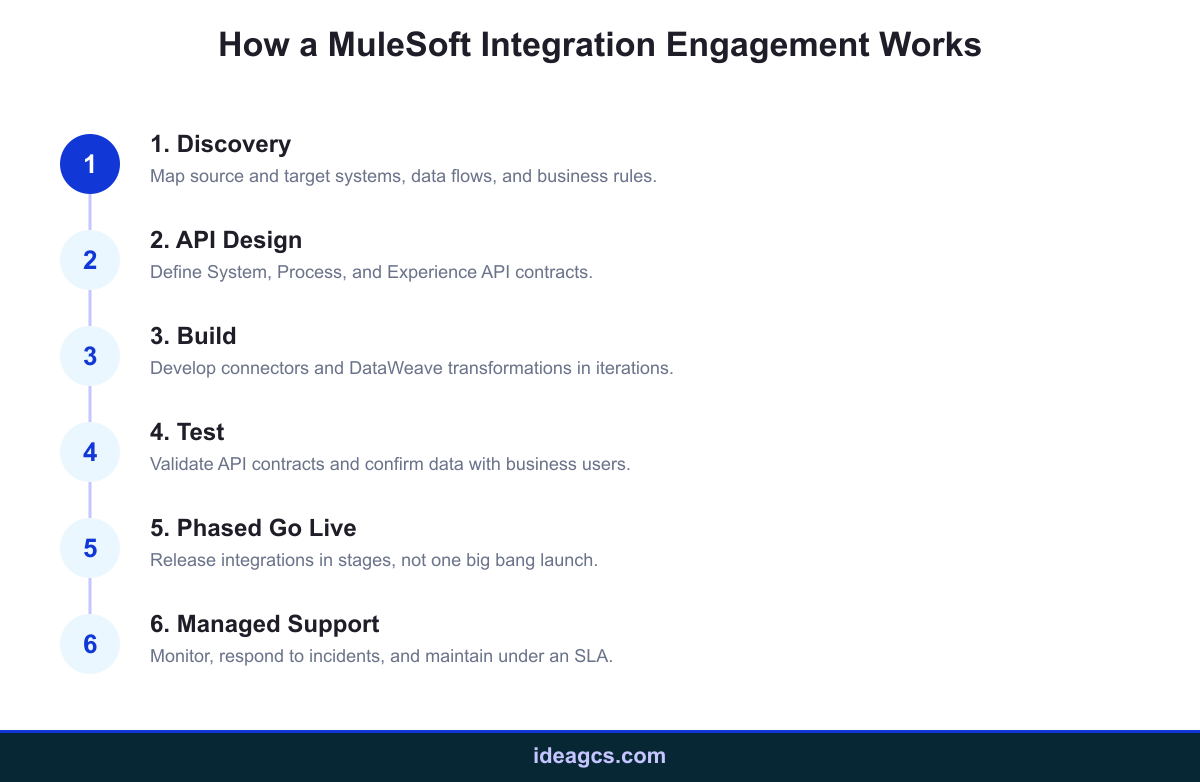
Engagements generally follow a consistent sequence regardless of industry: discovery and API design, incremental build and testing, phased go live, then a transition into ongoing managed support. IdeaGCS structures projects this way specifically so early phases de risk later ones, since API contracts get validated with business and technical stakeholders before a single line of implementation code is written.
Discovery typically takes one to three weeks depending on how many source systems are involved and how well documented they already are. Build and testing then proceed in short iterations, delivering working APIs in stages rather than as one large release at the end of the project, which lets the buyer's team start validating real data flows early instead of waiting months for a single big bang launch.
Testing itself usually happens on two tracks at once: automated tests that check each API contract behaves as specified, and manual validation with real business stakeholders confirming that the data flowing through the integration actually matches what their downstream reports and processes expect. Skipping the second track is a common reason integrations technically work but still get rejected by the business users who have to rely on them daily.
MuleSoft API Led Connectivity Versus Point to Point Integration
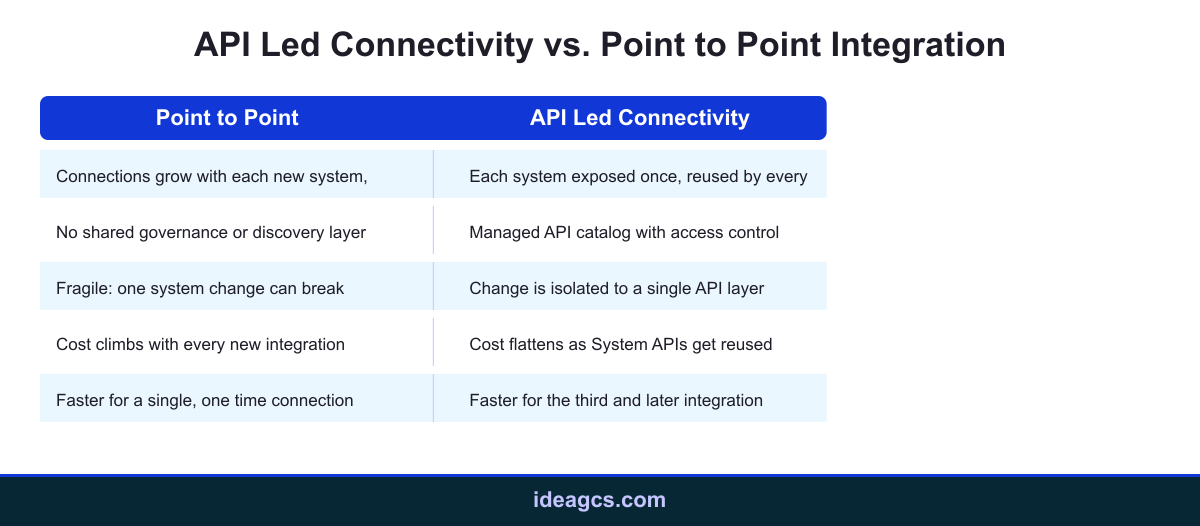
The core architectural choice in any integration program is API led connectivity versus point to point scripting. Point to point integration connects System A directly to System B, then System A directly to System C, and so on, which means every new system added multiplies the number of connections that must be built, tested, and maintained, a pattern sometimes called integration spaghetti.
API led connectivity instead layers System, Process, and Experience APIs so each backend system is exposed once and reused by every consumer that needs it. This is the architectural pattern behind most modern MuleSoft solutions, and it is the reason integration cost tends to flatten over time rather than climbing with every new system, since a new project typically reuses System APIs that were already built for an earlier initiative instead of starting from zero.
The tradeoff is upfront discipline. API led connectivity requires more architectural planning before the first integration ships, which can feel slower in month one compared to a quick point to point script. Organizations that skip this planning step to hit an early deadline usually end up rebuilding the same integration logic multiple times as more systems get added, which erases the time saved early on.
The N Squared Problem in Practice
With ten systems connected point to point, the theoretical maximum number of direct connections climbs into the dozens, and each one needs its own error handling, authentication, and monitoring. API led connectivity caps that growth by routing everything through a shared System API layer, so adding an eleventh system means building one new API, not renegotiating connections with all ten existing ones.
When Point to Point Is Still Fine
Point to point integration is not always wrong. A single, stable connection between two systems that will never need a third consumer rarely justifies the overhead of a full API layer. The architectural decision should scale with how many systems are involved and how likely that number is to grow, not be applied as a blanket rule in either direction.
MuleSoft Development Services
Development services cover new API and connector builds: designing endpoints, writing DataWeave transformations, and integrating with backend systems ranging from Salesforce to legacy on premises databases. This is project based work, typically scoped against a defined set of integration flows rather than an open ended retainer, and priced accordingly once the flow count and complexity are known.
Buyers evaluating MuleSoft development services should ask for a clear breakdown of which flows are in scope, what counts as a change request versus what was already included, and how DataWeave transformation complexity is estimated, since transformation logic handling nested, inconsistent, or poorly documented source data is often the most variable cost driver in a build even when the number of connectors looks small on paper.
It is also worth asking how a prospective partner handles error mapping and retry logic within a build, since integrations that only handle the happy path tend to generate a steady stream of production incidents once they meet real world data quality issues. A development partner that designs for failure up front, not just for the successful case, produces integrations that need far less firefighting once live.
Development timelines also depend on how many environments the build needs to move through before production. A typical path runs development, then a shared test environment, then a staging environment that mirrors production configuration, then production itself, with sign off gates between each stage. Skipping the staging step to save time is a common source of go live surprises, since staging is usually the first environment that surfaces production scale data volume and permission issues.
Version control and CI/CD practices matter here as much as they do in general application development. Integration flows that are managed through source control and deployed through an automated pipeline are far easier to roll back safely if a release introduces a problem, compared to flows that were built and deployed manually through a developer's local machine without a repeatable process behind them.
MuleSoft Managed Services and Ongoing Support
Once integrations go live, they need monitoring, incident response, and periodic updates as connected systems change on their own release cycles. MuleSoft support services typically run on a tiered SLA, from business hours coverage up to 24x7 follow the sun support for integrations that cannot tolerate downtime, such as those sitting between a payment system and an order management platform.
Many organizations debate managed services versus building an in house Center of Excellence to run integrations themselves. IdeaGCS has written a dedicated comparison on managed services versus in house management that walks through the staffing, cost, and control tradeoffs in more depth than this guide covers, including how team seniority mix and incident response time commitments affect the total cost of each option.
SLA tier should match actual business risk rather than default to the most expensive option. An internal reporting integration that refreshes overnight rarely needs the same response time guarantee as a customer facing checkout integration, and buying 24x7 coverage across the board when only a handful of flows are truly critical is a common source of managed services overspend.
Support scope should also be defined clearly up front: does the managed services contract cover only the APIs the partner originally built, or does it extend to integrations the buyer's own team builds later on the same platform. This distinction matters more than it first appears once an organization starts building new flows internally after the initial engagement wraps.
MuleSoft Consulting Services and Technical Staffing
Not every organization needs a full turnkey engagement covering design, build, and support. Some already run an internal integration team but need MuleSoft consulting services for architecture review and validation, or need technical staffing services to add certified MuleSoft developers to an existing team for a defined project window without committing to a permanent headcount increase.
This staffing angle matters because MuleSoft skills are still relatively scarce compared to more general purpose development skills, and certified developers with real production experience on Anypoint Studio and DataWeave are not interchangeable with a generalist backend engineer. Reading up on what makes a great MuleSoft developer is a useful next step before deciding whether to hire directly, engage a consultant for architecture only, or bring in staff augmentation for the build phase.
Consulting engagements are often the right starting point for organizations that are unsure whether their integration problem even needs MuleSoft specifically, versus a lighter weight tool or a targeted fix to an existing system. An architecture review before committing to a platform choice can save months of rework compared to selecting a platform first and discovering the fit issue mid build.
Staff augmentation arrangements also vary in how much ownership the augmented developer takes. Some engagements place a contract developer directly under the buyer's own technical lead, working inside their existing sprint process. Others have the staffing partner manage delivery end to end while simply reporting progress back to the buyer, which is closer to a light consulting engagement than pure staffing. Clarifying which model applies before the engagement starts avoids confusion later about who owns delivery decisions.
Choosing a MuleSoft Integration Partner
Partner selection should weigh certified developer availability, delivery methodology, post launch support SLAs, pricing transparency, and relevant industry experience. A partner that only quotes a build phase and stays vague on support terms is quietly pushing operational risk onto the buyer's own team once the project officially ends and the invoices stop.
It is also worth asking a prospective partner to walk through a past project of similar scope and industry, including what went wrong and how it was handled, since every real integration project hits at least one unexpected data quality or system access issue along the way. A partner that can only describe smooth projects is either inexperienced or not being fully candid.
For a deeper, checklist style breakdown of what to ask a prospective partner before signing, see how to choose the right integration service provider, which pairs well with this guide's broader overview and organizes evaluation questions into clear categories rather than a single long list.
Red Flags During Vendor Evaluation
Watch for vendors who cannot name the specific MuleSoft certifications their proposed team holds, who quote a single fixed price without asking any discovery questions about your systems first, or who cannot describe how they would handle a mid project scope change. Each of these signals a partner more focused on closing the deal than delivering the actual integration.
Good Signs Worth Weighting Heavily
Strong partners ask detailed questions about your existing systems before quoting, propose a phased delivery plan instead of one large release, and are transparent about what happens if a data source turns out to be messier than expected during discovery. Transparency about risk before the contract is signed is a far better predictor of a smooth project than a low headline price.
Why Enterprises Invest in MuleSoft Integration Services
The business case usually comes down to speed and reuse. Once a System API exists for a core platform like an ERP, every future project that needs that data reuses the same API instead of commissioning a new point to point build, which compounds savings across each additional integration project rather than delivering a one time benefit.
This compounding effect is also why organizations that adopt MuleSoft consulting services early, before their integration debt becomes unmanageable, tend to see a faster payback than those who wait until point to point scripts have already multiplied across dozens of systems. Retrofitting API led connectivity onto an existing mess is possible but takes longer and costs more than building it in from the start.
IdeaGCS has written more on why MuleSoft is key to enterprise digital transformation and on API led connectivity and business agility for readers who want the strategic case in more depth, and can consult official MuleSoft documentation for platform level technical detail beyond the scope of this guide.
The strongest version of this business case shows up over a multi year horizon rather than a single project. Organizations that track total integration spend often find that the third and fourth integration projects on a well built API layer cost a fraction of the first, since the foundational System APIs are already built, tested, and running in production.
There is also a talent retention angle that is easy to overlook. Engineers generally prefer working with a well governed, reusable API layer over maintaining a growing pile of fragile point to point scripts, and organizations with a reputation for messy integration debt often find it harder to attract strong integration talent than those with a clean, documented API catalog to point to during hiring conversations.
Conclusion
MuleSoft integration services turn a tangle of point to point connections into a governed, reusable API layer that gets faster and cheaper to extend with every new project. Whether an organization needs full delivery, staff augmentation, or ongoing managed support, the right partner should be transparent about scope, pricing, and support from the first conversation rather than leaving those details for the fine print. Talk to IdeaGCS to scope a MuleSoft integration engagement against your own systems landscape and current integration challenges.
Frequently Asked Questions
What are MuleSoft integration services?

How long does a typical MuleSoft integration project take?
What is the difference between MuleSoft development and managed services?
Do I need a certified MuleSoft developer for my project?
What is API led connectivity?
How much do MuleSoft integration services cost?
Can MuleSoft integration services be outsourced?
What industries use MuleSoft integration services the most?
What happens after a MuleSoft integration goes live?
How do I choose the right integration platform for my business?
Contact Us
Share on Social Media
Contact Us