MuleSoft Managed Services vs In-House Management: Which is Right for Your Business?
Introduction
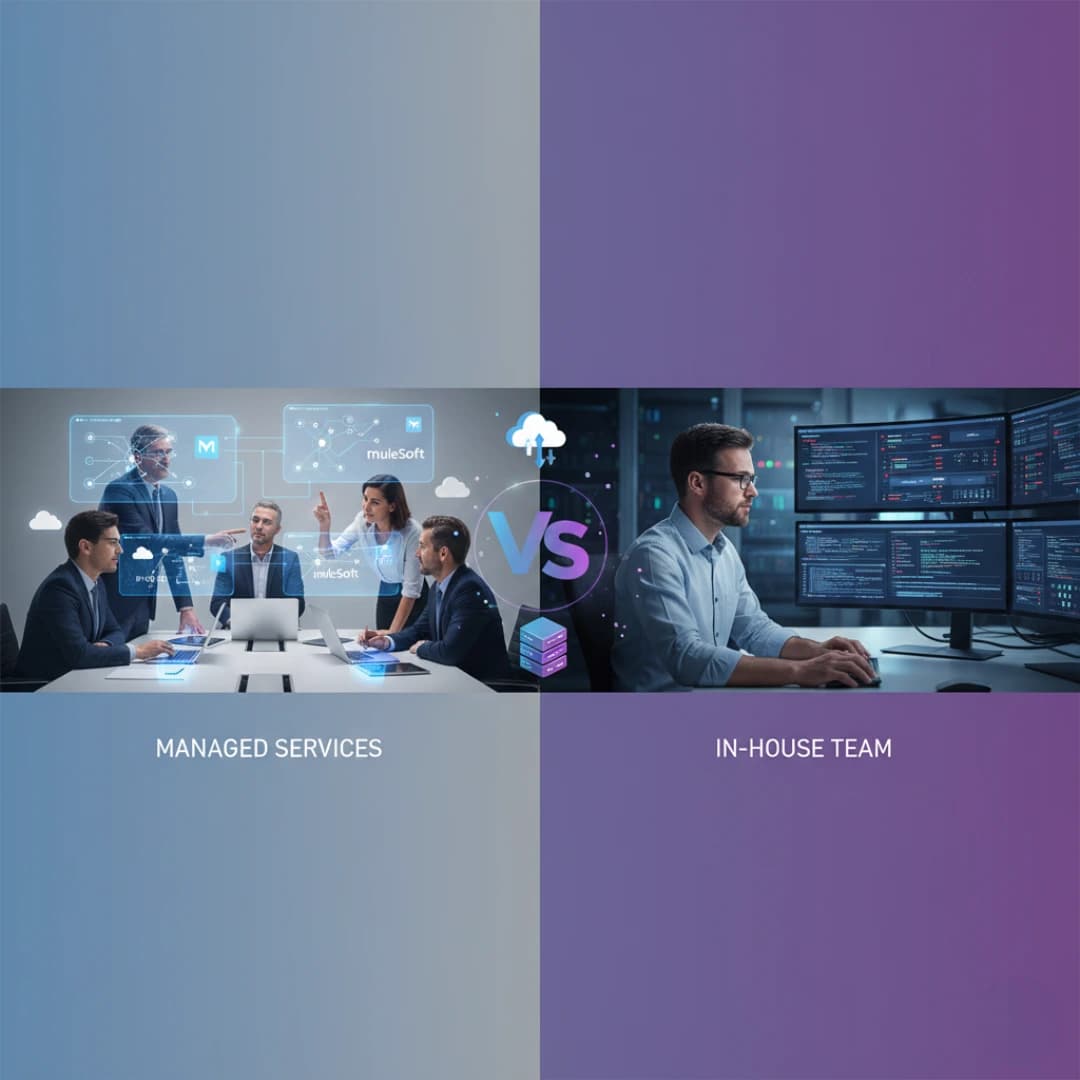
Choosing between mulesoft managed services and in-house management is one of the most critical decisions for organizations implementing MuleSoft integration solutions. With API-led connectivity becoming essential for digital transformation, businesses must evaluate whether to build an internal team or partner with external experts. This decision impacts your budget, operational efficiency, scalability, and long-term success.
In this comprehensive guide, we'll explore the key differences between managed services and in-house management, examining costs, expertise requirements, scalability considerations, and strategic advantages. By the end, you'll have the clarity needed to make an informed decision aligned with your business objectives.
Key Takeaways
MuleSoft managed services provide access to specialized expertise without the overhead of hiring and training full-time staff.
In-house management offers greater control but requires significant investment in recruitment, training, and infrastructure.
The right choice depends on your organization's size, budget, technical maturity, and strategic priorities.
Hybrid approaches combining both models can optimize flexibility and cost-effectiveness for growing enterprises.
Understanding MuleSoft Managed Services
MuleSoft managed services involve partnering with specialized providers who handle the planning, implementation, monitoring, and maintenance of your MuleSoft integration platform. These providers bring deep technical expertise and proven methodologies developed across hundreds of client engagements.
When you engage mulesoft professional services, you gain access to certified architects, developers, and administrators who stay current with platform updates and industry best practices. This eliminates the learning curve and accelerates time-to-value. Managed service providers typically offer 24/7 monitoring, proactive optimization, and rapid incident response—capabilities that would require substantial investment to replicate internally.
Furthermore, managed services operate on predictable monthly fees, converting capital expenditure into operational expenditure. This financial model provides budget certainty and eliminates unexpected costs associated with staff turnover, training, and infrastructure upgrades. For organizations prioritizing agility and speed-to-market, managed services deliver immediate access to resources without lengthy hiring cycles.
Benefits of Managed Services Approach
Partnering with a mulesoft development company offers several strategic advantages that extend beyond simple cost savings.
Access to Specialized Expertise: Managed service providers employ teams of MuleSoft-certified professionals with extensive cross-industry experience. These experts have encountered and solved complex integration challenges across healthcare, finance, retail, and manufacturing sectors. Their collective knowledge accelerates problem-solving and reduces implementation risks significantly.
Scalability and Flexibility: As your integration needs evolve, managed services scale resources up or down without hiring or layoffs. Whether launching a new product line, expanding to new markets, or acquiring another company, your provider adjusts capacity to match demand. This elasticity proves invaluable during periods of rapid growth or organizational change.
Latest Technology and Tools: Service providers invest heavily in training, certifications, and tooling that individual companies might find cost-prohibitive. Your team benefits from enterprise-grade monitoring platforms, automated testing frameworks, and optimization tools without direct investment. Providers also maintain relationships with MuleSoft, gaining early access to new features and technical support.
Reduced Time-to-Market: With experienced professionals handling implementation, businesses achieve production readiness 40-60% faster than in-house teams building capabilities from scratch. This speed advantage translates directly into competitive positioning and faster ROI realization.
The In-House Management Model
In-house management means building and maintaining an internal team responsible for all aspects of your MuleSoft implementation. This approach gives organizations complete control over their integration architecture, development priorities, and operational procedures.
Companies choosing in-house management typically hire MuleSoft architects, developers, administrators, and support staff. This team becomes intimately familiar with your business processes, data models, and application landscape. They develop deep institutional knowledge that can drive innovation and custom solutions tailored precisely to your requirements.
However, building this capability requires substantial upfront investment. Recruiting certified MuleSoft professionals in today's competitive market is challenging, with salaries ranging from $100,000 to $180,000 annually depending on experience level. Beyond compensation, you must budget for training, certifications, development tools, and infrastructure—costs that accumulate quickly before delivering any business value.
Advantages of Building Internal Capabilities
Developing in-house MuleSoft expertise offers distinct benefits for certain organizational profiles and strategic priorities.
Complete Control and Customization: Internal teams can experiment freely with custom solutions, develop proprietary integrations, and optimize for unique business requirements without external approval processes. This autonomy enables rapid prototyping and innovation aligned precisely with strategic objectives.
Deep Business Knowledge: In-house developers understand company culture, internal politics, and unspoken requirements that external consultants might miss. This contextual awareness leads to more intuitive solutions and smoother adoption. They also serve as integration champions who can educate colleagues and drive cultural change around API-led connectivity.
Long-term Cost Efficiency: For large enterprises with extensive, stable integration needs, in-house teams may prove more cost-effective over multi-year horizons. Once the initial investment in hiring and training is complete, ongoing costs stabilize. Organizations running 50+ integration flows with minimal changes might achieve better economics with permanent staff.
Intellectual Property Retention: Proprietary integration patterns, custom connectors, and architectural decisions remain within your organization rather than relying on external documentation or knowledge transfer. This intellectual capital becomes a competitive asset and facilitates future development efforts.
Critical Factors in Your Decision
Several key considerations should guide your choice between managed services and in-house management. Understanding these factors helps align your decision with broader business objectives and organizational capabilities.
Budget and Financial Considerations
Cost structures differ fundamentally between these models. MuleSoft managed services typically operate on monthly subscription fees ranging from $5,000 to $25,000 depending on complexity and support levels. This predictable expense includes personnel, tools, and platform management without capital investment.
In-house teams require salaries, benefits, office space, training, and infrastructure—easily exceeding $500,000 annually for a small team of four professionals. Additionally, consider hidden costs like recruitment fees, onboarding time, and productivity gaps during vacation or turnover. Financial models should project 3-5 year total cost of ownership rather than focusing solely on immediate expenses.
For startups and mid-sized companies, managed services often provide superior ROI by avoiding large upfront investments. For enterprises with 100+ employees and substantial integration portfolios, building internal capabilities may justify the investment through economies of scale.
Expertise Requirements and Availability
MuleSoft platform expertise remains scarce, with certified professionals commanding premium compensation. Assess whether your local market provides access to qualified candidates or if remote work policies expand your talent pool sufficiently.
Managed service providers maintain bench strength across skill levels—from junior developers to principal architects. This diversity ensures appropriate expertise for every task without overpaying for senior resources on routine maintenance. Internal teams often struggle with this balance, either overstaffing with expensive experts or understaffing and risking quality issues.
Consider also the breadth of knowledge required. Successful MuleSoft implementations demand expertise in API design, security, cloud platforms, DevOps, and various application protocols. Few individuals possess all these skills, requiring teams of specialists that managed services provide more economically.
Scalability and Growth Trajectory
Rapidly growing companies need integration capabilities that expand alongside business operations. MuleSoft consulting services excel at scaling resources dynamically—adding developers for major projects then scaling down during maintenance phases.
In-house teams lack this flexibility. Hiring takes 3-6 months from requisition approval to productive contribution. During high-demand periods, teams become overstretched, leading to burnout and quality compromises. During slow periods, staff sit idle—wasting valuable resources.
Organizations with unpredictable growth patterns, seasonal demand fluctuations, or project-based work benefit enormously from managed services flexibility. Those with steady, predictable workloads may prefer stable in-house staffing.
Making the Strategic Choice
The optimal approach balances your organization's specific circumstances against the strengths of each model. Consider these strategic guidelines when making your decision.
Choose Managed Services If:
You're implementing MuleSoft for the first time and lack internal expertise
Your organization has fewer than 500 employees or limited IT budgets
You need to accelerate time-to-market for competitive advantage
Integration demands fluctuate significantly throughout the year
You prefer operational expense models over capital expenditures
Access to local MuleSoft talent is limited or expensive
Choose In-House Management If:
You're a large enterprise with 50+ continuous integration projects
Your business requires highly customized, proprietary integration patterns
You have successful track records building and retaining specialized technical teams
Integration represents a core competitive differentiator for your industry
You possess budget and patience for 18-24 month capability building
Regulatory or security requirements mandate complete internal control
Consider Hybrid Approaches For:
Medium to large organizations wanting flexibility and control
Companies with stable baseline workloads but occasional surge demands
Organizations building long-term capabilities while managing short-term projects
Businesses requiring specialized skills not economically justified full-time
Many successful organizations start with managed services to accelerate initial implementation, then gradually transition selected functions in-house as internal capabilities mature. This progressive approach balances speed with long-term sustainability.
Conclusion
Deciding between mulesoft managed services and in-house management requires careful analysis of your organization's financial resources, technical maturity, growth trajectory, and strategic priorities. Neither approach is universally superior—the right choice depends on your specific circumstances and business objectives.
Managed services provide immediate access to expertise, predictable costs, and operational flexibility ideal for organizations prioritizing speed and agility. In-house teams offer deeper customization, complete control, and potential long-term cost advantages for enterprises with substantial, stable integration requirements.
With over 20 years of experience delivering next-generation IT solutions, IdeaGCS helps businesses navigate this critical decision. Our comprehensive MuleSoft integration services combine the best of both worlds—providing expert managed services while helping you build internal capabilities when strategically appropriate. Contact us today to discuss which approach aligns with your digital transformation goals and unlocks maximum value from your MuleSoft investment.
Frequently Asked Questions
What are MuleSoft managed services?

MuleSoft managed services are professional offerings where specialized providers handle the complete lifecycle of your MuleSoft integration platform, including implementation, monitoring, optimization, and maintenance. These services provide access to certified experts, 24/7 support, and proven best practices without requiring internal hiring and training investments.
How much do MuleSoft managed services cost compared to in-house teams?
MuleSoft managed services typically cost $5,000-$25,000 monthly depending on complexity, while in-house teams require $500,000+ annually for salaries, benefits, infrastructure, and training. Managed services convert capital expenditure to operational expenditure, providing predictable costs and eliminating unexpected expenses from staff turnover and technology upgrades.
What expertise is required for in-house MuleSoft management?
In-house MuleSoft management requires certified architects, developers, and administrators with expertise in API design, security protocols, cloud platforms, and DevOps practices. Teams need continuous training on platform updates, industry best practices, and emerging integration patterns. Most organizations require 4-6 specialized professionals minimum to ensure adequate coverage and capability depth.
Can small businesses benefit from MuleSoft managed services?
Yes, small businesses benefit significantly from MuleSoft managed services by accessing enterprise-grade integration expertise without large capital investments. Managed services eliminate lengthy hiring processes, provide immediate implementation support, and scale resources according to business needs. This approach enables small businesses to compete effectively with larger enterprises through advanced API-led connectivity.
What are the main advantages of building an in-house MuleSoft team?
Building an in-house MuleSoft team provides complete control over integration architecture, enables deep customization aligned with unique business requirements, and develops institutional knowledge specific to your organization. Internal teams understand company culture, business processes, and strategic priorities better than external consultants, leading to more tailored solutions and innovation.
How quickly can managed services implement MuleSoft compared to in-house teams?
Managed services typically achieve production readiness 40-60% faster than in-house teams building capabilities from scratch. Providers leverage pre-built frameworks, proven methodologies, and experienced professionals who can start immediately. In-house teams require 3-6 months for recruitment, onboarding, and training before reaching productive capacity on integration projects.
What is a hybrid approach to MuleSoft management?
A hybrid approach combines managed services for specialized tasks or surge capacity with in-house staff for core integration functions. This model allows organizations to maintain strategic control while accessing external expertise for complex projects, peak demand periods, or specialized skills not economically justified full-time. Many enterprises begin with managed integration services and gradually transition functions in-house.
How do managed services handle security and compliance requirements?
Managed service providers implement comprehensive security frameworks including data encryption, access controls, audit logging, and compliance monitoring aligned with industry standards like SOC 2, HIPAA, and GDPR. Providers employ dedicated security specialists, conduct regular vulnerability assessments, and maintain certifications that individual companies find difficult to replicate. All activities follow strict security protocols and client-approved procedures.
What factors determine the total cost of ownership for in-house MuleSoft teams?
Total cost of ownership for in-house teams includes salaries, benefits, recruitment fees, ongoing training and certifications, development tools, infrastructure, office space, and management overhead. Additional costs arise from staff turnover, productivity gaps during transitions, and potential quality issues from inexperienced team members. Organizations should project 3-5 year horizons including all direct and indirect expenses.
When should companies transition from managed services to in-house management?
Companies should consider transitioning when they reach sufficient integration maturity with 50+ stable flows, possess budgets exceeding $1 million annually for integration, can attract and retain specialized talent, and view integration as core competitive advantage. The transition typically occurs gradually over 12-24 months, maintaining managed services for specialized functions while building internal capabilities for routine operations and strategic initiatives.
Contact Us
Share on Social Media
Contact Us