MuleSoft for Healthcare: Connecting EHR, Billing, and Claims Without a Rebuild

Hospital systems and health networks run on a patchwork of software. Electronic health record platforms, billing and revenue cycle tools, and claims systems rarely come from the same vendor, and they were rarely designed to talk to each other. MuleSoft integration services for healthcare solve this by connecting existing systems through APIs instead of replacing them. This article explains how API led connectivity links EHR, billing, and claims platforms, what it costs compared to a full system replacement, and where healthcare IT leaders should start.
Key Takeaways
- API led integration connects EHR, billing, and claims systems without replacing any of them.
- Healthcare organizations avoid the downtime and retraining costs of a full system rebuild.
- MuleSoft's Anypoint Platform is built for the compliance and audit demands of regulated data.
- Document heavy workflows, like claims intake, benefit from pairing integration with AI OCR.
Why Healthcare Systems Resist a Full Rebuild
Replacing a hospital's core EHR or billing system is a multi year commitment. Clinical staff need retraining, historical records need migration, and any gap in coverage risks patient safety or a break in revenue cycle. Most health networks cannot accept that level of disruption, even when their current systems are aging.
The stakeholders affected go well beyond IT. Compliance teams need to revalidate every regulated data flow. Revenue cycle staff need billing and claims submission to keep working without a gap that delays reimbursement. Clinical documentation teams need order sets, templates, and charting workflows to survive the transition intact. A rebuild puts all of these groups through disruption at the same time, which is why most health networks only attempt it once a decade at most.
API led connectivity offers a different path. Instead of tearing out the EHR, billing platform, or claims system, an integration layer sits between them and moves data on a defined schedule or in real time. Clinical and finance teams keep working in the tools they already know while the underlying data finally moves cleanly between systems.
What This Costs Compared to a Full Rebuild
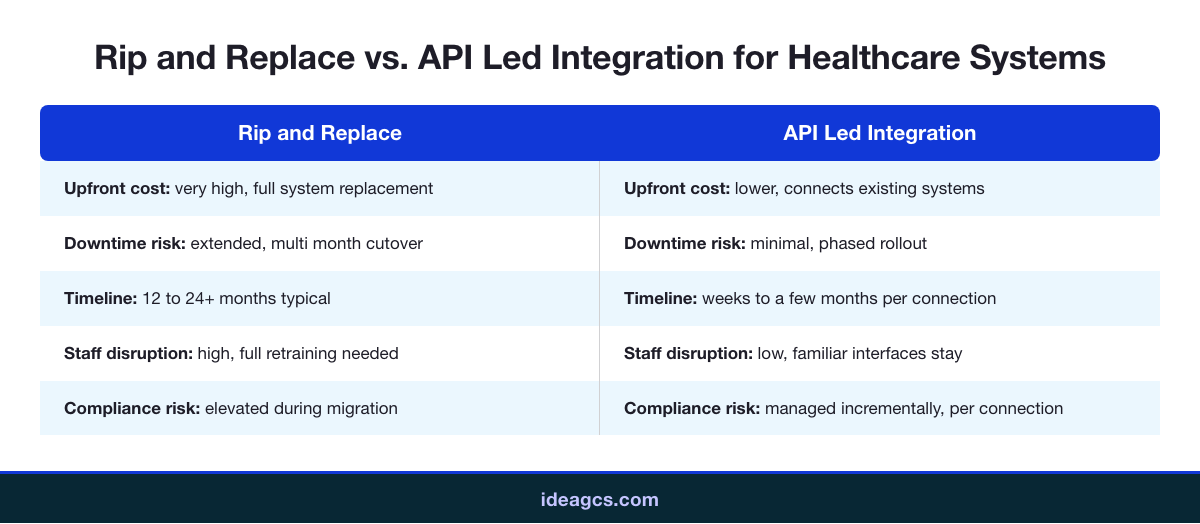
A full EHR or billing system replacement typically runs into seven or eight figures once licensing, data migration, staff retraining, and parallel running costs are included, and the twelve to twenty four month timeline means those costs land before the organization sees any return. An API led integration project scopes very differently. Because it connects existing systems rather than replacing them, the work is priced per connection rather than per enterprise rollout, and a single EHR to billing connection is a fraction of a rebuild's budget.
The bigger cost difference shows up in what a rebuild does not capture on paper: lost productivity while staff relearn workflows, temporary duplicate data entry during cutover, and the compliance risk of running two systems in parallel during migration. Integration avoids all three, since the underlying systems and the staff workflows built around them do not change.
Connecting EHR, Billing, and Claims Through APIs
A typical healthcare integration links three layers. System APIs expose data from the EHR, the billing platform, and the claims system in a consistent format. Process APIs apply business logic, for example matching a patient encounter in the EHR to the correct billing code before it reaches the claims system. Experience APIs then deliver that combined data to the tools staff actually use, whether that is a billing dashboard or a patient portal.
In practice, a single patient encounter might trigger several of these flows at once: the EHR posts the encounter, a process API checks it against payer rules and assigns the correct billing code, and a second process API pushes the coded claim to the clearinghouse while updating the billing dashboard staff already use. None of that requires a new system, only a defined path for existing data to travel.
This layered approach, sometimes called API led connectivity, is documented in detail by MuleSoft's own platform overview, and it is the same pattern IdeaGCS applies whether the systems involved are Epic, Cerner, a custom billing tool, or a regional claims clearinghouse.
Healthcare data also arrives in more formats than most industries deal with, from HL7 and FHIR feeds coming out of clinical systems to X12 EDI transactions required by payers for claims and eligibility checks. A System API layer built for healthcare needs to normalize all of these into a consistent internal format before any process logic runs, which is a large part of why generic integration platforms built for retail or finance data often need heavy customization to work reliably in a hospital environment.
Where Compliance Fits Into the Integration Layer
Healthcare data movement is governed by HIPAA, and any integration between EHR, billing, and claims systems has to account for the HIPAA administrative simplification requirements that govern electronic transactions between providers and payers. An API led integration layer gives compliance teams a single, auditable point where data movement can be logged, encrypted, and access controlled, rather than relying on ad hoc file transfers between systems.
That single point of control matters operationally, not just for audits. Every connection can enforce encryption in transit and at rest, apply role based access so only authorized systems and users see protected health information, and generate a consistent audit trail across every EHR, billing, and claims transaction, regardless of which vendor built the underlying system.
This is also why a phased integration is often the lower risk option compared with a rebuild. Each connection can be reviewed, tested, and signed off individually, instead of validating an entire replacement system in one compliance push before go live.
Extending Integration to Document Heavy Claims Work
Claims intake still involves a large volume of scanned forms, referral letters, and supporting documentation. Once EHR, billing, and claims systems are connected through APIs, that same integration layer can route incoming documents to an AI OCR pipeline, part of IdeaGCS's broader data and AI services, that extracts structured data automatically. IdeaGCS covers this pairing in more depth in its guide to AI OCR for healthcare document management, which walks through use cases like prior authorization and claims intake automation.
Prior authorization requests are a good example of where this compounds. A scanned referral letter can be read by the OCR pipeline, matched against the patient record through the same API layer that already connects the EHR and claims system, and routed into the correct queue automatically, cutting the manual data entry step out of a process that otherwise slows down every stage behind it.
Getting Started Without Disrupting Care Delivery
Most healthcare organizations start with a single, well defined connection, such as linking the EHR to the billing system for a specific department, rather than attempting an enterprise wide rollout at once. IdeaGCS explains this incremental approach further in its overview of how MuleSoft integration drives enterprise digital transformation, which applies the same phased logic across industries beyond healthcare.
A typical rollout runs in three stages. The first connects one department's EHR and billing flow and validates it against real claims. The second extends the same pattern to additional departments or facilities once the first connection is proven. The third adds the claims clearinghouse and document automation layer once the core data flow is stable. Each stage delivers value on its own, so care delivery is never waiting on the full project to finish.
Resourcing this well matters as much as sequencing it well. A first connection is usually delivered by a small team, often one integration developer paired with someone who understands the receiving system's billing rules, working alongside the hospital's own IT and compliance staff rather than replacing them. Health networks without that integration skill set in house typically bring in dedicated MuleSoft developers for the build, then hand off documented, supportable connections to their internal team once the pattern is proven.
Conclusion
EHR, billing, and claims systems do not need to be replaced to work together. MuleSoft integration services for healthcare connect them through APIs, keep staff in familiar tools, and give compliance teams a single auditable data layer. For health networks weighing a costly rebuild against a phased integration, the integration path is almost always faster, cheaper, and less disruptive to care delivery. The right starting point is rarely the whole organization at once. It is one well scoped connection, proven against real claims and real compliance requirements, that becomes the template for everything that follows. Talk to IdeaGCS about mapping your first EHR to billing connection.
Frequently Asked Questions
What are MuleSoft integration services for healthcare used for?

Does API integration replace our EHR system?
How does integration help with HIPAA compliance?
Can integration connect our claims clearinghouse too?
How long does a healthcare MuleSoft integration take?
Do we need to migrate historical patient data?
What is API led connectivity?
Can this approach also handle scanned claims documents?
Who typically owns a healthcare integration project?
How do we start evaluating MuleSoft for our organization?
Contact Us
Share on Social Media
Contact Us