Outsourcing DevOps to the Philippines: Cost, Time-Zone Coverage, and Talent Compared to India

Two locations dominate the conversation when an enterprise decides to move delivery engineering offshore, and the comparison is usually made badly. India is treated as the default and the Philippines as the cheaper alternative, when in practice the cost gap is narrower than assumed and the meaningful differences sit elsewhere — in coverage windows, in the shape of the available talent pool, and in what happens to your team eighteen months in.
IdeaGCS runs delivery out of both, so this is written from the inside rather than from a market report. It is a comparison of trade-offs, not a recommendation of one over the other, because the right answer genuinely depends on which constraint is binding for you.
Key Takeaways
- The cost difference between the two markets is real but smaller than most business cases assume — coverage and retention move the total more than rate does.
- The Philippines' time-zone position makes genuine follow-the-sun coverage with North America and Australia straightforward; India's makes European overlap straightforward.
- India has the deeper senior cloud and platform engineering pool; the Philippines has the stronger operations and support culture and better English-language fluency at scale.
- Retention, not rate, is the variable that most often wrecks an offshore delivery business case.
- A split model across both markets is common at scale and is worth modelling before defaulting to one.
Start With the Constraint, Not the Rate
Before comparing locations, be clear about what you are trying to fix. Three constraints send enterprises offshore, and each points to a different answer.
If the constraint is cost per engineer, both markets deliver a substantial reduction against US, UK and Australian rates, and the difference between them is a second-order effect. Choosing on rate alone tends to produce a decision that is right for the first year and wrong for the third.
If the constraint is coverage — you need eyes on production outside your own working day — geography decides it, and the decision is close to mechanical once you plot the overlap.
If the constraint is capacity you cannot recruit locally, the question is which market has depth in the specific skill you are short of. That is not the same question as which market is larger.
Most requirements are a blend, but there is nearly always a dominant one. Naming it out loud shortens the evaluation considerably.
Time-Zone Coverage: The Difference That Is Not Negotiable
This is the cleanest distinction between the two, because it is arithmetic rather than judgement.
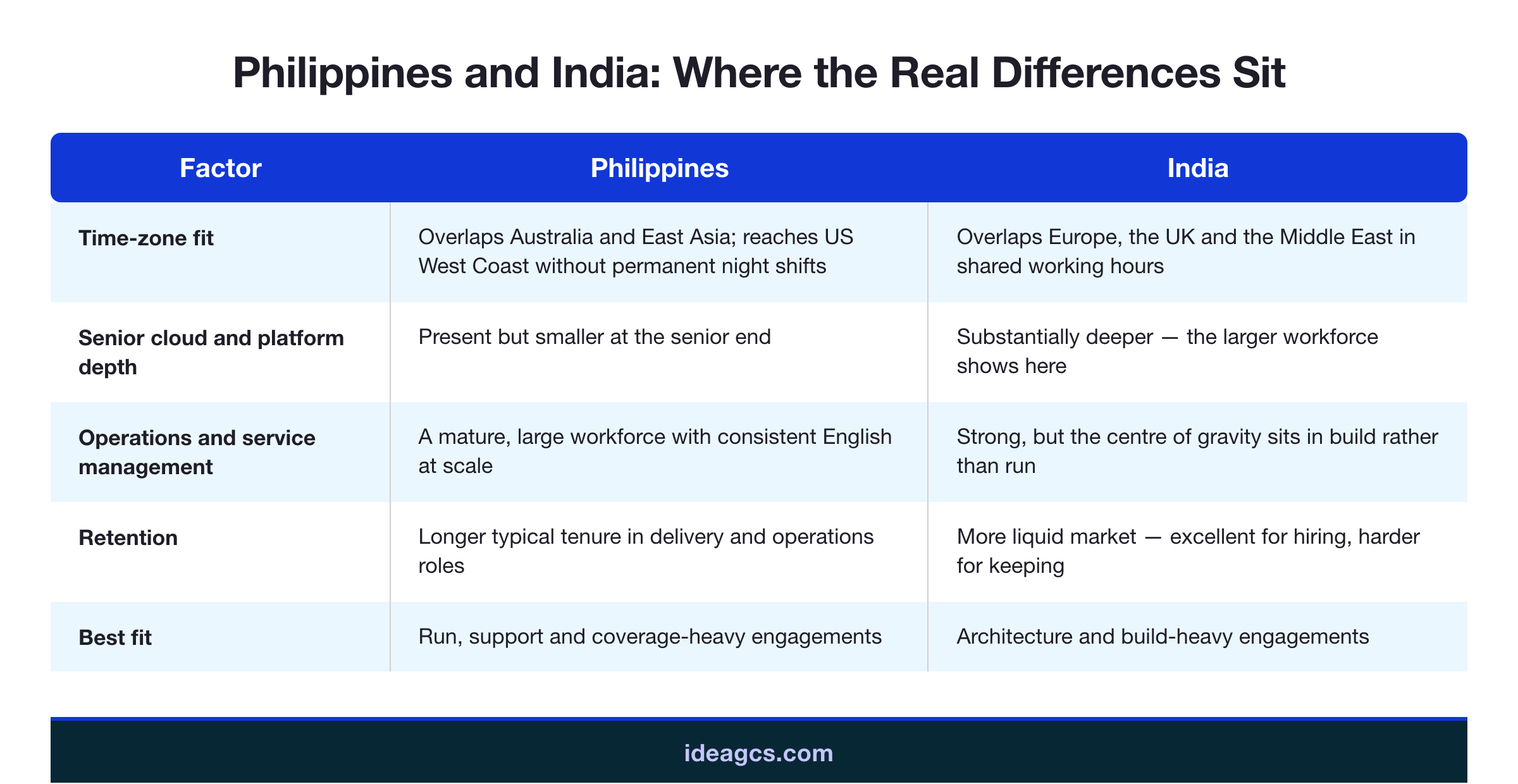
The Philippines sits in a position that overlaps comfortably with Australia and East Asia during its own working day, and reaches the US West Coast in its early morning and late evening. For a North American business wanting genuine overnight cover — someone awake and accountable while the primary team sleeps — it works without asking anyone to keep unnatural hours permanently.
India overlaps well with Europe, the Middle East, and the UK. A UK business gets most of its afternoon in shared hours with an Indian team, which is enough for real-time collaboration rather than handover-only working. Reaching the US West Coast from India, by contrast, means someone is working a night shift, and night shifts have a retention cost that shows up six to twelve months later.
The practical rule: pick the market whose normal working day overlaps the hours you need, rather than the one whose rate you prefer and then engineering around the gap. Rotas built to bridge a bad geographic fit are the most reliable predictor of attrition in an offshore team.
Cost: Where the Business Case Usually Goes Wrong
Rates in both markets vary more by seniority and specialism than by country. A senior platform engineer with production Kubernetes and infrastructure-as-code experience commands a premium in Manila and in Bengaluru alike, because the same global employers are competing for them.
The larger error in most business cases is modelling only the rate. Three other lines move the total more:
Ramp time. An engineer who takes three months to become productive on your estate costs you three months regardless of their rate. Markets with deeper domain-adjacent experience shorten this.
Retention. Replacing an engineer costs recruitment, ramp, and the knowledge that leaves with them. India's technology labour market is more liquid and more competitive, which is excellent for hiring and less good for keeping. The Philippines typically shows longer tenure in delivery and operations roles, and that difference compounds.
Management overhead. Distributed teams need more deliberate communication than co-located ones, and someone has to do it. Budgeting zero for this is the single most common omission.
Model those four lines together and the two markets usually land closer than the headline rates suggest — with the ordering sometimes reversing entirely for operations-heavy work.
Talent Depth: Different Shapes, Not Different Sizes
India's technology workforce is larger by an order of magnitude, and the depth shows most clearly at the senior end of cloud architecture, platform engineering, and large-scale distributed systems. If you need someone who has designed a multi-region estate before, the pool is deeper.
The Philippines' strength is different and often underrated. The country's business process and shared-services sector has produced a large, mature workforce in operations, service management, and customer-facing technical roles, with English fluency that is high and — importantly — consistent. For cloud operations, monitoring, incident response, and the service-management side of delivery engineering, that combination is difficult to match.
The implication for buyers is straightforward. Weight India when the work is heavy on architecture and build. Weight the Philippines when the work is heavy on run, support, and coverage. Where the engagement contains both, split it. Our guide on when to bring engineering work in-house versus outside covers the prior decision this one follows.
The Split Model, and When It Is Worth the Overhead
At sufficient scale, running both markets is not a hedge — it is a design. A common shape places architecture and build in India, operations and coverage in the Philippines, and a small onshore core holding the estate relationship and the on-call accountability of last resort.
The overhead is real. Two locations means two management relationships, two sets of local employment practice, and a handover boundary that has to be designed rather than assumed. It is worth it when either the coverage requirement or the skill split is genuinely bimodal. It is not worth it for a team of eight.
The threshold most organisations find is somewhere around twenty to twenty-five offshore engineers, or the point at which a single market can no longer cover both the build roadmap and the run commitment without one of them suffering.
Making It Work Once the Decision Is Made
Location choice is maybe a third of the outcome. The rest is engagement design, and the same failures recur.
Contract knowledge transfer explicitly. Named internal owner, documented runbooks, a defined point at which your team runs the pipeline while the partner watches. Without this, an offshore engagement quietly becomes a dependency.
Give the offshore team ownership of something end to end. Teams that only execute tickets do not develop judgement about your estate, and judgement is most of what you are buying after the first year. The reference pattern here is the same one that governs any delivery-engineering partner relationship.
Budget for travel, at least at the start. Two weeks of overlap in person early in an engagement does more for a distributed team than a year of video calls. It is a small line against the cost of a team that never quite gels.
Measure the same things you would onshore. Deployment frequency, lead time, change failure rate, restore time. If an offshore team is measured differently from an onshore one, you have created two classes of engineer and the results will follow.
IdeaGCS staffs both markets — specialist hiring services where the requirement is people, and delivery automation services where it is a delivered capability.
Conclusion
The Philippines and India are not competing on the same axis. One offers coverage that fits North America and Asia-Pacific and a deep operations and service-management workforce; the other offers European overlap and the deeper senior cloud and platform engineering pool. Rate is the least interesting difference between them, and business cases built on rate alone tend to be wrong by the third year.
Decide which constraint is actually binding, model ramp and retention alongside rate, and design the engagement so knowledge accumulates on your side of the boundary. Where the requirement is genuinely bimodal and the scale supports it, run both. Talk to IdeaGCS if you want the split modelled against your own roadmap.
Frequently Asked Questions
Is the Philippines cheaper than India for delivery engineering?

Which market is better for 24/7 production cover?
Where is the senior cloud architecture talent deeper?
How big does a team need to be before splitting across both markets makes sense?
What is the most common reason an offshore delivery engagement fails?
How long does it take an offshore team to become productive?
Do we still need onshore staff?
How do language and communication differ between the markets?
What should be in the contract that usually is not?
Can we start small and scale?
Contact Us
Share on Social Media
Contact Us