Technical Staffing and Enterprise IT Support: A Complete Guide for Enterprise Buyers

Two capabilities that get budgeted separately are in practice tightly coupled. The people you can hire determine what you can support, and the support commitments you have made determine which roles you must fill. Organisations that plan them apart end up with a service level they cannot staff or a team with nothing defined to deliver.
This guide covers both: the engagement models available for technical capability, how support is actually specified and priced, where the two intersect, and the transitions between models that cause most of the difficulty.
Key Takeaways
- Decide on duration and specificity: permanent for continuous work, contract for bounded work, outsourced for defined service.
- A service level is a commercial instrument, not a quality statement — what it excludes matters more than the response time it promises.
- Coverage windows drive support cost more than volume does.
- Niche skills are usually cheaper bought than hired, because the hiring cycle exceeds the need.
- The transition between models is where knowledge is lost; contract it rather than assuming it.
The Engagement Models for Technical Capability
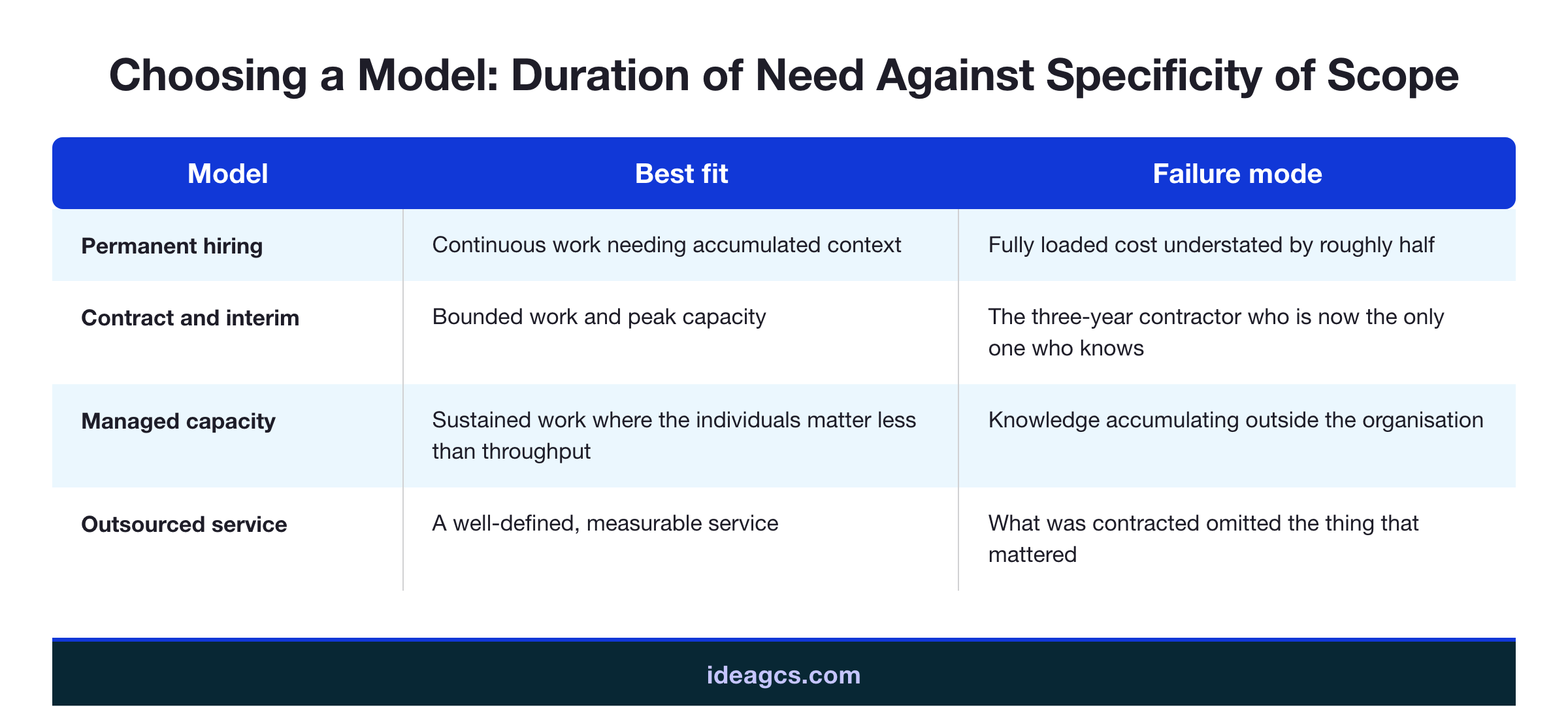
Permanent hiring. Suits continuous work requiring accumulated context. It is the only model that builds durable institutional knowledge, and the only one whose true cost is routinely understated — fully loaded cost is commonly around double base salary once employer taxes, benefits, equipment, recruitment, ramp, management and attrition are counted.
Contract and interim. Named individuals for a bounded period. Higher day rate, no long-term commitment, faster to start. Suits peak capacity and defined pieces of work. Its failure mode is the contractor who has been there three years and is now the only person who understands a critical system.
Managed capacity. A partner supplies a team against a scope rather than named individuals. You buy throughput; they carry the staffing risk. Suits sustained work where the specific individuals matter less than the delivery.
Outsourced service. A partner takes accountability for an outcome or a service level rather than for effort. Suits well-defined, measurable services — a support desk, an application under maintenance, an infrastructure estate.
The selection question is not which is best but two prior ones: how long the need lasts, and how precisely it can be specified. Long and vague points to permanent. Short and precise points to contract or outsourced. The remaining quadrants are where judgement is required. Our comparison of hiring models for scaling technology teams covers the recruitment side in detail.
Where Hiring Is the Wrong Instrument
Three situations recur where an organisation opens a permanent role and should not.
Niche skills needed occasionally. Specialist integration, a particular cloud discipline, a regulated-domain skill. The hiring cycle for these commonly exceeds the duration of the need, and a permanent hire ends up under-utilised or drifting into work they were not hired for.
Peak capacity. A migration, a compliance deadline, a product launch. Hiring for a peak leaves a trough, and the trough is where redundancy conversations happen.
Work that is really a deliverable. "We need a MuleSoft developer" is often "we need three integrations built". The second is buyable as an outcome, usually faster and at less total cost than recruiting for the first.
The mirror error also exists: contracting indefinitely for work that is genuinely continuous. That is more expensive per unit of delivery and leaves the knowledge outside the organisation.
How Support Is Actually Specified
A support arrangement is defined by five things, and buyers tend to negotiate only the first.
Response and resolution targets by severity. The standard service-management vocabulary is worth agreeing before the numbers are. Response is when someone starts; resolution is when the service is restored. Providers quote response targets because they are controllable. Resolution targets are what the business experiences, and a contract with response targets only has committed to answering the phone.
Coverage window. Business hours, extended hours, or continuous. This drives cost more than ticket volume does, because it drives the staffing model. Continuous coverage requires a rota with enough people to sustain it, and that is a step change rather than an increment.
Scope of what is supported. Which applications, which infrastructure, which user populations, and — critically — what happens at the boundary with systems the provider does not support. Incidents rarely respect the boundary.
Escalation and authority. Who can declare a major incident, who can authorise an emergency change, and how quickly a decision-maker can be reached out of hours.
Exclusions. The most informative part of any support contract. Third-party product defects, changes rather than incidents, anything requiring vendor engagement, and problem management as distinct from incident management are all commonly excluded and commonly assumed to be included.
The single most useful question to any support provider is what they will not do. The clarity of the answer predicts the relationship better than the price does.
Coverage Economics
Support cost is driven by the shape of the commitment more than by demand.
Business-hours support in a single geography is straightforward: enough people to handle the volume, with some headroom. Extending to continuous coverage in one location means shift work, which carries a retention cost that appears six to twelve months in. Providing continuous coverage across geographies means a genuine follow-the-sun arrangement — more expensive to establish and considerably more sustainable, because nobody works permanently against their body clock.
That geographic point is why offshore and multi-location delivery models dominate enterprise support. The choice between locations is driven by which working day overlaps the hours you need, and our comparison of Philippines and India delivery works through the trade-offs for the engineering side of the same decision.
The buyer-side implication: be honest about what coverage is genuinely needed. Continuous cover for systems whose users are asleep is a common and expensive default, and reviewing it against actual out-of-hours incident volume frequently frees a substantial budget.
Where Staffing and Support Intersect
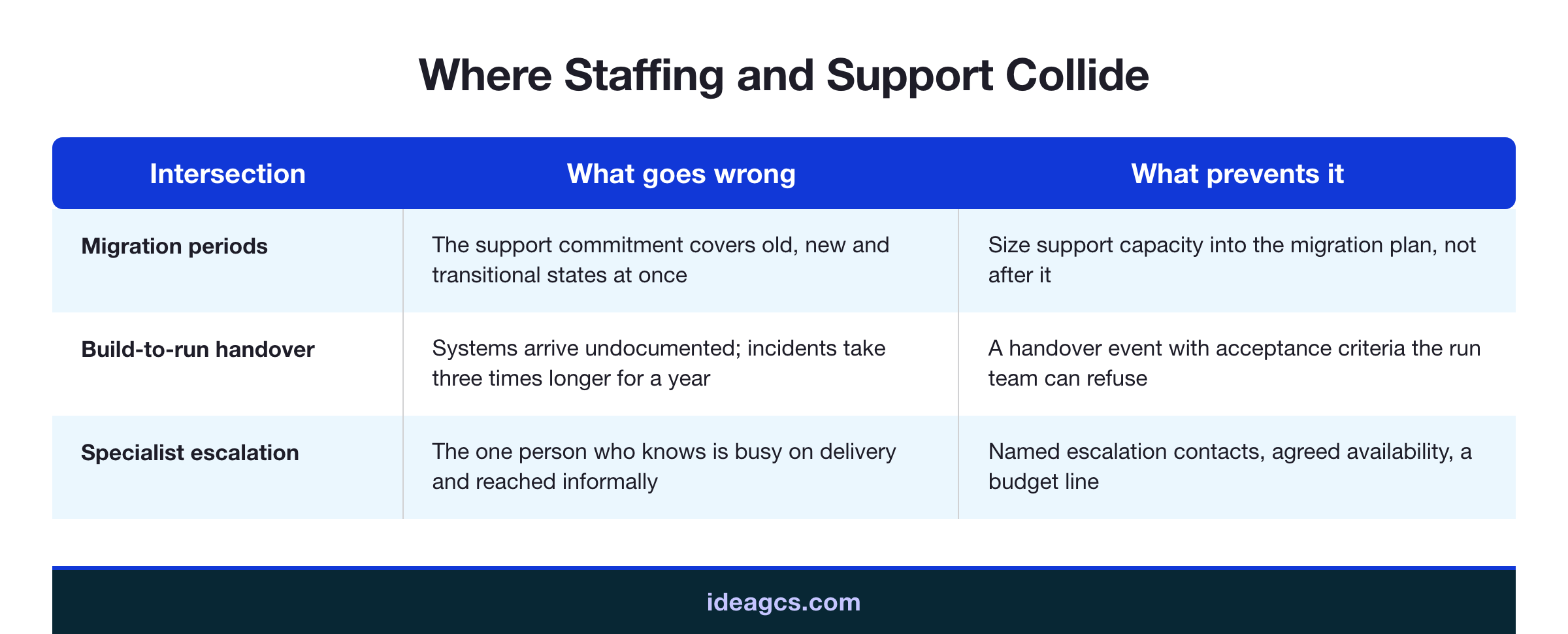
Three intersections cause most of the practical difficulty.
Migrations. During any significant migration, the support commitment applies to both the old and the new estate simultaneously, and to the transitional states in between. Staffing plans routinely account for the build and not for the doubled support surface. This is the most common cause of a support function being overwhelmed by a programme it was not consulted on.
Knowledge boundaries. A support team can only support what it understands. Systems built by a delivery team that then dispersed become the systems where incidents take longest, and no service level survives that for long. Handover from build to run needs to be a defined event with acceptance criteria, not an email.
Specialist escalation. Front-line support resolves the common cases; the uncommon ones need someone who knows the system deeply. That person is scarce, usually busy on delivery, and the arrangement for reaching them is often informal. Formalising it — named escalation contacts, agreed availability, and a budget line for their time — costs little and prevents a recurring failure.
IdeaGCS covers both sides: specialist hiring services for capability and enterprise service-desk services for run, which is why the two are scoped together rather than sequentially.
Building a Support Function From Nothing
Organisations that have grown quickly often reach a point where support is happening but nothing is structured — engineers answer questions directly, requests arrive by message, and nobody knows how much of the engineering week is being consumed. Four steps turn that into a function without over-engineering it.
Make demand visible first. Before designing anything, capture what is actually arriving: volume, type, who it comes from and roughly how long it takes. A fortnight of honest recording usually surprises everyone, and it is the only basis on which to size anything.
Define severity in your own language. Not generic tiers — the actual business services, named. "The payment run", "claims intake", "the ordering channel". This single artefact resolves most future disagreements about priority before they happen.
Separate the front line from the specialists. The largest early win is not more people; it is stopping specialists being interrupted for things a front line could resolve. That requires a knowledge base, which requires someone owning it, which is the resource most commonly omitted.
Then decide build or buy. With demand measured, severity defined and a knowledge base started, the make-or-buy comparison can be made on evidence rather than on impression — and either option costs less than it would have without the first three steps.
Contracting: The Terms That Decide the Relationship
Whether capability or support is bought, five contractual terms do most of the work, and none of them is the rate.
Knowledge transfer with a defined end point. A named internal owner, documented runbooks, and a period where your team operates while the supplier observes. Without a defined point at which the transfer is complete, it never is.
Named staff and what happens when they change. The gap between the people at the pitch and the people on the account is the most common structural complaint in this market. Name them, and agree what notice and what replacement standard applies.
Scope stated as exclusions. What a supplier will not do is more informative than what they will. Ask for it in writing before comparing prices; the clarity of the answer predicts the engagement better than the number does.
A commercial model that flexes downward. Requirements shrink as well as grow. An arrangement that penalises you for needing less next year is one you will be arguing about at renewal.
Exit provisions agreed at signature. What is handed over, in what format, within what period. Negotiated at notice — with the counterparty's cooperation already lost — these are worth considerably less.
Two further terms matter specifically for support. Severity assignment should sit with the customer, with a challenge process that does not downgrade during the challenge. And cross-boundary incident ownership — who owns an incident spanning supported and unsupported systems — should be named, because without it an outage becomes a supplier discussion while the business waits.
Managing the Transitions
Most organisations change model at some point: contract to permanent, in-house to outsourced, one provider to another. The transitions are where value leaks.
Contract to permanent. The knowledge is in a contractor's head and there is no contractual obligation to transfer it. Build the obligation in at the start rather than negotiating it at notice.
In-house to outsourced. The incoming provider needs to learn an estate the outgoing team may have little incentive to explain well. A defined shadowing period with the outgoing team still engaged is the mitigation, and it is worth paying for.
Provider to provider. The hardest, because the outgoing party's cooperation is contractual rather than voluntary. Exit provisions should specify what is handed over, in what format, and within what period — agreed at signature, when you have leverage.
The common principle: transitions should be designed when the relationship starts, not when it ends.
Measuring Both
For staffing: time to fill, quality of hire measured at six and twelve months, retention at twelve months, and the proportion of roles filled internally versus externally. Time to fill alone drives the wrong behaviour.
For support: resolution time by severity rather than response time, first-contact resolution rate, incident volume trend, repeat-incident rate, and user satisfaction sampled rather than solicited at ticket closure. The repeat-incident rate is the most diagnostic and the least commonly tracked — it distinguishes a support function that closes tickets from one that removes causes.
For both: the proportion of engineering effort spent on unplanned work. It is the number that tells you whether the arrangement as a whole is stable or deteriorating.
Conclusion
Technical capability and support are one problem viewed from two angles. Choose the engagement model on duration and specificity of need rather than on rate. Specify support on resolution rather than response, coverage rather than volume, and exclusions above all. Plan the two together at migration points, because that is where the doubled support surface catches organisations out.
And design the transitions between models at the start, when you have leverage and nobody is leaving. That single discipline prevents most of the value leakage in this area. Talk to IdeaGCS if you want capability and support scoped as one requirement.
Frequently Asked Questions
How do we choose between hiring, contracting and outsourcing?

What does a permanent engineer really cost?
What is the most important part of a support contract?
Should we contract on response time or resolution time?
What drives support cost most?
When is buying a deliverable better than hiring a specialist?
Why do migrations overwhelm support functions?
How should build-to-run handover work?
What is the most useful support measure that nobody tracks?
When should transition arrangements be agreed?
Contact Us
Share on Social Media
Contact Us