Where Legacy Booking Systems Are Quietly Losing Travel and Hospitality Revenue

Travel and hospitality operators rarely lose money in one visible place. They lose it in small amounts, continuously, in the gaps between systems that were never designed to work together — a rate that took six hours to update across channels, an upsell that could not be offered because the booking engine did not know the guest was a returning one, a cancellation that freed inventory nobody could resell in time.
None of these registers as a failure. Each is absorbed as normal. Added up across a year they are usually larger than any single line item in the technology budget, which is why the case for change is a revenue case rather than an IT one.
Key Takeaways
- Revenue leakage in this sector is distributional — many small losses rather than one large one — which is why it survives budget scrutiny.
- Rate and inventory latency across channels is the largest single leak in most estates.
- Guest data fragmented across booking, property, loyalty and point-of-sale systems makes personalisation impossible and repeat business harder to earn.
- Direct booking economics only improve when the direct channel is genuinely better, not merely cheaper for the operator.
- Integration is nearly always the cheaper first move; replacing the property or reservation system rarely needs to come first.
Where the Revenue Actually Goes
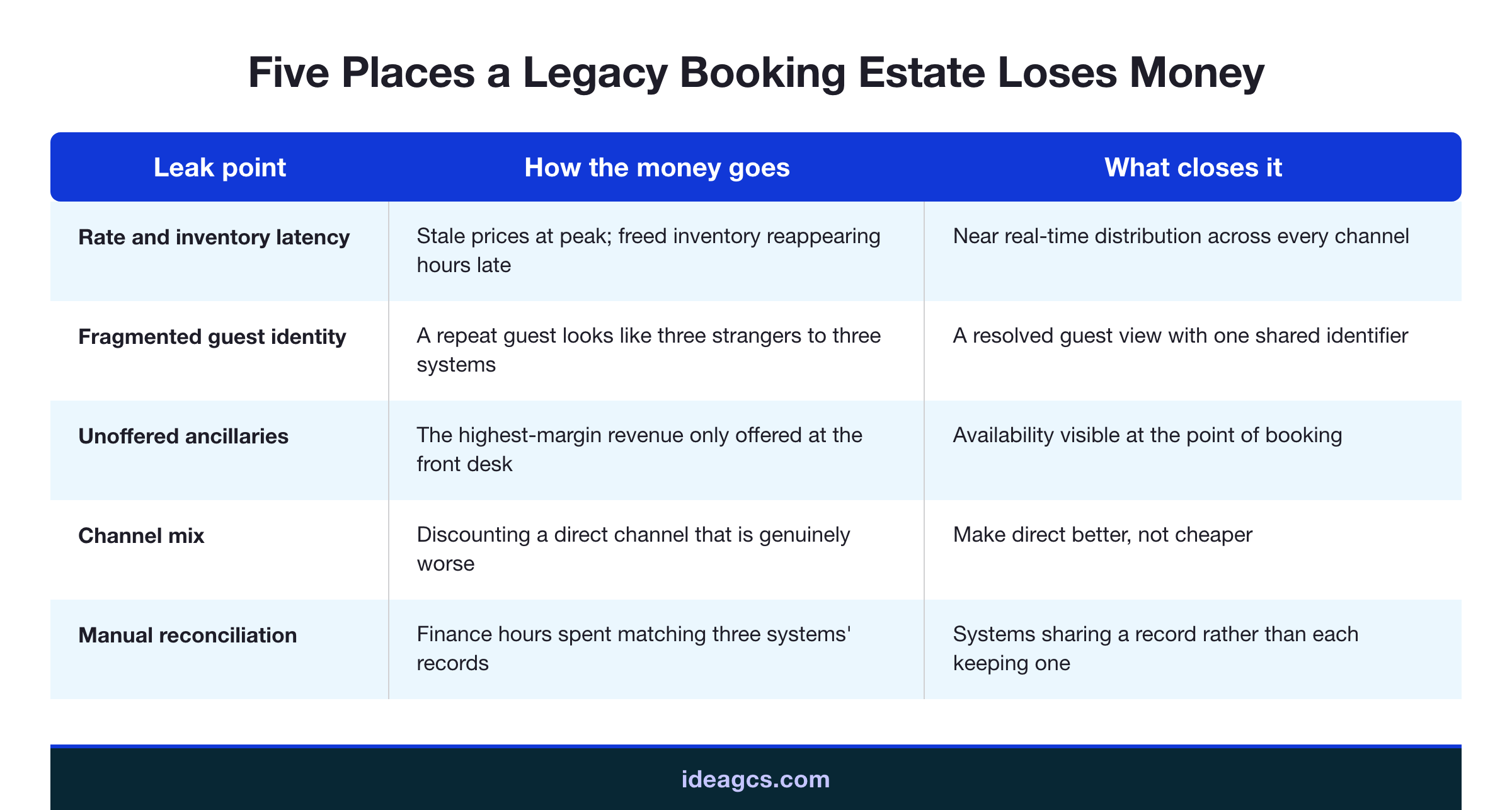
Rate and inventory latency
When a rate change takes hours to propagate across the direct site, online travel agents, the global distribution system, and the mobile app, two things happen. Inventory sells at a stale price during peak demand, and the operator either honours a rate they did not intend or absorbs the cost of a cancellation and a poor guest experience.
The reverse is worse. Inventory freed by a cancellation that takes six hours to reappear on the highest-yield channel is inventory sold at a discount or not at all. At high occupancy, that latency is directly a yield problem.
Fragmented guest identity
A returning guest whose history sits in the property management system, whose loyalty status sits in a separate platform, and whose current booking sits in the reservation engine is, from the systems' point of view, three different people. The consequence is not just a missed personalisation opportunity — it is that the operator cannot reliably tell a high-value repeat guest from a first-time price-led booker, and therefore treats both the same.
Upsell and ancillary revenue that never gets offered
Room upgrades, late checkout, spa, dining, parking, and experiences are the highest-margin revenue in the business. Offering them requires knowing what is available, what the guest is likely to want, and when they are receptive. Estates where availability lives in one system and the guest relationship in another can only offer these at the front desk, which is the least effective moment.
Channel mix and the direct booking problem
Every operator wants a higher share of direct bookings and most attack it with discounting. The structural problem is usually that the direct channel is worse — slower, offering less inventory visibility, unable to recognise a returning guest, unable to bundle ancillaries at the point of booking. Discounting a worse experience buys share expensively and temporarily.
Manual reconciliation
Finance teams in this sector spend a striking amount of time reconciling what the booking system says was sold against what the property system says was delivered against what the payment processor settled. This is pure cost, it scales with volume, and it is almost entirely a symptom of systems that do not share a record.
Why Replacing the Core System Is Usually the Wrong First Move
The instinct is to blame the property management or reservation platform and start a replacement programme. That is occasionally right and usually premature.
Core system replacement in this sector is a multi-year commitment with heavy operational disruption. Front-desk and revenue teams retrain, historical data migrates, and the operator runs on an unfamiliar system through at least one peak season. The business case has to be very strong to justify that before cheaper options are exhausted.
Most of the leaks above are not caused by the core system being bad. They are caused by the core system being isolated. Rate latency is a distribution integration problem. Fragmented guest identity is a data problem across systems that each hold part of the truth. Unoffered ancillaries are an availability-visibility problem. Reconciliation is a reporting problem.
An integration layer that lets these systems exchange data in near real time addresses the majority of the loss without touching the platforms themselves — the same argument set out in our modernisation path that avoids a rip-and-replace for a different regulated sector, and structurally in our walkthrough of layered API design.
Sequencing the Work
Start with rate and inventory distribution. It is the largest leak, the most measurable, and the change is contained. Reducing propagation latency from hours to minutes produces a number the commercial team can see within a single season.
Then unify guest identity. Not a new system — a resolved view across the systems that already hold guest data, with a single identifier the others can reference. This is the foundation for everything on the personalisation and retention side, and it is more data work than platform work.
Then make ancillary availability visible at booking. Once identity and availability are both accessible, offering the right upsell at the right moment becomes a configuration question rather than an engineering one.
Then improve the direct channel on merit. With identity resolved and ancillaries offerable, the direct channel can be genuinely better than the intermediaries rather than merely cheaper. That is the only durable way to shift channel mix.
Reconciliation improves throughout as a by-product, because the systems are now sharing a record rather than each keeping their own.
What to Measure
Take the baseline before starting. Four numbers carry most of the signal.
Rate propagation time — measured, not estimated, across each channel. Most operators discover this is worse than they believed.
Repeat guest rate and the share of bookings made direct. These move slowly and are the outcome measures that matter commercially.
Ancillary revenue per stay. The fastest-moving of the four once availability is visible at the point of booking.
Hours spent on financial reconciliation per period. Unglamorous, easy to measure, and frequently the number that gets the programme funded.
The general discipline is covered in our framework for transformation work that produces evidence — capture the baseline before anything changes, because a reconstructed one is not usable.
Seasonality Changes the Delivery Plan
This sector has a constraint most others do not: there are periods when nothing may be touched. Peak season is not a good time to change a booking flow, and in some segments the peak is most of the year.
Two implications. First, the delivery calendar has to be built backwards from the operational calendar, with hard freeze windows treated as fixed rather than negotiable. Second, the work has to be decomposed into pieces small enough to fit between freezes — which happens to be the right way to deliver it anyway.
The corollary is that these programmes take longer in elapsed time than the effort suggests, and a plan that ignores seasonality will be renegotiated in its first quarter.
Conclusion
The revenue that legacy booking estates lose is real, continuous, and mostly invisible because it arrives in small pieces. Rate latency, fragmented guest identity, unoffered ancillaries, a direct channel that is not actually better, and manual reconciliation account for most of it.
Almost none of that requires replacing the reservation or property system first. It requires those systems to exchange data in near real time, sequenced so the largest leak closes first and the seasonal calendar is respected. Measure the four numbers before starting, because the case for the next phase will be made with them. Talk to IdeaGCS if you want the leaks quantified against your own estate.
Frequently Asked Questions
Do we need to replace our property management system?

What is the single largest source of revenue leakage?
How long does it take to see a commercial result?
Why does discounting fail to shift bookings to the direct channel?
What does unifying guest identity actually involve?
How do we handle peak season constraints?
What should we measure before starting?
Is ancillary revenue really worth prioritising?
How much of the reconciliation effort can be removed?
Where should a smaller operator start?
Contact Us
Share on Social Media
Contact Us