Modernising Claims Portals for Insurance Carriers Without Touching the Core

A claims portal is the part of an insurance business a customer judges it by. It is used at the worst moment of the relationship, by someone who did not want to be there, and the experience is remembered far longer than the premium was.
It is also, in most carriers, the part of the estate that has been modernised least — because it sits directly on top of a claims system that nobody wants to touch. The good news is that the portal can be rebuilt substantially without the core being replaced, and most of the benefit is available without it.
Key Takeaways
- The portal's job is to reduce uncertainty, and uncertainty is what drives call volume.
- Status visibility with plain-language explanation is the single highest-return feature.
- Document upload works only when the portal tells the customer whether what they sent was usable.
- Accessibility is a regulatory and commercial requirement in this sector, not a refinement.
- Build against an integration layer rather than directly against the claims system, or the portal becomes another thing that cannot be changed.
What a Claims Portal Is Actually For
The instinct is to define it as a channel for submitting claims. That is a small part of the job.
The larger part is reducing uncertainty. A customer with an open claim wants to know three things: whether it has been received, what happens next, and when. In most carriers, obtaining those answers means telephoning, which is why claims call volume is dominated by status enquiries rather than by anything requiring a handler's judgement.
That reframes the design question. A portal that accepts submissions but cannot answer "where is my claim" removes a small amount of work and none of the calls. One that answers the status question well removes a large share of the contact volume and improves satisfaction at the same time, which is an unusual combination.
The second function is document exchange, which matters because claims are document-heavy and because the current arrangement — email, post, and occasionally fax — is slow, unauditable, and error-prone at both ends.
Status Visibility Is the Highest-Return Feature
Doing it properly requires more than exposing an internal status code.
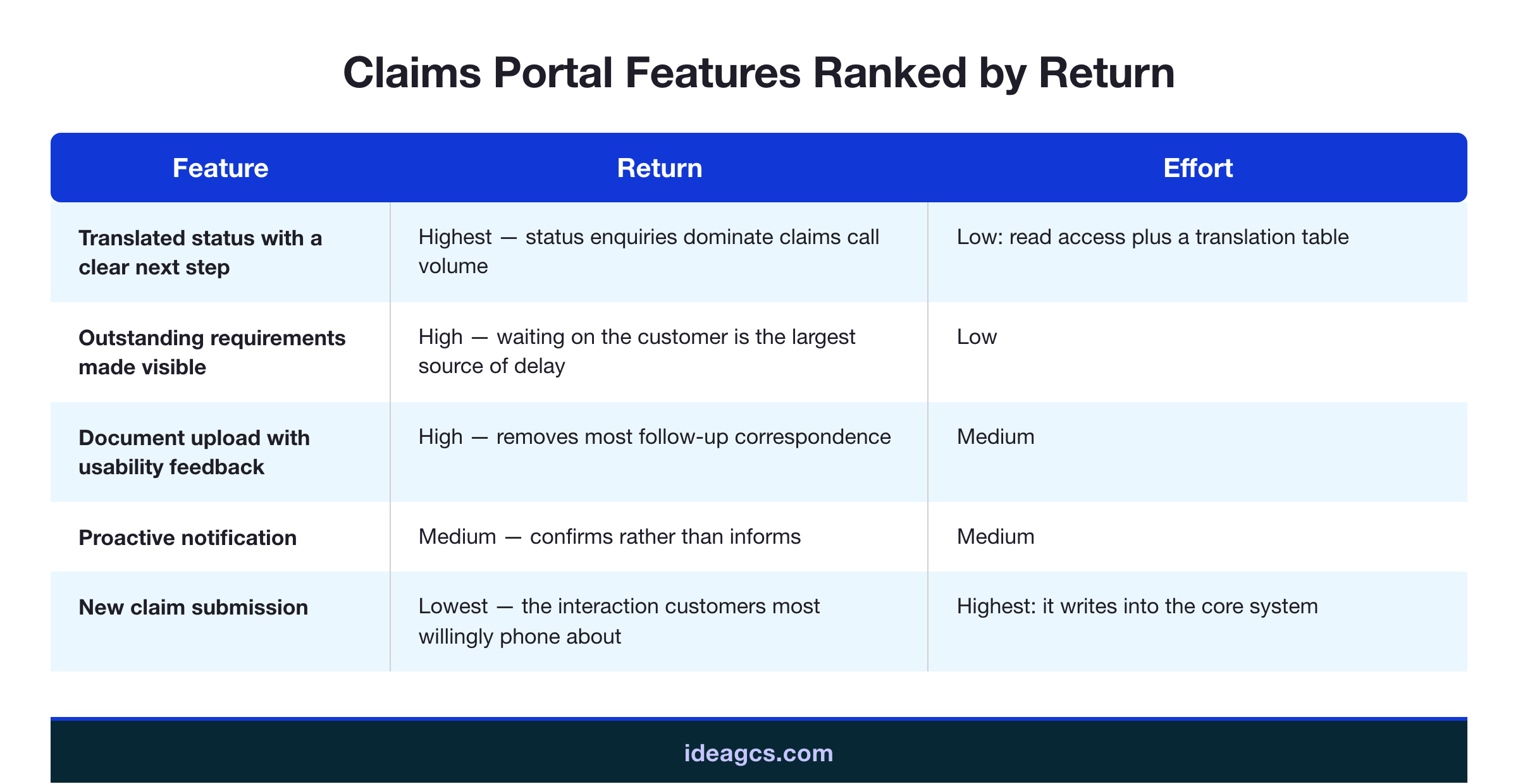
Translate the internal state. Claims systems — and the clinical feeds behind them, where health data standards apply — carry statuses meaningful to handlers and opaque to customers. "Pending adjuster allocation" needs to become "we are assigning your claim to an assessor". The translation table is a business artefact, and writing it is usually the first time a carrier articulates its own process in customer language.
Say what happens next and roughly when. A status without a next step leaves the customer exactly as uncertain as before. Timescales can be ranges and should be honest; a range that is usually met builds more confidence than a precise date that slips.
Say what is needed from them. The largest single cause of claim delay is waiting on the customer, and customers frequently do not know they are being waited on. Making outstanding requirements visible and prominent shortens cycle times measurably and costs very little.
Update proactively. A status page the customer must remember to check is weaker than a notification when something changes. Push where the customer has opted in; the portal then confirms rather than informs.
Document Upload That Actually Works
Adding a file-upload control is straightforward and largely useless on its own. Three things make the difference.
Immediate usability feedback. A photograph too blurred to read, a page cut off, a wrong document type — the customer should be told at upload, not three days later by a handler. This single feature removes a large share of the follow-up correspondence in a claims operation.
Clarity about what is required. "Supporting documents" produces a scattergun response. Naming the specific documents, with an example where the format matters, produces usable submissions first time.
Confirmation and traceability. The customer needs to see what has been received and when. Uncertainty about whether a document arrived generates as many calls as uncertainty about the claim itself.
Behind this, machine reading of the uploaded document can classify it, extract key fields, and route it — with confidence thresholds so anything uncertain goes to a person rather than being guessed. Our explainer on automated document handling covers the mechanics, and IdeaGCS delivers it through its data and machine learning services.
Build Against an Integration Layer
The most consequential architectural decision is what the portal talks to.
Building directly against the claims system produces a portal coupled to a platform that changes slowly, is difficult to test against, and may be replaced within the portal's lifetime. Every subsequent change to either becomes a change to both.
Building against an integration layer that exposes claims data and operations through stable interfaces decouples the two. The portal can then be changed at web pace while the claims system changes at claims-system pace, and if the core is eventually replaced, the portal is repointed rather than rewritten.
There is a second benefit: the same interfaces serve the mobile app, the broker portal, and the contact centre desktop. Carriers that build point-to-point for each channel end up maintaining three implementations of the same business logic that gradually diverge. The structure is set out in our walkthrough of layered API design, and the carrier-specific path in our modernisation route for policy systems.
Accessibility Is Not Optional Here
Insurance serves the whole population, including — disproportionately, at claim time — people who are injured, distressed, elderly, or dealing with a bereavement. A claims portal that assumes a fully able user in a calm state is failing precisely the people using it.
The requirements are well established and not onerous when designed in: keyboard operability throughout, sufficient colour contrast, correct semantic structure for screen readers, labelled form controls, meaningful error messages, and no reliance on colour alone to convey meaning.
Two additions specific to this context. Sessions should tolerate interruption — someone completing a claim after an accident will be interrupted, and a form that discards progress on timeout is a genuine cruelty. And language should be plain, tested with real users, and free of policy terminology that the customer has no reason to know.
Retrofitting accessibility is several times the cost of designing it in, and in most jurisdictions it is a compliance obligation rather than a preference.
Sequencing the Build
Status visibility first, because it carries the highest return and depends on the fewest moving parts. It requires read access to claims data and the translation table, and it will reduce call volume before anything else is built.
Document exchange second, with usability feedback included from the start rather than added later.
Notifications third, once there is something worth notifying about.
Submission fourth. This is counterintuitive — most projects start here — but new claim submission is the lowest-volume interaction and the one where a customer is most willing to telephone. Building it first delivers the least and takes the longest, because it writes into the core system rather than reading from it.
Self-service transactions last, if at all. Updating bank details, accepting a settlement, arranging an appointment — valuable, and each one touches the core in ways that need care.
Supporting It Afterwards
A customer-facing portal changes the support profile of the claims operation. Three things need planning rather than discovering.
Contact-centre alignment. Handlers must see exactly what the customer sees. A customer reading one status while the handler reads another is worse than no portal at all.
Incident severity. A claims portal outage during a catastrophe event is a materially different incident from a routine one. Severity definitions should reflect that, and the support arrangement should be tested against it.
Content ownership. Status translations, document requirement lists, and help text need an owner in the claims business, not in IT. Unowned content decays and the portal slowly stops matching the process. IdeaGCS covers the run side through its enterprise service-desk services.
Conclusion
A claims portal earns its cost by removing uncertainty, and the features that remove uncertainty — translated status, a clear next step, visible outstanding requirements, and honest feedback on uploaded documents — are cheaper to build than the submission flow most projects start with.
Build against an integration layer so the portal and the core can change at their own speeds, design accessibility in rather than retrofitting it, and give the content an owner in the claims business. None of this requires the claims system to be replaced, which is what makes it achievable this year rather than in the next core programme. Talk to IdeaGCS if you want the status layer scoped first.
Frequently Asked Questions
Do we need to replace our claims system to modernise the portal?

Which feature returns the most?
Why not build the claim submission flow first?
What makes document upload actually useful?
Why build against an integration layer rather than the claims system directly?
How important is accessibility for a claims portal?
What accessibility issue is specific to claims?
How does a portal change the support arrangement?
What reduces claim cycle time most?
Can machine reading of documents be used safely here?
Contact Us
Share on Social Media
Contact Us