Automating Underwriting and Claims Without Disrupting Insurance Operations
 Digital Transformation
Carriers have been told for a decade that underwriting and claims can be automated, and most have automated the easy parts and stopped. What remains is the majority of the work — the referrals, the exceptions, the complex risks, the claims that do not fit a template — and it is where the cost and the cycle time actually sit.
The reason progress stalls is rarely technology. It is that the next increment touches decisions carrying regulatory weight and reputational risk, and nobody wants to be the person who automated a claims decision that turns out to have been wrong. That is a reasonable instinct. It is also solvable, by being precise about which decisions are being automated and what evidence exists behind each one.
Key Takeaways
- Automate the decision path, not the decision — routing, enrichment and preparation return more than replacing judgement does.
- Straight-through processing rates rise fastest when exception handling improves, not when the happy path gets faster.
- Every automated decision needs an explanation a regulator and a customer can both follow.
- Document-heavy claims intake is usually the single highest-return automation available to a carrier.
- Portfolio drift is the real risk of automated underwriting, and it needs monitoring designed in from the start.
Separate the Decision From the Path to It
Most of the elapsed time in an underwriting or claims case is not spent deciding. It is spent assembling — retrieving prior policy history, pulling third-party data, chasing a missing document, routing the file to the right person, and waiting in a queue.
That distinction matters commercially. Automating the assembly is low-risk, high-return, and does not require anyone to accept a machine-made decision. Automating the decision itself is a much larger step with regulatory implications, and it should be taken later, on narrower ground, and with far more evidence.
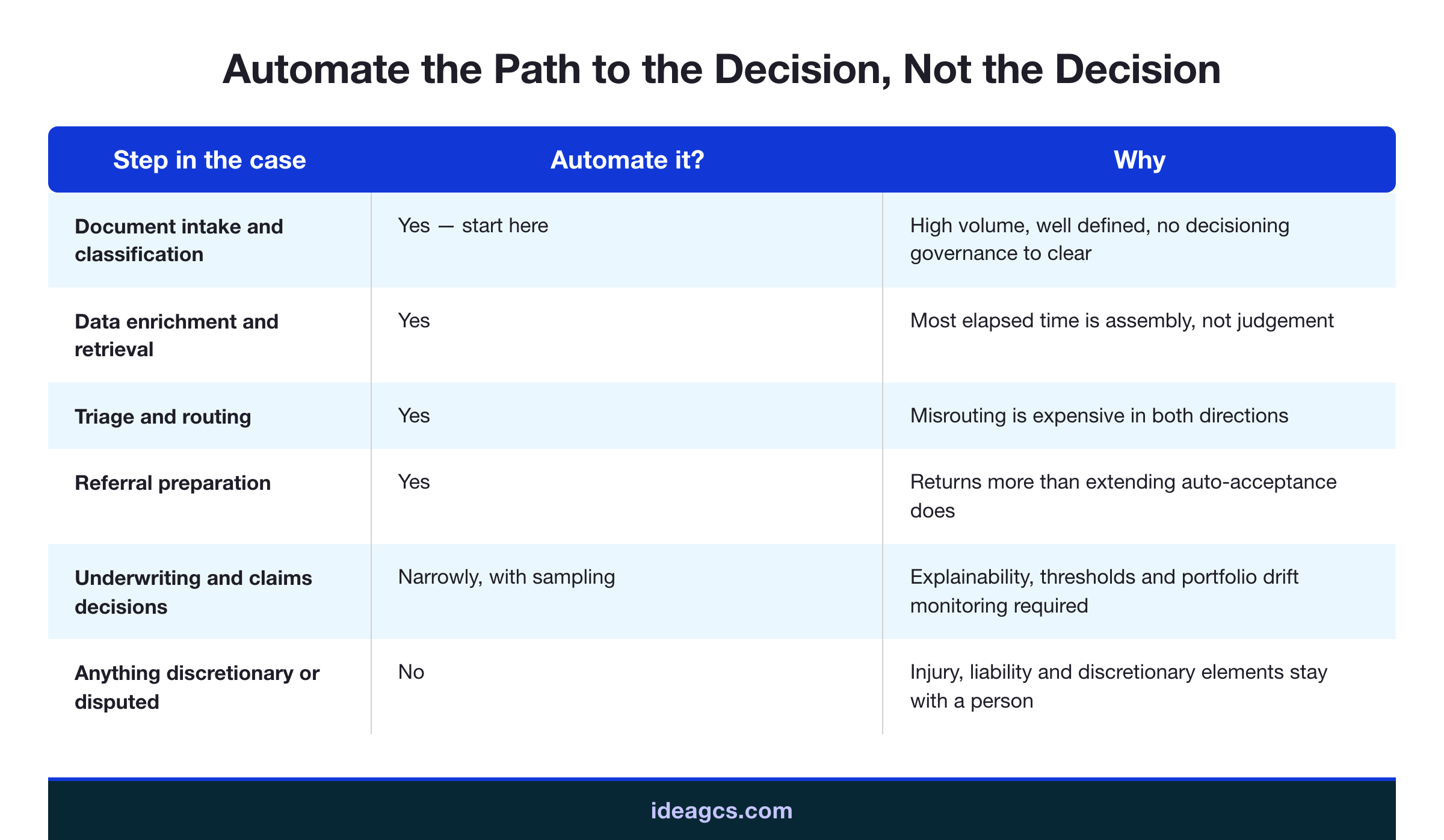
A carrier that automates only the path — enrichment, routing, document handling, and preparation — commonly removes the majority of cycle time without changing a single underwriting rule. That is the work to do first, and a surprising number of carriers skip past it to the harder problem.
Where to Start: Document Intake
Claims and new business both begin with documents. Scanned forms, medical reports, repair estimates, police reports, broker submissions, correspondence. In most carriers these arrive in a mailbox, are opened by a person, are classified by a person, and have their key fields typed into a system by a person.
This is the highest-return automation available to most carriers, for four reasons. The volume is high and constant. The task is well-defined. The error rate of manual entry is higher than anyone estimates. And it does not touch decisioning at all, so the governance conversation is short.
Machine reading of documents classifies the item, extracts the fields, and routes it — with confidence thresholds so that anything uncertain goes to a human rather than being guessed. The measure of a good implementation is not the extraction rate; it is that low-confidence items are reliably escalated rather than silently accepted. IdeaGCS covers this through its data and machine learning services, and our explainer on automated document handling sets out the mechanics.
Underwriting: Automate the Straightforward, Improve the Referrals
Most carriers already auto-accept the cleanest risks in personal lines, leaving the harder half of risk assessment with a person. The next increment is usually framed as extending auto-acceptance, and that is the less valuable half of the opportunity.
The larger opportunity is referrals. A referred case consumes an underwriter's time, and much of that time goes on assembling context rather than exercising judgement. A referral that arrives with prior history retrieved, third-party data attached, the triggering rule explained, and comparable cases surfaced takes a fraction of the time of one that arrives as a bare case number.
There is a second benefit. When referrals are prepared consistently, the reasons for referral become analysable, and carriers routinely discover that a small number of rules generate a large share of referrals — often rules written for a product that no longer exists.
Where auto-acceptance is extended, three controls matter. Confidence thresholds set conservatively and reviewed on evidence. A random sample of auto-accepted cases reviewed by underwriters, permanently rather than during a pilot. And portfolio monitoring that detects drift in the mix of risks being accepted, because the failure mode of automated underwriting is not a wrong decision on one case; it is a slow shift in the book that nobody notices for two quarters.
Claims: Triage First, Settlement Later
The equivalent sequencing in claims is triage before decisioning.
Automated triage assesses a new claim on arrival — complexity, likely reserve, fraud indicators, whether it needs a specialist — and routes it accordingly. This is high-value because misrouting is expensive in both directions: a complex claim sitting with a generalist takes longer and settles worse, and a simple claim on a specialist's desk wastes scarce capacity.
Automated settlement should follow, narrowly. Low-value, well-defined, high-volume claim types with clear policy terms are appropriate; anything involving injury, liability disputes, or discretionary elements is not. The boundary should be defined by the claims function and written down, and it should be revisited on evidence rather than on ambition.
Reserving deserves a note. Automated reserve setting is attractive and consequential — reserves affect solvency reporting. Where it is used, the model needs the same governance any capital-relevant model receives, which is materially more than a routing rule needs.
Explainability Is Not Optional
Any automated decision affecting a policyholder must be explicable in terms a customer and a regulator can both follow. Not "the model scored 0.83", but which factors drove the outcome and how.
Three practical requirements follow. The decision logic must be recoverable after the fact, which means logging inputs and version alongside the output — a decision cannot be explained if the version of the rules that produced it has since been changed. There must be a route by which a customer challenges an automated outcome and reaches a human with authority to overturn it. And the population of automated decisions must be monitored for disparate outcomes across customer groups, because a model can be individually explicable and collectively unfair.
This is not primarily a technology constraint. It is a design constraint that shapes which decisions are suitable for automation in the first place, and it is much cheaper to apply at the start. The broader regulated-sector framing is in our notes on compliance-first modernisation in financial services.
Delivering Without Disrupting the Operation
Underwriting and claims teams are running at capacity. A programme that adds work to them will lose to the day job every time.
Three delivery principles apply. Deliver in small increments that each stand alone, so value arrives continuously rather than at a distant go-live. Run parallel for a defined period on anything touching a decision, with outputs compared and differences adjudicated by the business rather than by the project. And treat the operational calendar — renewal peaks, catastrophe response, year-end — as a fixed constraint on the delivery plan.
The change-management side deserves as much attention as the engineering. Underwriters and claims handlers whose judgement is being partly automated need to understand what has been automated, why, and where their judgement is still required. Programmes that skip this get quiet resistance that is very difficult to diagnose and very effective at stopping adoption. The underlying platform work usually sits on the integration layer described in our carrier modernisation path.
What to Measure
Cycle time by case type, split into assembly time and decision time. The split is the important part, because it tells you whether you have a decision problem or a preparation problem — and it is almost always the latter.
Straight-through processing rate, alongside the rate of cases that required rework after automated handling. The second number stops the first from being gamed.
Referral volume and referral cause distribution. Falling referral volume is good; concentration of referrals in a small number of rules is an opportunity.
Portfolio composition over time for automated underwriting, monitored continuously rather than reviewed annually.
Leakage in claims — the difference between what was paid and what should have been paid under the policy. This is the number that determines whether claims automation was worth doing.
Conclusion
The way to automate underwriting and claims without disrupting the operation is to stop trying to automate the judgement first. Automate intake, enrichment, routing, triage and preparation — the path to the decision — and most of the cycle time and cost comes out without a governance argument.
Extend into decisioning narrowly, on well-defined case types, with conservative thresholds, permanent sampling, explainability designed in, and portfolio monitoring watching for drift. Sequence around the operational calendar and bring the underwriters and handlers with you, because their quiet resistance is more effective than any technical obstacle. Talk to IdeaGCS if you want the intake stage scoped first.
Frequently Asked Questions
What should a carrier automate first?

Is automating the underwriting decision itself worth doing?
What is the main risk of automated underwriting?
Which claims can safely be settled automatically?
What does explainability actually require?
Do we need to replace our policy administration system first?
How do we keep the operation running during delivery?
What should we measure?
Why does straight-through processing plateau?
What is the most common non-technical failure?
Contact Us
Share on Social Media
Contact Us