RPO vs Staffing Agency: Which Is Right for Your Business?

When evaluating your talent acquisition options, the RPO vs staffing agency question is one that most growing organisations face. Both models exist to help businesses hire more effectively, but they operate on fundamentally different principles, serve different hiring profiles, and deliver different outcomes. Understanding these differences is essential before committing to either approach. This guide breaks down the key distinctions between recruitment process outsourcing and traditional staffing agencies across cost, quality, scalability, and long-term strategic value.
Key Takeaways
RPO provides end-to-end process ownership and brand-aligned hiring at a lower cost-per-hire than agency recruitment at volume
Staffing agencies are faster to activate for one-off specialist vacancies but become expensive and inconsistent at scale
IdeaGCS RPO is designed for organisations with ongoing or volume hiring needs across the UK, India, US, UAE, and Philippines
How RPO and Staffing Agencies Differ Fundamentally
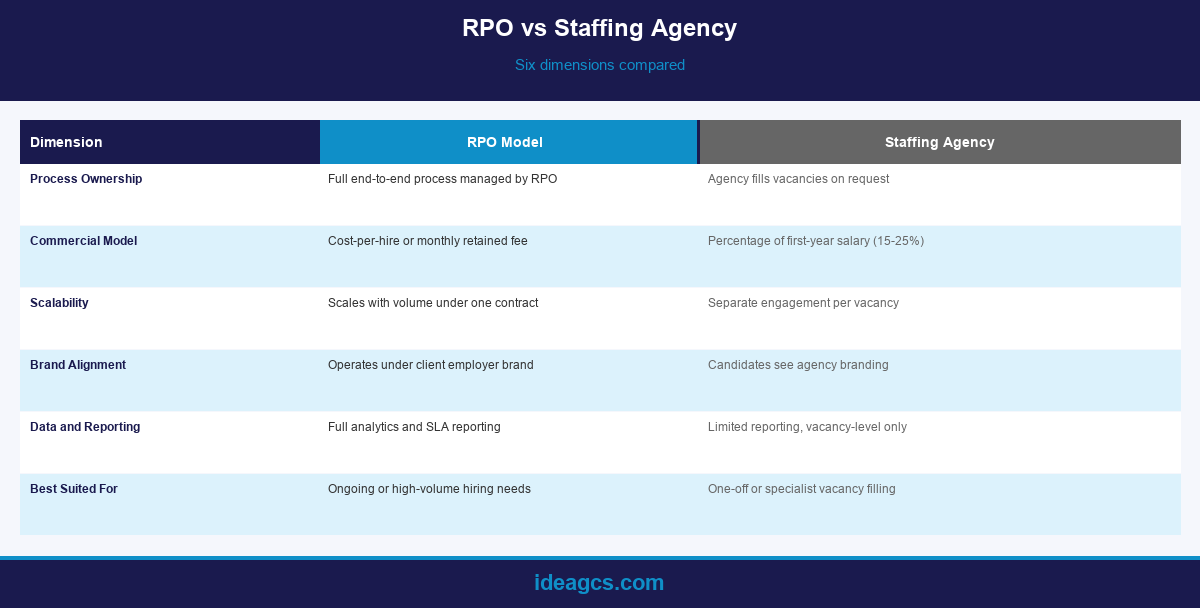
A staffing agency operates as an external vendor that fills specific vacancies on request. The client identifies a need, briefs the agency, and the agency presents candidates. The relationship is transactional: the agency earns a placement fee, typically a percentage of the candidate's first-year salary, for each successful hire. The client retains full responsibility for the recruitment process design, the employer brand experience, and the consistency of hiring standards across roles.
An RPO provider takes a fundamentally different position. Rather than filling individual vacancies, the RPO partner owns the recruitment process itself, acting as an embedded extension of the client's HR function. Process design, sourcing strategy, screening methodology, candidate communication, and hiring analytics all sit within the RPO engagement. This structural difference means RPO delivers consistency and accountability that a multi-agency model cannot replicate. Read the complete guide to RPO to understand the full scope of what modern RPO engagements cover.
Comparing Cost: RPO vs Agency Recruitment
Agency recruitment typically charges 15 to 25 percent of the placed candidate's first-year salary. At low volumes, this is often cost-effective. As hiring volumes grow, the cumulative cost becomes significant. An organisation hiring 50 professionals per year at an average salary of GBP 50,000 and paying a 20 percent agency fee spends GBP 500,000 annually in placement fees alone, before factoring in the internal time cost of managing multiple agency relationships, briefing calls, and feedback cycles.
RPO pricing is structured differently. Cost-per-hire models under RPO typically range from GBP 1,500 to GBP 5,000 per placement depending on role complexity, volume, and geography, representing a 30 to 60 percent reduction compared to agency fees for equivalent roles. Monthly retained or management-fee RPO arrangements provide even greater predictability for organisations with consistent hiring volumes. For a detailed breakdown of RPO pricing factors, contact IdeaGCS to receive a scoped estimate based on your hiring profile.
Quality and Candidate Experience
Agency recruitment introduces a layer of brand dilution. Candidates interact with the agency rather than directly with the employer, creating inconsistency in how the employer value proposition is communicated. When multiple agencies are briefed on the same role, the experience is further fragmented. Different agencies will present the opportunity differently, ask different screening questions, and provide varying levels of candidate preparation, leading to an uneven experience that reflects poorly on the hiring employer.
RPO eliminates this fragmentation. The RPO provider operates under the client's employer brand, using approved messaging and a consistent candidate journey from first contact through to offer acceptance. Hiring manager feedback is captured and acted on systematically, improving the quality of shortlists over time. Candidate satisfaction scores, which directly influence offer acceptance rates and early tenure retention, are typically significantly higher in RPO-managed processes than in multi-agency models.
When to Choose RPO and When to Use an Agency
The right choice depends on your hiring profile. Staffing agencies are the better option for one-off specialist vacancies, interim and contract placements, and situations where speed of activation is the primary requirement. If you need a single niche role filled quickly and lack the sourcing capability internally, a specialist agency with deep sector knowledge is often the fastest path. For a broader view of what drives organisations toward RPO, read our article on why RPO is replacing traditional hiring models.
RPO is the stronger choice when hiring volumes are consistent, when cost-per-hire is a strategic metric under pressure, when employer brand consistency across the candidate experience matters, or when you are scaling into new markets and need local talent acquisition expertise. IdeaGCS provides RPO services across the UK, India, US, UAE, and Philippines for organisations that need more than a transactional agency relationship to achieve their talent acquisition goals.
The RPO vs staffing agency decision ultimately comes down to hiring volume, strategic intent, and cost tolerance. For organisations with ongoing hiring needs, employer brand ambitions, and a desire to reduce cost-per-hire, RPO offers a structurally superior model. For one-off or highly specialist vacancies, agencies remain useful. Many organisations use a hybrid approach: RPO for core volume and select agencies for niche roles. IdeaGCS can help you design the right model for your specific context. Explore our recruitment and staffing services to learn more.
Frequently Asked Questions
What is the main difference between RPO and a staffing agency?

An RPO provider owns the full recruitment process as an embedded partner, operating under the client's employer brand. A staffing agency fills individual vacancies on request as an external vendor, charging a placement fee per hire without process ownership.
Is RPO cheaper than using a staffing agency?
Yes, at volume. RPO typically reduces cost-per-hire by 30 to 60 percent compared to agency recruitment at equivalent hiring volumes. The saving increases as volume grows, since RPO fees do not scale proportionally with the number of hires.
Can you use both RPO and a staffing agency?
Yes. Many organisations use a hybrid model: RPO for core, ongoing, or volume hiring, and specialist agencies for niche or one-off roles where the agency has specific market depth. IdeaGCS can design a blended model to fit your hiring mix.
How quickly can RPO be activated compared to an agency?
A staffing agency can typically begin sourcing within 24 to 48 hours of a brief. RPO implementation takes four to eight weeks for full setup. However, once live, an RPO engagement delivers faster time-to-fill than multi-agency models for ongoing hiring.
Does RPO replace the internal HR team?
No. RPO is designed to complement internal HR by taking ownership of candidate-facing recruitment activity. Internal teams retain control of employer brand, compensation decisions, and final hiring approvals. RPO reduces HR workload without removing strategic oversight.
Which industries use RPO most?
RPO is most common in technology, financial services, healthcare, professional services, and logistics. These sectors typically combine high hiring volumes, specialist talent requirements, and strong employer brand awareness needs that make RPO structurally advantageous over agency recruitment.
What does RPO cost per hire?
RPO cost-per-hire typically ranges from GBP 1,500 to GBP 5,000 per placement depending on role level, geography, and volume. This compares favourably to agency fees of 15 to 25 percent of first-year salary. IdeaGCS provides scoped estimates on request.
Does RPO work for small companies?
Project and selective RPO models are accessible for smaller businesses with specific hiring needs. Full RPO becomes more cost-effective at higher volumes. IdeaGCS works with businesses of all sizes, designing the right RPO scope for their stage and hiring profile.
Contact Us
Share on Social Media
Contact Us